
The 5th UfM Ministerial Meeting on strengthening the role of women in society was held on October 26 in Madrid.
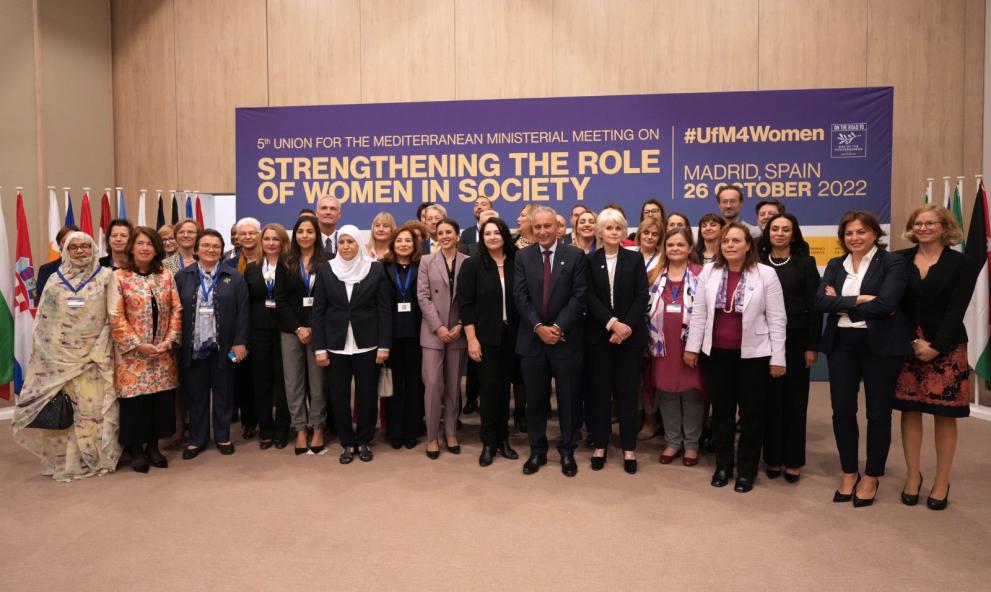
The host was the Spanish Minister of Equality, Irene Montero, in the presence of the European Commissioner for Equality, Helena Dalli, and the Secretary General of the UfM, Nasser Kamel. The UfM Member States adopted a Declaration with recommendations, actions and concrete measures in four priority areas. These include improving legal frameworks; promoting women’s access to leadership in public life and decision-making; increasing women’s participation in economic life; and combating and preventing violence against women and girls.

The Parliament’s fight for gender equality in the EU
|
Some of the commitments made by the 42 countries promote the transition to formal employment for women workers; support and encourage women’s entrepreneurship; promote gender equality and inclusive leadership models from early education in all fields, including science, technology, engineering and mathematics (STEM); expand gender-responsive financing for climate and environmental action by reaching out to women’s organizations, businesses and cooperatives; and adopt comprehensive laws that define and criminalize all forms of violence against women and girls, including cyber-violence.
The ministers acknowledged that gender equality in the Euro-Mediterranean region has come a long way since 2015, when they established a regional dialogue process to strengthen the r ole of women in the UfM countries. According to the first UfM Progress Report on Gender Equality, published in March 2022, many countries have strengthened legal frameworks and developed new programs and policies to increase women’s participation in the political, economic and social spheres, and to protect them from all forms of discrimination and gender-based violence.
UfM Blue Finance Conference: Investing in a Sustainable Blue Economy in the Mediterranean |
However, the Ministers agreed that additional efforts are needed to strengthen women’s economic and political empowerment, and to end violence against women and girls in the Euro-Mediterranean region, especially in light of the various crises, including those related to health, climate change and, more recently, emerging needs (food, water and energy security). They also recognized that rural women face unique challenges and that special efforts are required to improve their opportunities and raise their status in society.
The adoption of the Ministerial Declaration will be followed this afternoon by a high-level Regional Conference entitled “Women for the Mediterranean”. The Conference, which is organized by the UfM Secretariat every two years, was held until Thursday, October 27 in Madrid and brought together more than 100 high-level representatives and international experts. In the midst of the current regional crises, it provided an opportunity to share experiences, good practices and lessons learned on women’s empowerment and women’s rights.
These discussions also help shape the roadmap for the implementation of country mandates in the coming years, particularly in the direction of an inclusive and effective gender equality policy based on a gender transformative approach and the mobilization of regional public and private actors. The contributions of the experts are crucial to advance cooperation, with an emphasis on implementation, execution and effective follow-up, as well as to raise awareness of regional efforts to date, those currently underway and those to be carried out in the future.
More information: Representation of the European Commission in Spain
Publicaciones relacionadas:
 Parliament’s Petitions Committee looks at complaints in Spain: Madrid, Catalonia and Elche
 The EU Emergency Response and Coordination Center receives the Medal of Merit for Civil Protection
 Madrid hosts the fifteenth session of the EuroLat Assembly from 24-27 July
 The European Commissioner for Justice, Didier Reynders, will take part in the Ibero-American Forum in Spain.
 Commission disburses €17 billion under SURE to Italy, Spain and Poland
Leave a Reply