
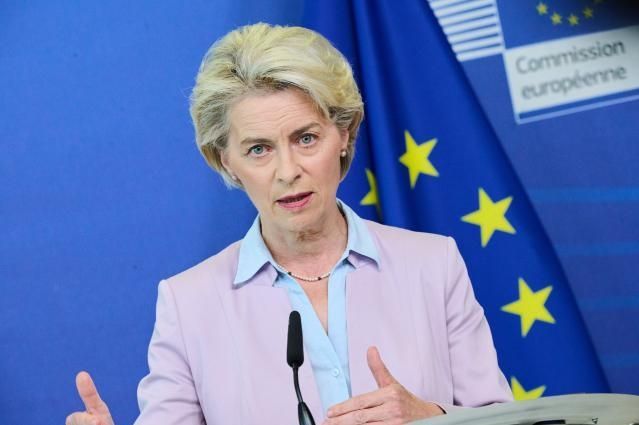
We are facing an extraordinary situation, not only because Russia is an unreliable supplier, as we have witnessed over the last days, weeks, months, but also because Russia is actively manipulating the gas market. I am deeply convinced that with our unity, our determination, our solidarity, we will prevail. And we have, over the last six months, during this war, very much increased our preparedness and we have weakened the grip that Russia had on our economy and our continent. We have done three things, as you recall: The first one was demand reduction. Demand reduction, so save gas in order to save it in the storage. We have created a joint storage, and this is really a success story, because now we are already at 82% with the joint storage in Europe. As you know, our goal was to reach 80% at the end of October. So we overshoot it, and that is good.
The second step that we have taken was: Diversify away from Russian fossil fuels. And you know that we have stopped the import of Russian coal. We are winding down the Russian oil. And we have been working very hard to diversify away from Russia towards other reliable suppliers, like for example the United States or Norway, Azerbaijan, Algeria and others. Actually today, Norway is delivering more gas to the European Union than Russia. And we were able, if you look at the cuts that Russia has done in gas, to completely compensate so far the gas imports through other reliable suppliers.

Strengthening cultural heritage resilience for climate change. Where the European Green Deal meets cultural heritage
|
And of course, the third step is the most important one. This is massive investments in renewables. We have REPowerEU on the table. The renewables are cheap, they are home-grown, they make us independent. We will deploy renewables this year that are an equivalent to round about 8 billion cubic metres. So the renewables are really our energy insurance for the future.
But we also see that the Russian manipulation of the gas market has spillover effects on the electricity market. So there is, on the one hand, the Russian manipulation, but there are also other factors during this summer. We see the effects of climate change. We see the drought. Hydropower has been reduced by 26% in the European Union, and by 46% in Portugal. And we have the fact that we have less nuclear electricity in the European Union at the moment being. And this is the reason why we are now confronted with astronomic electricity prices for households and companies, and with an enormous market volatility. Therefore, we will put forward a set of five different immediate measures.
The first one is smart savings of electricity. What has changed over the summer, because of the elements I was just mentioning, is that we see that there is a global scarcity of energy. So whatever we do, one thing is for sure: We have to save electricity, but we have to save it in a smart way. If you look at the costs of electricity, there are peak demands. And this is what is expensive, because, in these peak demands, the expensive gas comes into the market. So what we have to do is to flatten the curve and avoid the peak demands. We will propose a mandatory target for reducing electricity use at peak hours. And we will work very closely with the Member States to achieve this.
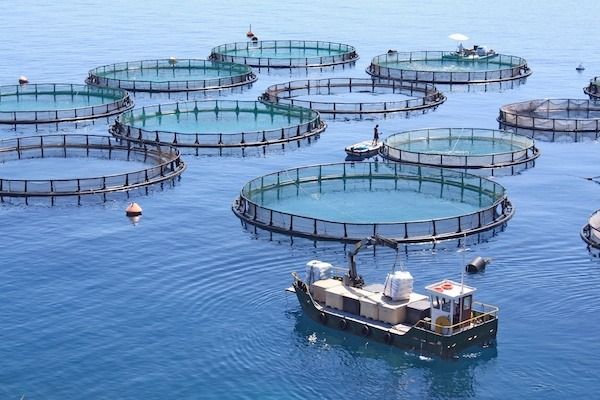
Renewable energy powers open sea farming innovation
|
The second measure: We will propose a cap on the revenues of companies that are producing electricity with low costs. The low-carbon energy sources are making in these times – because they have low costs but they have high prices on the market – enormous revenues. Revenues they never calculated with; revenues they never dreamt of; and revenues they cannot reinvest to that extent. These revenues do not reflect their production costs. So, it is now time for the consumers to benefit from the low costs of low-carbon energy sources like, for example, the renewables. We will propose to re-channel these unexpected profits to the Member States so that the Member States can support the vulnerable households and vulnerable companies.
The third measure is that the same goes, of course, for the unexpected profits of fossil fuel companies. Oil and gas companies have also made massive profits. Therefore, we will propose that there is a solidarity contribution for fossil fuel companies. Because all energy sources must help to overcome this crisis. Member States should invest these revenues to, as I said, support vulnerable households and vulnerable companies, but also to invest them in clean home-grown energy sources, as the renewables are, for example.
The fourth point is addressing the energy utility companies that must be supported to be able to cope with the volatility of the markets. Here, it is a problem of securing futures markets. And for that, liquidity is needed. These companies are currently being requested to provide unexpected large amounts of funds now, which threatens their capacity not only to trade, but also the stability of the futures markets. It is a liquidity problem. Therefore, we will help to facilitate the liquidity support by Member States for energy companies. We will update our temporary framework and enable thus state guarantees to be delivered rapidly.
The fifth and the last point: We aim at lowering the costs of gas. Therefore, we will propose a price cap on Russian gas. Of course, the objective is here very clear. We all know that our sanctions are deeply grinding into the Russian economy, with a heavy negative impact. But Putin is partially buffering through fossil fuel revenues. So here, the objective is: We must cut Russia’s revenues, which Putin uses to finance his atrocious war in Ukraine. And now our work of the last months really pays off. Because, at the beginning of the war, if you looked at the imported gas, 40% of it was Russian gas, since a long time. Today, we are down to 9% only.
So these are the five measures that we will discuss with the Member States at the informal Energy Ministers Council on Friday. These are tough times, and they will not be over soon. But I am deeply convinced that, if we show the solidary, the unity and we have the determination for that, we have the economic strength, we have the political will, that then we shall overcome.

Leave a Reply