• Skip to primary navigation
  • Skip to main content
  • Skip to footer
  • Bluesky
  • Facebook
  • Instagram
  • Twitter
  • YouTube
CDE Almería – Centro de Documentación Europea – Universidad de Almería

CDE Almería - Centro de Documentación Europea - Universidad de Almería

Centro de Documentación Europea de la Universidad de Almería

  • HOME
  • WHAT´S ON
    • EU NEWS
    • Activities
    • EU Calls and Awards
    • Radio Program «Europe with You»
  • DOCUMENTATION
    • EU Media Collection
      • Web Space
      • MEDIATHEQUE REPOSITORY
  • Europe on the net
    • Institutions
    • EU Representation in Spain
    • European information network of Andalusia
  • ABOUT US
    • Presentation
    • Services
    • People
    • Contact
  • Spanish
  • English

Education and Culture

Inicio » EU News » Education and Culture » Page 9

12 de December de 2023

A more digital and greener education thanks to the European Student Card

With the European Student Card, students and schools can access all the information necessary to facilitate mobility across Europe, through a simple digital platform. The European Student Card is an initiative created to help both institutions and higher education students during Erasmus + exchanges.  How? Through a centralised digital platform, students and schools can access all […]

Read More

Education and Culture,  EU News,  Teaching and Education Educación

1 de December de 2023

Erasmus+ supported mobility opportunities for more than 1.2 million students and teachers in 2022

Erasmus+, the EU’s programme for education, training, youth and sport, supported some 26,000 projects in 2022, benefitting over 73,000 organisations.  It provided learning mobility opportunities to more than 1.2 million students, learners, professors, teachers, trainers, youth workers and young people. These are the main results of the 2022 edition of the Erasmus+ Annual Report, presented today […]

Read More

Education and Culture,  EU News,  Teaching and Education 2022,  Erasmus +,  learners,  Mobility,  opportunities,  teachers

29 de November de 2023

Commission supports Erasmus+ 2024 mobility and cooperation in education, training, youth and sport with 4.3 billion euros

The Commission launched the 2024 call for proposals under Erasmus+, the EU’s programme to support education, training, youth and sport in Europe. With a budget of €4.3 billion for next year, Erasmus+ will continue to support transnational experiences of school pupils, students in higher education and vocational education and training. The programme also offers opportunities to […]

Read More
Education and Culture,  EU News,  Teaching and Education 2024,  Erasmus +,  European Commission,  proposals

29 de November de 2023

EU funds tool to help journalists and fact-checkers distinguish truth from lies

Is what I am reading or watching online true? An EU-backed project has enhanced a tool that helps journalists and fact-checkers tell truth from lies. Verifying online content can be a long and tiring process, and recent advances in AI have made it even easier to create and spread false and misleading texts, images and […]

Read More

Communication,  Education and Culture,  EU News CORDIS,  disinformation,  fact,  fact-checker,  fact-checking,  Fake News,  InVID-WeVerify plugin,  vera.ai,  verification,  «Database of Known Fakes»

pantalla GAME OVER

27 de November de 2023

The Council approved conclusions on enhancing the cultural and creative dimension of the European video games sector

The video games sector is an integral part of the ecosystem of cultural and creative industries. It interacts with other sectors and has great potential to transmit cultural content and highlight the value of the richness of European creation, heritage and history. In parallel, the video games industry is a booming economic sector – this is proven by the fact […]

Read More
Culture,  Education and Culture,  EU News,  Research and Innovation culture,  European Union,  Videogames

22 de November de 2023

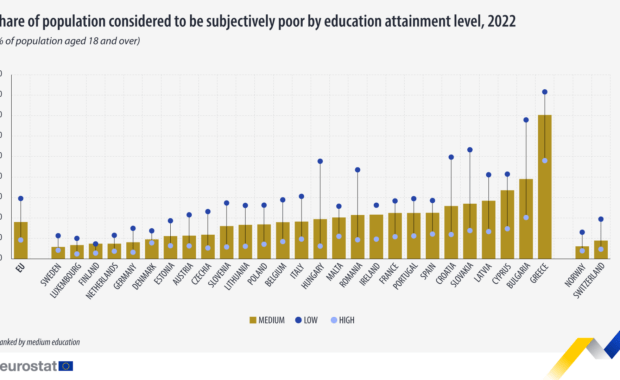
Subjective poverty in the European Union is higher among people with lower educational attainment

In 2022, almost one third (29.5%) of the EU population with a low educational attainment level (International Standard Classification of Education (ISCED), levels 0-2) was considered poor. The rate was more than 3 times lower (9.2%) for people with high education (ISCED levels 5-8) while the share for people with a medium educational attainment level (ISCED levels 3 […]

Read More

Education and Culture,  EU News,  Research and Innovation Eurostat,  lower educated,  Poverty,  Subjective poverty

Vista de espaldas de un actor vestido de rojo que saluda hacia la oscuridad del patio de butacas

22 de November de 2023

Parliament calls for better working conditions for artists and cultural workers

On Tuesday, MEPs adopted their proposals for EU measures to improve living and working conditions for professionals working in the art, cultural and creative sectors. In the legislative initiative, adopted by 433 votes in favour to 100 against and 99 abstentions, MEPs stress that the gaps between national social systems, different national definitions of artists and […]

Read More

Culture,  Education and Culture,  EU News Artists,  Cultura,  cultural workers,  European Parliament,  Working conditions

22 de November de 2023

Eurobarometer: TV still main source for news but social media is gaining ground

A dedicated Eurobarometer survey, published by the European Parliament, takes an in-depth look at media habits, including trust in different media sources. Awareness and media recall 68% of respondents recall having recently obtained news about the European Union via either press, internet, television or radio – with considerable variation across Member States, between 49% in […]

Read More

Communication,  Education and Culture,  EU News Eurobarometer,  European Union,  social media,  TV

10 de November de 2023

Recognition of parenthood in the EU: no discrimination against children’s rights

MEPs propose to limit the possibility for EU countries to refuse to recognise parenthood established in another member state based on public policy concerns. With 14 votes against 4 and no abstentions, the Legal Affairs Committee (JURI) adopted its opinion on draft legislation facilitating the recognition of parenthood across the EU. Its aim is to […]

Read More
Education and Culture,  EU News,  Institutional Affairs,  International Politics and Cooperation,  Law,  State Members Childrens´ rights,  European Parenthood Certificate,  European Parliament,  PARENTHOOD,  Recognition of parenthood

  • « Go to Previous Page
  • Page 1
  • Interim pages omitted …
  • Page 7
  • Page 8
  • Page 9
  • Page 10
  • Page 11
  • Interim pages omitted …
  • Page 33
  • Go to Next Page »

Footer

  • CDE Almería
  • Biblioteca Nicolás Salmerón – Universidad de Almería
  • Planta: 1ª, Despacho: 1.05.0B.
  • Ctra. Sacramento s/n. Almería (Spain)
  • Teléfono: (+34) 950 015266

HOME
NEWS
DOCUMENTATION
EUROPE ON THE NET
ABOUT US

  • LEGAL NOTICE
  • PRIVACY POLICY
  • COOKIE POLICY
  • ACCESSIBILITY
  • SITEMAP

Copyright © 2026 CDE Almería · Creative Commons LicenseThis work is licensed under a Creative Commons Attribution-NonCommercial 4.0 International License.

<p>El Centro de Documentación Europea de la Universidad de Almería utiliza cookies propias y de terceros para facilitar al usuario la navegación en su página Web y el acceso a los distintos contenidos alojados en la misma. Asimismo, se utilizan cookies analíticas de terceros para medir la interacción de los usuarios con el sitio Web. Pinche el siguiente enlace si desea información sobre el uso de cookies y como deshabilitarlas. </p>

Politica de privacidad

El Centro de Documentación Europea de la Universidad de Almería utiliza cookies propias y de terceros para facilitar al usuario la navegación en su página Web y el acceso a los distintos contenidos alojados en la misma. Asimismo, se utilizan cookies analíticas de terceros para medir la interacción de los usuarios con el sitio Web. Pinche el siguiente enlace si desea información sobre el uso de cookies y como deshabilitarlas. <a href="/politica-de-cookies" rel="noopener" target="_blank">Más información</a>

Cookies estrictamente necesarias

Las cookies estrictamente necesarias tiene que activarse siempre para que podamos guardar tus preferencias de ajustes de cookies.

Básicamente la web no funcionara bien si no las activas.

Estas cookies son:

  • Comprobación de inicio de sesión.
  • Cookies de seguridad.
  • Aceptación/rechazo previo de cookies.
Cookies de terceros

Esta web utiliza Google Analytics, Google Tag Manager y Yandex Metrika para recopilar información anónima tal como el número de visitantes del sitio, o las páginas más populares.

Dejar estas cookies activas nos permite mejorar nuestra web.

Política de cookies

Pinche el siguiente enlace si desea información sobre el uso de cookies y como deshabilitarlas. Más información