
Recent Eurostat data shows that, in terms of total gross weight of goods, the United States was the EU’s largest maritime freight transport partner in the second quarter of 2022, with a total of 61 million tonnes, surpassing Russia (57 million tonnes).
Russia came in second position, followed by the United Kingdom (55 million tonnes), Türkiye (36 million), China (31 million), Norway (29 million), Brazil (24 million), Egypt (19 million), Nigeria (14 million) and Canada (13 million). The EU’s transport with the United States, Russia and the United Kingdom combined represented one-third of total extra-EU maritime freight transport.
Comparing the second quarter of 2022 with the same quarter of 2021, maritime transport between the EU and Russia recorded the largest fall (-22.1%), followed by Brazil (-12.6%). By contrast, traffic between the EU and Egypt and the United States increased substantially over the same period, by 22.9% and 21.1%, respectively.
Trade flows dominated by inward movements of liquid bulk goods
In the second quarter of 2022, 17 out of the top 20 trade flows were inward movements and 3 were outward movements: outward movements of Roll-on Roll-off (Ro-Ro) mobile units to the United Kingdom (11 million tonnes); and of large containers to China (8 million) and the East Coast of the United States (7 million). The top 3 inwards movements were of large containers from China (16 million), crude oil from the East Coast of the United States (10.4 million) and oil products from Russian ports on the Baltic Sea (10.4 million).
Liquid bulk goods (crude oil, oil products and liquefied gas) dominated inward trade flows, with the exception of large containers from China; coal from the East Coast of the United States and Australia; ores and agricultural products from Brazil; and Ro-Ro mobile units from the United Kingdom.
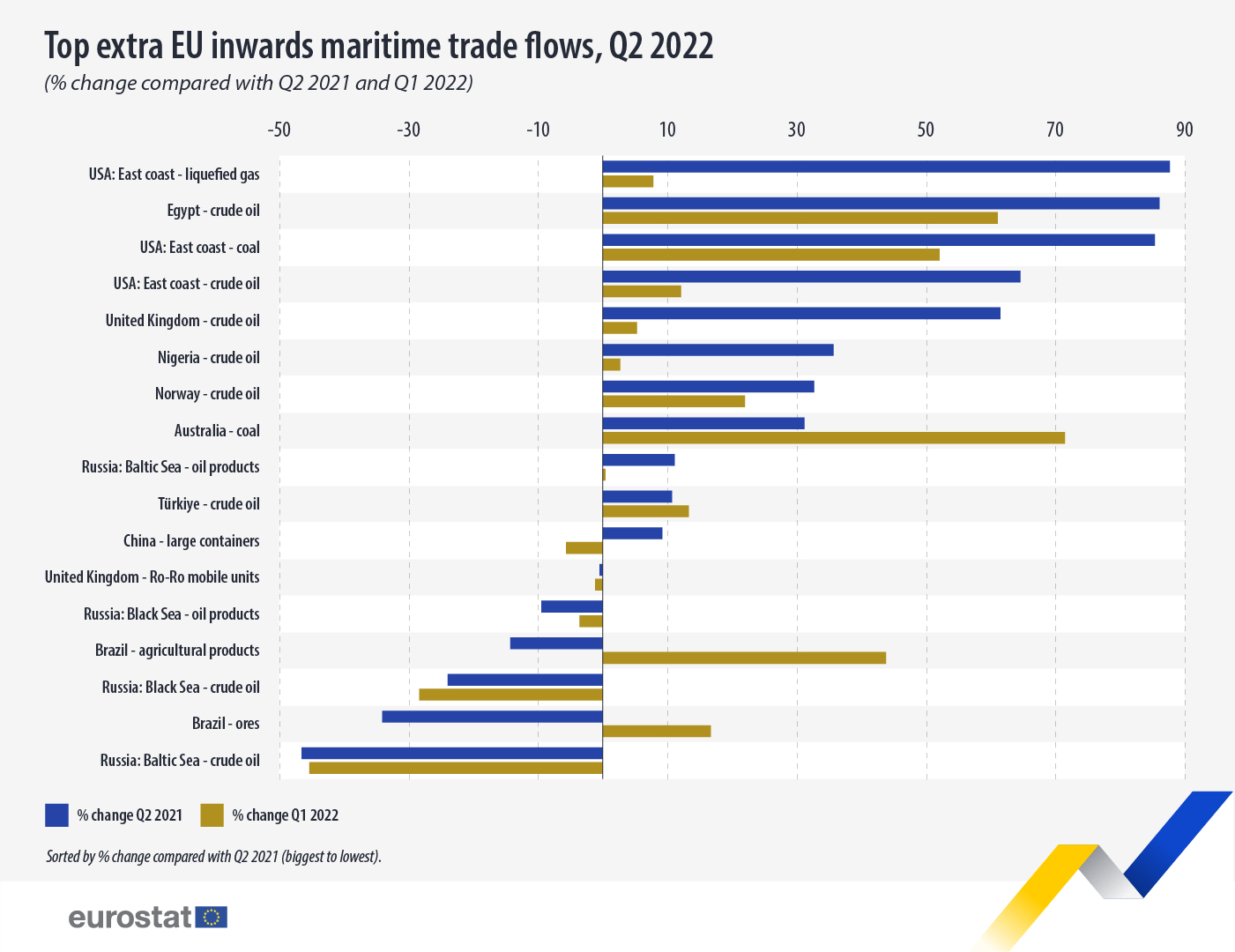
In the second quarter of 2022, crude oil (10 million tonnes) and liquefied gas (9 million) from ports on the East Coast represented almost one-third (32%) of the total transport between the EU and the United States. Inward movements of coal (7 million) from the same ports in the United States were also substantial, representing 12% of the total transport.
Comparing the second quarter of 2022 with the same quarter of 2021, there were substantial increases in inward movements. The biggest increases were in liquefied gas, coal and crude oil from the East Coast of the United States (+87.7%, +85.4% and +64.6%, respectively); crude oil from Egypt (+86.1%), the United Kingdom (+61.5%), Nigeria (+35.7%), Norway (+32.7%) and Türkiye (+10.7%); coal from Australia (+31.2%); and oil products from Russian ports on the Baltic Sea (+11.1%).
EU agrees on maximum price for a barrel of Russian crude oil
|
By contrast, large decreases were observed for crude oil from Russian ports on the Baltic Sea (-46.6%) and Russian ports on the Black Sea (-24.0%); and ores and agricultural products from Brazil (-34.1% and 14.3%, respectively). In terms of outward movements, large decreases were observed for large containers to China (-29.2%) and to the East Coast of the United States (-10.4%).
More information: Eurostat
Publicaciones relacionadas:
 EU-US strengthen coordination on export controls on Russia
 The EU wins against the US on Spanish black olives
 Spain’s top maritime freight transport and commerce in Algeciras, Valencia, and Barcelona
 Bivalve mollusk market resumes in the EU and USA
 23 May 2022: Macroeconomic dialogue with the social partners
Leave a Reply