
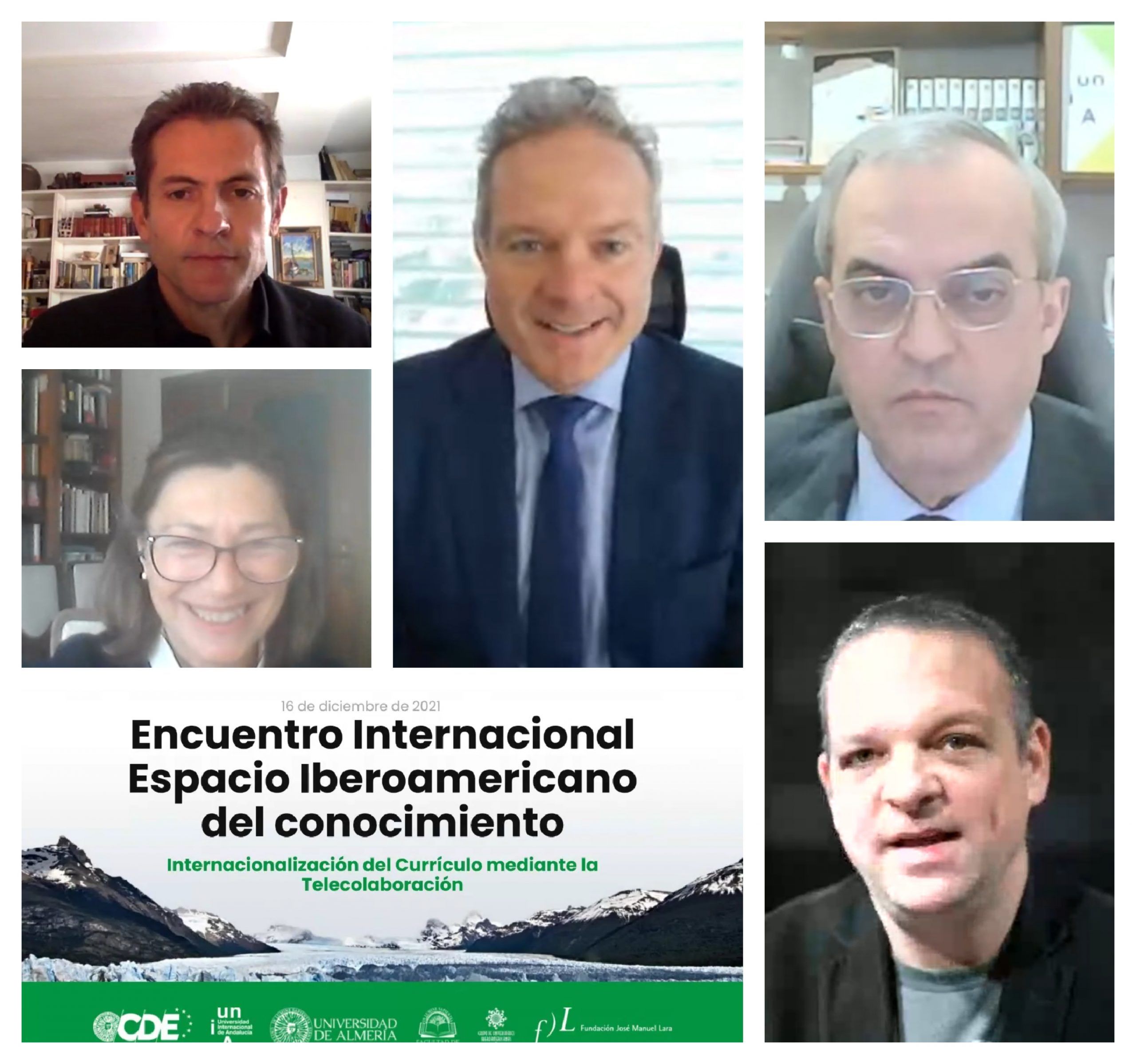
On December 16, the First International Meeting of the Ibero-American Knowledge Space: Internationalization of the Curriculum through Telecollaboration, promoted by the International University of Andalusia (UNIA) and Grupo La Rábida, was held at the UAL. The UAL, the European Documentation Center of Almeria and the Faculty of Humanities also participated in the organization of this telematic event.
This international meeting addresses the new scenario in which academic training is taking place, where it is essential to promote experiences and activities, both curricular and extracurricular, that favor international university coordination and involve a reorganization of the curriculum. In this sense, the objective of this meeting on Internationalization of the Curriculum and Telecollaboration was to contribute innovative ideas to promote Ibero-American inter-university cooperation through virtual teaching and the internationalization of the curriculum, and to serve as a meeting point for teachers, researchers and representatives of university institutions, whose experiences in the dynamics of internationalization “will help to design a solid structure for inter-university cooperation”.
Arturo F. Chica, vice-rector of Internationalization of the UNIA, Diego Luis Valera, vice-rector of Research and Innovation of the UAL, and professors José Manuel de Amo and Ana Fe Gil Serra, members of the organizing committee, inaugurated the meeting. Osvaldo Cleger, professor of the School of Modern Languages at the Georgia Institute of Technology (USA), offered an interesting reflection on the new didactic challenges in the current university teaching activity through his lecture ‘Inverted class: hybrid learning spaces in a post-covid environment’.
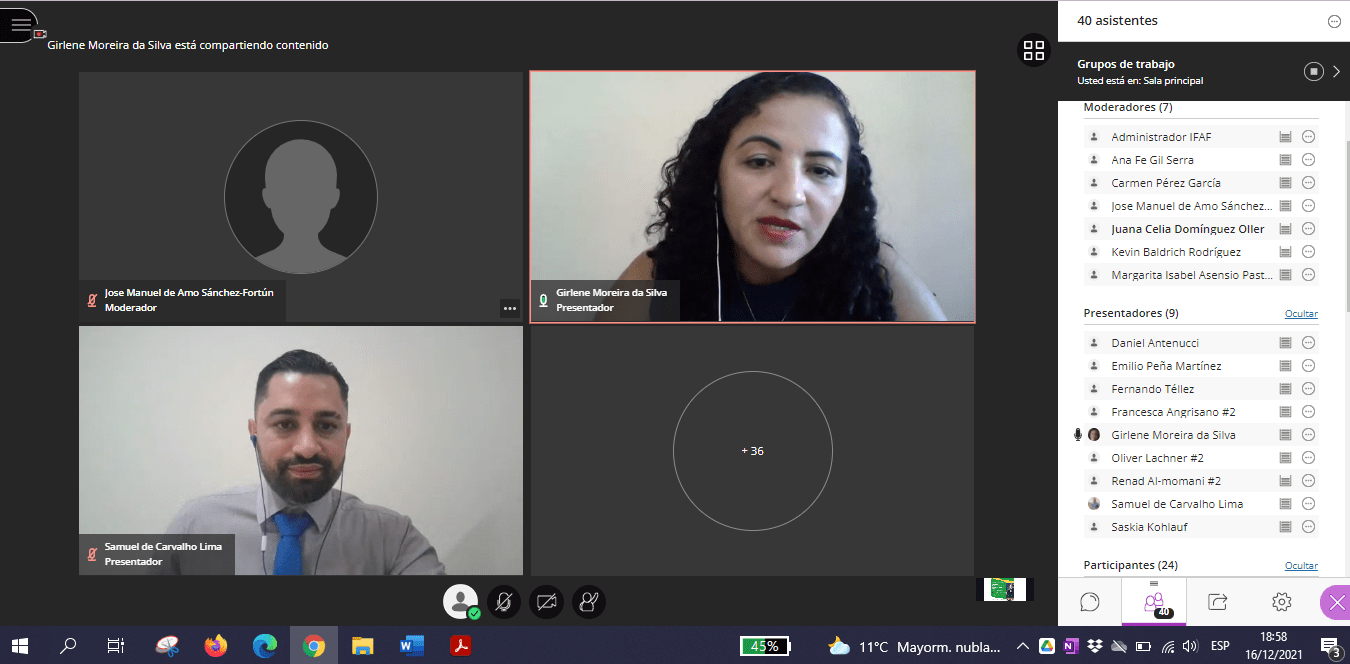
The UAL presented some recent experiences in the field of telecollaboration and internationalization of the curriculum, such as the projects “HABLAMOS”, by Margarita Asensio (UAL) and Renad Al-Momani, from the University of Jordan, “TELE-TÁNDEM”, by Saskia Kohlauf (UAL), Oliver Lachner from the National University of Mar del Plata (Argentina) and Francesca Angrisano from the Polytechnic School of Augsburg (Germany). Another example of good practices carried out at the UAL was the presentation “Proposals for internationalization in telecollaboration processes in IFRN (Brazil): the experience of teaching Brazilian Portuguese to the academic community of the University of Almeria”, by Samuel de Carvalho Lima and Girlene Moreira da Silva from the Instituto Federal de Educação, Ciência e Tecnologia do Rio Grande do Norte IFRN (Brazil).
Ana Fe Gil Serra, as director of the European Documentation Center of Almeria, presented the main results of the European pilot program Erasmus+Virtual Exchanges and its impact on European higher education and Emilio Peña, from the Foundation of the University of Almeria, presented the most significant results of the efforts made by Spanish universities to adapt their teaching activities to the needs arising during the pandemic.
During the meeting, other examples of collaboration between Ibero-American universities were also presented, such as ‘Model for collaborative online learning based on the internationalization of the curriculum in Law and Economics. A methodological proposal for telematic university teaching in the context of Ibero-America’, by J. Ignacio Leo-Castela and ‘Is a virtual post-doctorate feasible: Reflections from the Ibero-American experience’, by Mr. José Antonio Frías and Mr. Críspulo Travieso Rodríguez, professors at the University of Salamanca.
This international meeting closed with the round table discussion ‘Spain and Ibero-America: telecollaboration as a tool for the internationalization of the curriculum’, with the participation of Daniel Antenucci, former vice-rector of the Universidad Nacional Mar del Plata (Argentina) and Fernando Téllez, director of International Relations of the Fundación Universitaria del Área Andina (Colombia). This debate was moderated by Kevin Baldrich from UAL.
Source: UAL News
More information:
Impact of COVID-19 on young people in the EU
Erasmus+ virtual exchanges (EVE)
Emergency remote schooling during COVID-19. A closer look at European families




Leave a Reply