• Skip to primary navigation
  • Skip to main content
  • Skip to primary sidebar
  • Skip to footer
  • Bluesky
  • Facebook
  • Instagram
  • Twitter
  • YouTube
CDE Almería – Centro de Documentación Europea – Universidad de Almería

CDE Almería - Centro de Documentación Europea - Universidad de Almería

Centro de Documentación Europea de la Universidad de Almería

  • HOME
  • WHAT´S ON
    • EU NEWS
    • Activities
    • EU Calls and Awards
    • Radio Program «Europe with You»
  • DOCUMENTATION
    • EU Media Collection
      • Web Space
      • MEDIATHEQUE REPOSITORY
  • Europe on the net
    • Institutions
    • EU Representation in Spain
    • European information network of Andalusia
  • ABOUT US
    • Presentation
    • Services
    • People
    • Contact
  • Spanish
  • English

The metals that hold the key to curing cancer

Inicio » EU News » The metals that hold the key to curing cancer

7 de June de 2019

A Spanish institute developed drug candidates containing metals to target cancer cells.
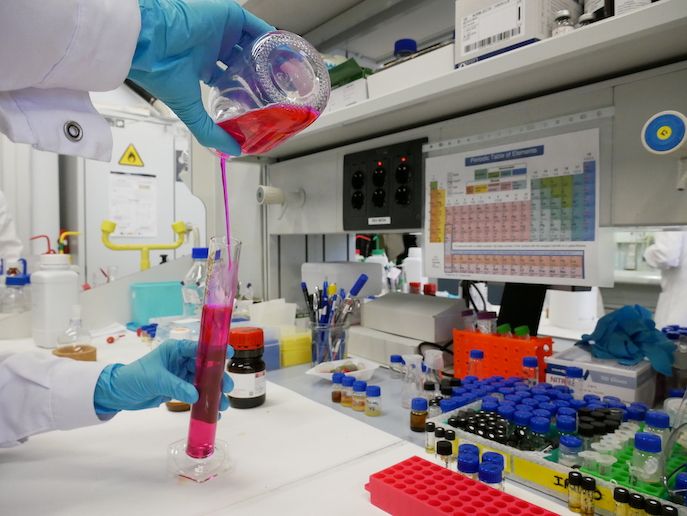
A Madrid laboratory developed families of drug candidates to treat cancer, using metals like iridium, ruthenium and osmium, during four-year EU-funded project MEMOTUMCELLMACH.

The IMDEA Nanoscience Institute, with support from the Marie Curie programme, says its research on metallodrugs based on iridium shows they could be up to 200 times more effective against cancer cells than cisplatin – one of the most commonly used drugs for cancer patients.

“We now know that the iridium family of drugs is super potent,” says laboratory head Dr. Ana Pizarro. “They accumulate in the mitochondria or power house of the cancer cell and exclusively so.” The team also developed a family of osmium-based candidates to control pH inside the cancer cell. “The impact it could have on cancer progression and invasion is scarily good,” she said.

Multiple targets

Scientists discovered the metallodrug cisplatin, which contains an atom of platinum, by chance in the 1960s and is still used in about 50 % of chemotherapy treatments worldwide.

But cisplatin and other drugs on the market don’t work for all types of cancers and sometimes affect healthy cells. “There is no single cause of cancer, there is no single target, so there is no single magic bullet,” said Dr. Pizarro.

She focused on ways to get the metal compounds to switch ‘on’ to react and attack cancer cells while remaining inactive outside the cancer cells. That means they wouldn’t destroy healthy cells, causing pain and side effects to patients.

More Information

Access to the full news

Publicaciones relacionadas:

New intraoperative probe for breast cancer tissue A mobile app that saves lives: remote symptom monitoring for cancer patients Why stem cells could hold key to tackling breast cancer Mini robots to create patterns inspired by nature Imminent anti-metastatic vaccine for prostate cancer

EU News health,  Innovación,  Investigación

“This is a space for debate. All comments, for or against publication, that are respectful and do not contain expressions that are discriminatory, defamatory or contrary to current legislation will be published”.

Reader Interactions

Leave a Reply Cancel reply

Your email address will not be published. Required fields are marked *

This site uses Akismet to reduce spam. Learn how your comment data is processed.

Primary Sidebar

Footer

  • CDE Almería
  • Biblioteca Nicolás Salmerón – Universidad de Almería
  • Planta: 1ª, Despacho: 1.05.0B.
  • Ctra. Sacramento s/n. Almería (Spain)
  • Teléfono: (+34) 950 015266

HOME
NEWS
DOCUMENTATION
EUROPE ON THE NET
ABOUT US

  • LEGAL NOTICE
  • PRIVACY POLICY
  • COOKIE POLICY
  • ACCESSIBILITY
  • SITEMAP

Copyright © 2026 CDE Almería · Creative Commons LicenseThis work is licensed under a Creative Commons Attribution-NonCommercial 4.0 International License.

<p>El Centro de Documentación Europea de la Universidad de Almería utiliza cookies propias y de terceros para facilitar al usuario la navegación en su página Web y el acceso a los distintos contenidos alojados en la misma. Asimismo, se utilizan cookies analíticas de terceros para medir la interacción de los usuarios con el sitio Web. Pinche el siguiente enlace si desea información sobre el uso de cookies y como deshabilitarlas. </p>

Politica de privacidad

El Centro de Documentación Europea de la Universidad de Almería utiliza cookies propias y de terceros para facilitar al usuario la navegación en su página Web y el acceso a los distintos contenidos alojados en la misma. Asimismo, se utilizan cookies analíticas de terceros para medir la interacción de los usuarios con el sitio Web. Pinche el siguiente enlace si desea información sobre el uso de cookies y como deshabilitarlas. <a href="/politica-de-cookies" rel="noopener" target="_blank">Más información</a>

Cookies estrictamente necesarias

Las cookies estrictamente necesarias tiene que activarse siempre para que podamos guardar tus preferencias de ajustes de cookies.

Básicamente la web no funcionara bien si no las activas.

Estas cookies son:

  • Comprobación de inicio de sesión.
  • Cookies de seguridad.
  • Aceptación/rechazo previo de cookies.
Cookies de terceros

Esta web utiliza Google Analytics, Google Tag Manager y Yandex Metrika para recopilar información anónima tal como el número de visitantes del sitio, o las páginas más populares.

Dejar estas cookies activas nos permite mejorar nuestra web.

Política de cookies

Pinche el siguiente enlace si desea información sobre el uso de cookies y como deshabilitarlas. Más información