• Skip to primary navigation
  • Skip to main content
  • Skip to primary sidebar
  • Skip to footer
  • Bluesky
  • Facebook
  • Instagram
  • Twitter
  • YouTube
CDE Almería – Centro de Documentación Europea – Universidad de Almería

CDE Almería - Centro de Documentación Europea - Universidad de Almería

Centro de Documentación Europea de la Universidad de Almería

  • HOME
  • WHAT´S ON
    • EU NEWS
    • Activities
    • EU Calls and Awards
    • Radio Program «Europe with You»
  • DOCUMENTATION
    • EU Media Collection
      • Web Space
      • MEDIATHEQUE REPOSITORY
  • Europe on the net
    • Institutions
    • EU Representation in Spain
    • European information network of Andalusia
  • ABOUT US
    • Presentation
    • Services
    • People
    • Contact
  • Spanish
  • English

Immigration law enforcement in the EU: 2023 figures

Inicio » Noticias UE » Asuntos Sociales » Migration and Demography » Immigration law enforcement in the EU: 2023 figures

8 de May de 2024

In 2023, 118 935 non-EU citizens were refused entry into the EU territory at one of its external borders, a 16% decrease compared with 142 420 in the previous year.
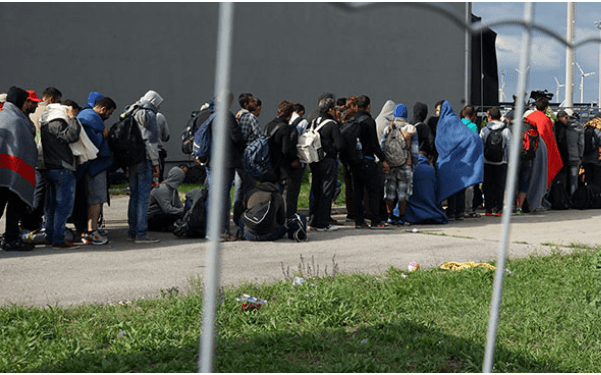
An additional 1.27 million people were found to be illegally present in one of the EU countries, indicating a 13% increase compared with 1.12 million in 2022.

This information comes from data on the enforcement of immigration legislation published by Eurostat. The article presents a selection of findings from the more detailed Statistics Explained article.
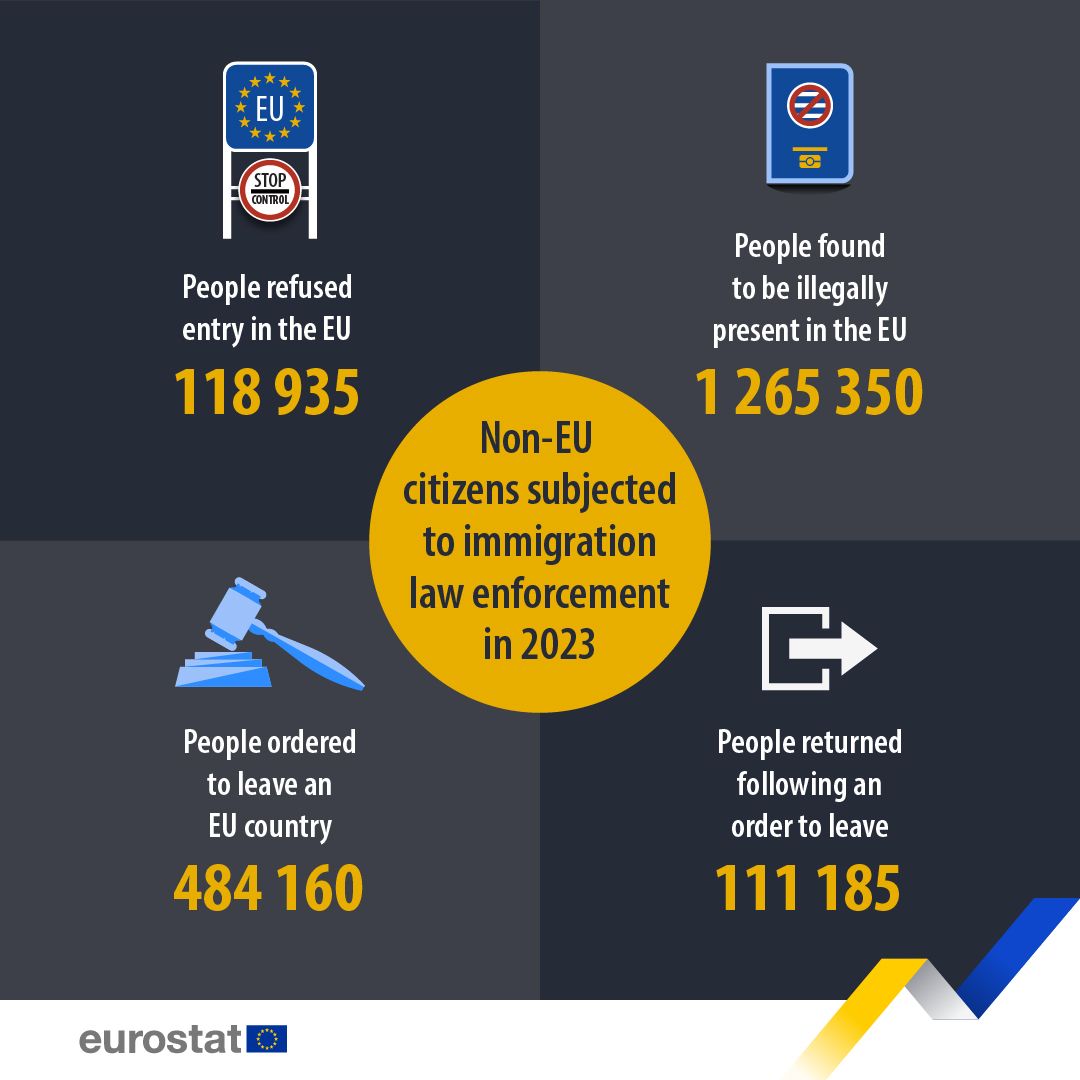
The number of non-EU citizens issued with an order to leave an EU country was 484 160, an increase of 4% compared with 2022 (466 350).

Non-EU citizens returned to another country: +25% compared with 2022

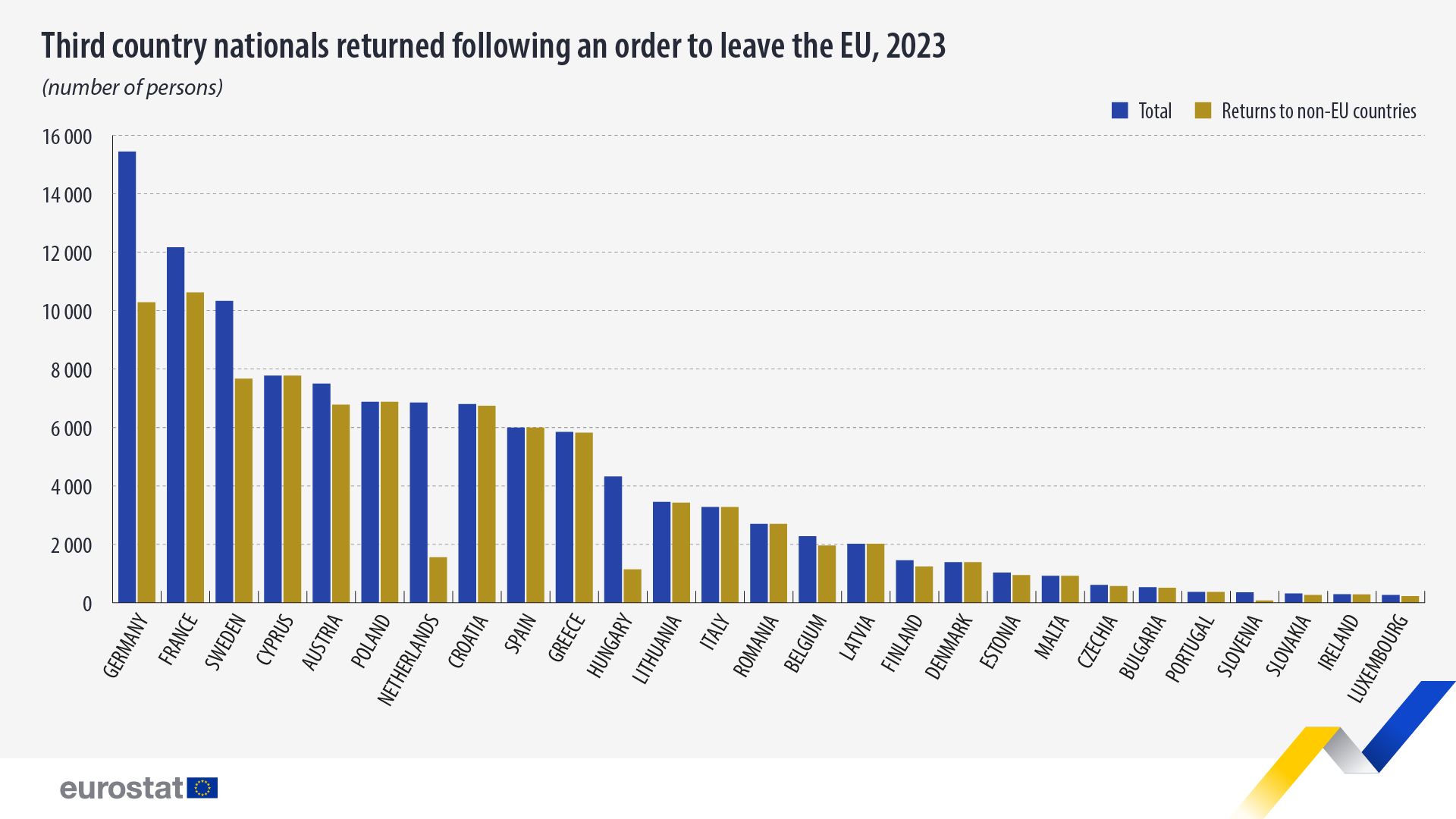
Following an order to leave, 111 185 non-EU citizens were returned to another country (including other EU countries), a 25% increase compared with 88 910 in 2022. Out of the 111 185, 91 465 were returned to the countries outside the EU.

Germany reported the largest number of non-EU citizens returned to another country (15 445), followed by France (12 170) and Sweden (10 330).

Georgians (10 345) topped the list of non-EU citizens returned to another country, followed by Albanians (7 810) and Turks (5 595).
More information: Eurostat

Publicaciones relacionadas:

Eurostat: Spain had the second lowest fertility rate in the European Union in 2022 Eurostat: Spain recorded the highest life expectancy in the EU in 2023 26 coordinated arrests in Belgium and France of suspects of a migrant smuggling criminal group More legal options for migrant workers coming to the EU 1 in 4 children in the EU at risk of poverty or social exclusion




EU News,  Migration and Demography,  Social Affairs Albania,  EU,  Eurostat,  France,  Georgia,  Germany,  immigration,  Sweden,  Türkiye

“This is a space for debate. All comments, for or against publication, that are respectful and do not contain expressions that are discriminatory, defamatory or contrary to current legislation will be published”.

Reader Interactions

Leave a Reply Cancel reply

Your email address will not be published. Required fields are marked *

This site uses Akismet to reduce spam. Learn how your comment data is processed.

Primary Sidebar

Footer

  • CDE Almería
  • Biblioteca Nicolás Salmerón – Universidad de Almería
  • Planta: 1ª, Despacho: 1.05.0B.
  • Ctra. Sacramento s/n. Almería (Spain)
  • Teléfono: (+34) 950 015266

HOME
NEWS
DOCUMENTATION
EUROPE ON THE NET
ABOUT US

  • LEGAL NOTICE
  • PRIVACY POLICY
  • COOKIE POLICY
  • ACCESSIBILITY
  • SITEMAP

Copyright © 2026 CDE Almería · Creative Commons LicenseThis work is licensed under a Creative Commons Attribution-NonCommercial 4.0 International License.

<p>El Centro de Documentación Europea de la Universidad de Almería utiliza cookies propias y de terceros para facilitar al usuario la navegación en su página Web y el acceso a los distintos contenidos alojados en la misma. Asimismo, se utilizan cookies analíticas de terceros para medir la interacción de los usuarios con el sitio Web. Pinche el siguiente enlace si desea información sobre el uso de cookies y como deshabilitarlas. </p>

Politica de privacidad

El Centro de Documentación Europea de la Universidad de Almería utiliza cookies propias y de terceros para facilitar al usuario la navegación en su página Web y el acceso a los distintos contenidos alojados en la misma. Asimismo, se utilizan cookies analíticas de terceros para medir la interacción de los usuarios con el sitio Web. Pinche el siguiente enlace si desea información sobre el uso de cookies y como deshabilitarlas. <a href="/politica-de-cookies" rel="noopener" target="_blank">Más información</a>

Cookies estrictamente necesarias

Las cookies estrictamente necesarias tiene que activarse siempre para que podamos guardar tus preferencias de ajustes de cookies.

Básicamente la web no funcionara bien si no las activas.

Estas cookies son:

  • Comprobación de inicio de sesión.
  • Cookies de seguridad.
  • Aceptación/rechazo previo de cookies.
Cookies de terceros

Esta web utiliza Google Analytics, Google Tag Manager y Yandex Metrika para recopilar información anónima tal como el número de visitantes del sitio, o las páginas más populares.

Dejar estas cookies activas nos permite mejorar nuestra web.

Política de cookies

Pinche el siguiente enlace si desea información sobre el uso de cookies y como deshabilitarlas. Más información