
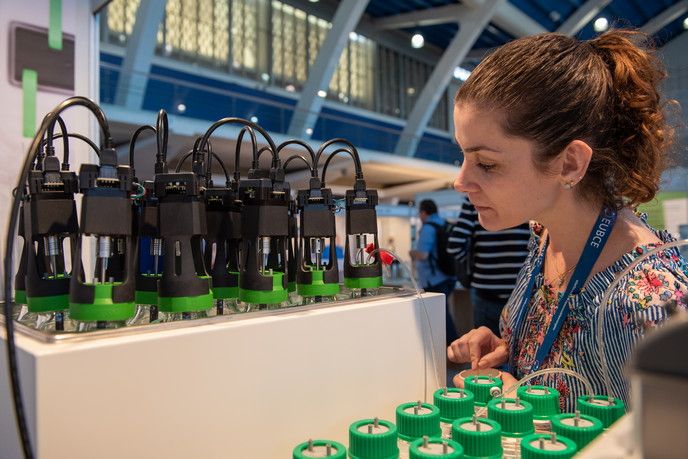
If the European Commission’s 2018 strategy for a climate neutral economy by 2050 is to succeed, the EUBCE 2019 conference in Lisbon underlined that it will not do so based on technical advances alone. As well as investment, it will require a range of collaborations.
The European Commission’s communication about its strategy for a climate neutral economy by 2050, makes it clear that success involves not only investing in realistic technological solutions, but also ‘empowering citizens and aligning action in key areas such as industrial policy, finance, or research.’
EUBCE provided CORDIS with a good opportunity to learn more about EU-funded initiatives working to achieve just that.
Investment and collaboration for a new sector
The Bio-Based Industries Joint Undertaking (BBI JU) is funded through the EU’s Horizon 2020 fund (EUR 975 million) and private investment (EUR 2.7 billion). Guided by the Strategic Innovation and Research Agenda (SIRA) developed by the industry, this partnership between the EU and the Bio-based Industries Consortium sets out the challenges facing the nascent bioeconomy.
With around 100 projects currently in its portfolio, BBI JU investment of around EUR half a billion has resulted in more than a 100 new bio-based value chains, well over the target of 10 by 2020.
The current call is open until 4 September with a total budget of EUR 135 million and is built around four strategic orientations: Feedstock, Process, Products, and Market uptake.
Co-creating the bioeconomy
Thankfully the exhibition space at EUBCE offered memorable EU-funded examples of efforts to increase collaboration and reduce sector fragmentation.
BIOVOICES was set up to involve stakeholders from public authorities (including policy makers), industry, researchers and civic society, in the decisions shaping the bioeconomy. By offering forums for discussion and debate, it seeks to increase the acceptance, relevance, know-how and quality of biobased innovations and products.
Midway through the project, BIOVOICES is currently organising 70 events around Europe, many of which are designed with a common framework for comparable results, to illuminate differences between countries.
Another inspiring exhibitor facilitating cooperation across the bioeconomy, was the EU-funded BRISK2initiative.
BRISK2 targets early stage biofuel researchers in academia and industry, seek access to further facilities and expertise. Its knowledge exchange can tap into the resources of 15 key bioenergy partners with 55 installations across Europe, offering the support of well equipped labs and leading scientists. “Suppose you’re doing your PhD and you want to upscale your process or do some modelling but you don’t have enough data, our platform can provide these things,” Daniel Nowakowski, EBRI Laboratories Manager of Aston University, UK, explains.
Additionally, as well as maintaining an accessible database of biomass properties, BRISK2 also works on biofuel protocols for the sector. “We know about the limitations of the end products, so we can work on standardisation after characterisation by our partners”, says Daniel.
The road to a bio-based economy will almost certainly not be without its potholes and detours, but on the evidence of EUBCE it will be travelled by ingenious and cooperative enthusiasts in it for the long haul.
For more information
please see: event website
Publicaciones relacionadas:
 Mini robots to create patterns inspired by nature
 Commission increases national support to farmers up to €25,000
 Parliament to host conference on abolishing the death penalty
 The EC and the consumer protection authorities demand clear information on prices and discounts
 Economic policies in EU: some progress, challenges remain
Leave a Reply