
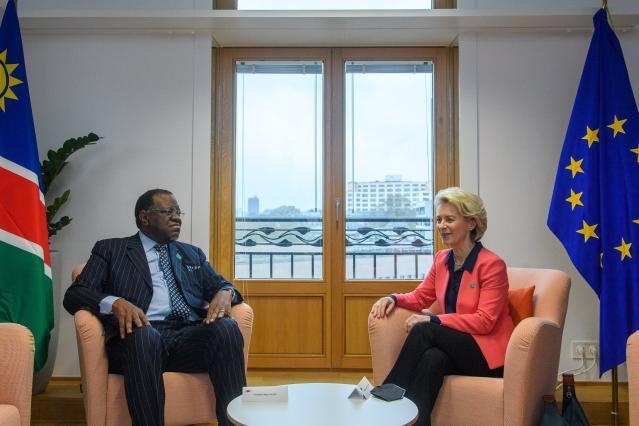
Today, Commission President Ursula von der Leyen and President of Namibia Hage Geingob signed a Memorandum of Understanding establishing a strategic partnership between the EU and Namibia at the COP27 in Egypt.
The partnership aims to ensure the development of a secure and sustainable supply of raw materials, refined materials and renewable hydrogen to support the green and digital transformation of the partners’ economies. It deepens the cooperation in areas with mutual benefits for both parties. The partnership will promote local value addition in Namibia by supporting the development of the mining and renewable hydrogen value chains. It will support sustainable raw materials value chains and facilitate investment and funding opportunities to modernise the Namibian industries and drive economic and social development.
President of the Commission Ursula von der Leyen said: “I am so glad to sign this agreement between the EU and Namibia for the development of raw materials value chains and renewable hydrogen. This is not only a huge step forward for the EU’s climate ambitions but also an agreement beneficial to Namibia, a front-runner in the development of renewable hydrogen in Africa. It shows Europe’s commitment to work with partner countries on our shared commitments to a greener and more resilient future in line with the Global Gateway Strategy. I would like to thank President Geingob for his commitment and look forward to our cooperation. This partnership is a key step in strengthening relations between the EU and Namibia, based on mutual trust, deepened political dialogue and concrete cooperation projects.”
Environment Council: Climate Summit COP 27
|
The partnership contains six main pillars:
- Integration, where feasible, of raw materials and renewable hydrogen value chains, including networking, new business models and promotion and facilitation of trade and investment linkages;
- Cooperation to leverage Environmental, Social, and Governance (ESG) Criteria and align with international standards;
- Mobilisation of funding for the development of soft and hard infrastructure required for projects development and for leveraging private sector funding through cooperation to address trade matters, including inclusiveness, and improving investments on climate action;
- Capacity building, training and skills development along raw materials and renewable hydrogen value chains;
- Co-operation on research and innovation along the raw materials value chain, including on mineral knowledge and circularity, hydrogen technologies and skills;
- Regulatory alignment, standards and certification.
The EU and Namibia have committed to develop an operational Roadmap for 2023-2024, with concrete joint actions agreed within six months of the signature of the Memorandum of Understanding. These actions are to be carried out in close cooperation with relevant industrial and financial stakeholders from the EU Member States and Namibia.
In parallel, today, the European Investment Bank (EIB) and Namibia are signing a joint declaration to deepen their cooperation in support of renewable energy, including renewable hydrogen. The EIB and Namibia will work towards the implementation of a loan by EIB Global to the Government of Namibia of up to €500 million. The loan will allow for long term, sustainable projects, and investments.
Background
Raw materials and renewable hydrogen value chains are critical to the green and digital transitions. They are essential for the deployment of critical technologies like wind turbines (with rare earth magnets) and semiconductors (polysilicon). Similarly, renewable hydrogen technology supports the decarbonisation of hard to abate sectors and energy intensive industries.
The EU needs to secure a sustainable supply of raw materials, especially critical raw materials, as an essential prerequisite for delivering on green and clean energy objectives. As part of the Action Plan on Critical Raw Materials, the Commission has already started working to build partnerships with resource-rich third countries, making use of all external policy instruments and respecting its international obligations.
The Commission has already established three strategic partnerships on raw materials with Canada (June 2021), Ukraine (July 2021) and Kazakhstan (November 2022), on behalf of the EU. The partnerships allow both sides to advance trade and investments into a secure, sustainable and resilient raw materials value chain, which is key to achieving the transition to climate-neutral and digitalised economies. The implementation of the partnership with Ukraine, partially interrupted due to the Russian invasion of the country, will be re-started during the EU Raw Materials Week 2022.
In the margins of the EU-Africa Summit in February 2022, President von der Leyen and Mr Hage Geingob, President of Namibia, discussed the establishment of a partnership on sustainable raw materials value chains and renewable hydrogen, as one of the key flagships of the Global Gateway strategy.
Source: European Commission
Publicaciones relacionadas:
 Spain wins the Environment category of the LIFE Awards
 Simpler EU energy labels for lighting products
 Protecting birds from the dangers of power lines
 Digital Assembly 2022: A closer look into the digital future
 COP27: EU calls on all Parties to take concrete steps to limit global warming to 1.5°C and respect the Paris Agreement
Leave a Reply