
The European Parliament Office in Spain launched the challenge: “#EPASvsDisinfo” to the European Parliament’s Ambassador and Mentor Schools to collect ideas on how to fight disinformation. Those who accepted the challenge had to produce an Instagram “reel” style video on how to fight disinformation where creativity and originality were paramount.
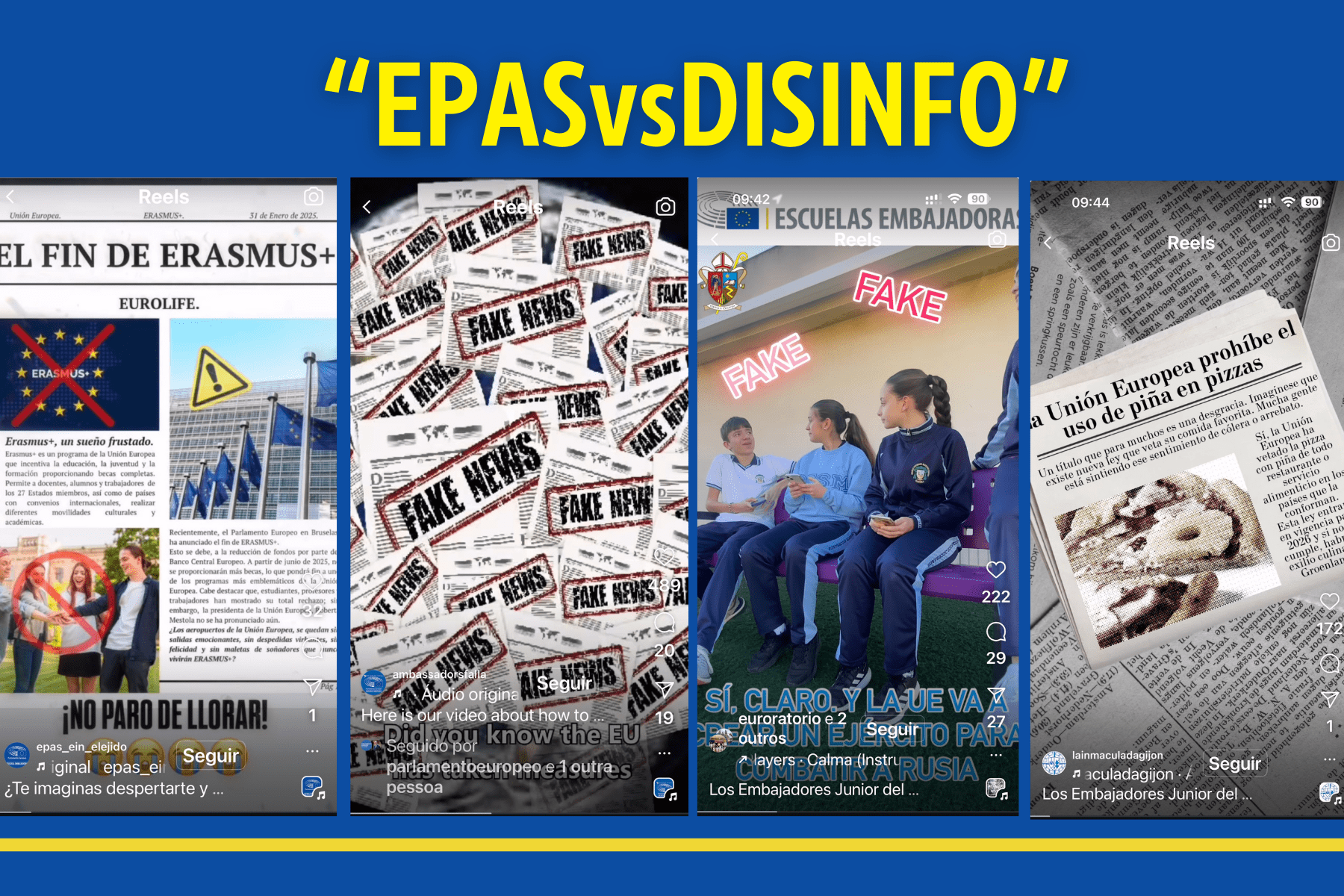
Divina Infantita El Ejido School (El Ejido, Almeria) and IES Manuel de Falla (Coslada, Madrid) have been the winners of this challenge and will travel to Strasbourg to take part in the next session of the Euroescola programme, which will take place on 28 March. On this occasion, students from all over the European Union will occupy the seat of the MEPs for a day to debate on the environment. During the session, the students will have to reach agreements to finally pass a resolution.
The response to this challenge from Colegio Divina Infantita El Ejido has been a video where students, excited about being selected to participate in a mobility programme, are alarmed when they read the false news about the end of Erasmus+ and quickly spread it. However, it all turns out to be a nightmare, and upon waking up, a student verifies from official sources that the news is false. The video aims to raise awareness about the spread of fake news, the importance of verifying information and encouraging critical thinking, highlighting the value of Erasmus+ and the shared responsibility in the fight against disinformation.
IES Manuel de Falla Coslada presented a video on the rapid spread of disinformation in media and social networks. Current EU measures such as the Code of Practice and the EDMO are mentioned, but more actions are proposed: an app to verify news, sanctions for those who spread disinformation and the mandatory implementation of media education in schools through verification workshops.
The aim of the “#EPASvsDisinfo” challenge was precisely to familiarise students with the workings of the European institutions and to bring them closer to some of the issues the European Parliament is working on, such as, in this case, the fight against disinformation.
Disinformation and young people
According to the latest Eurobarometer published by the European Parliament, 76% of young Europeans aged 16-30 believe they have been exposed to disinformation in the last seven days, and 70% are confident in their ability to recognise it.
In nine EU countries, including Spain, more than half of respondents say they have been exposed to disinformation ‘often’ or ‘very often’, with the highest proportions in Malta (59%), Hungary (58%), Greece (57%), Luxembourg (55%) and Belgium (54%). In Spain, the figure stands at 51%. In contrast, the proportion of those who believe they have never been exposed to disinformation and fake news is highest in Romania (19%), followed by Bulgaria (11%).
70% of survey participants are confident in their ability to recognise disinformation. Respondents in Malta and Croatia were the most confident in their ability to identify fake news, while those in Austria, Germany and Slovenia were the least confident. In Spain, 67% of young people were confident, but only 15% said they were “very confident”.
More information: European Parliament.
Publicaciones relacionadas:
 European Parliament calls for new media grants, with focus on combating disinformation
 EU funds tool to help journalists and fact-checkers distinguish truth from lies
 José Manuel Pérez Tornero, from Almeria, will be elected new president of RTVE
 Parliament launches the Daphne Caruana Galizia journalism prize
 The European Commission fights against disinformation
Leave a Reply