• Skip to primary navigation
  • Skip to main content
  • Skip to primary sidebar
  • Skip to footer
  • Bluesky
  • Facebook
  • Instagram
  • Twitter
  • YouTube
CDE Almería – Centro de Documentación Europea – Universidad de Almería

CDE Almería - Centro de Documentación Europea - Universidad de Almería

Centro de Documentación Europea de la Universidad de Almería

  • HOME
  • WHAT´S ON
    • EU NEWS
    • Activities
    • EU Calls and Awards
    • Radio Program «Europe with You»
  • DOCUMENTATION
    • EU Media Collection
      • Web Space
      • MEDIATHEQUE REPOSITORY
  • Europe on the net
    • Institutions
    • EU Representation in Spain
    • European information network of Andalusia
  • ABOUT US
    • Presentation
    • Services
    • People
    • Contact
  • Spanish
  • English

What are the European Capitals of Culture in 2023 and why should you visit them?

Inicio » EU News » Education and Culture » Culture » What are the European Capitals of Culture in 2023 and why should you visit them?

1 de March de 2023

Each year, several EU cities are named Capitals of Culture (COE) in recognition of their rich heritage and cultural value.
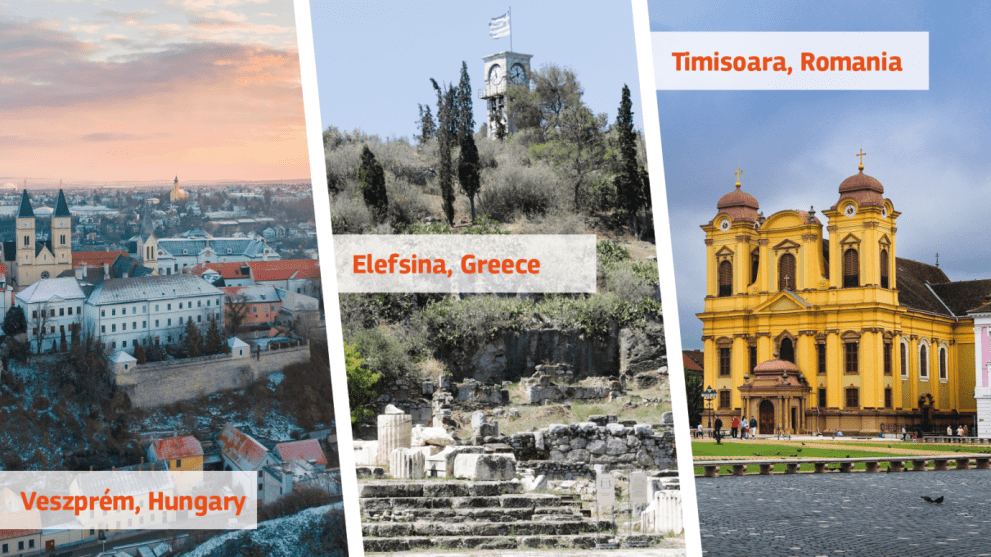
For this edition, Veszprém (Hungary), Eleusis (Greece) and Timisoara (Romania) were chosen. Here are some reasons to visit them.

So far, four Spanish cities have become European Capitals of Culture: Madrid (1992), Santiago de Compostela (2000), Salamanca (2002) and San Sebastian (2016). According to the calendar, Spain will not have another European Capital of Culture until 2031.

The European Capitals of Culture project started in 1985 and more than sixty European cities have already been protagonists. Now it’s time to find out which cities have been chosen for 2023!
Promoting Europe’s cultural heritage and diversity

Veszprém: the city where Hungarian queens are crowned

Veszprém is a city near Lake Balaton, located 115 kilometers from Budapest, the capital of Hungary. There you can find one of the most important zoological parks of Hungary, enjoy its impressive medieval castle, visit the Cathedral of St. Michael, where the different queens of Hungary have been crowned, or its magnificent Fire Tower.

Veszprém has about 60,000 inhabitants who enjoy every step of the history of the medieval city. If you visit, you should remember two names: Stephen I and Gisela, the first kings of Hungary. There are numerous nods to these personalities and they have become the great figures of Veszprém.

The trip from Budapest is very comfortable and can be made by public transport. If you prefer, you can opt for an organized tour departing from Budapest for just over fifty euros.

Eleusis: history meets modernity

The city is nestled in the Gulf of Elefsina and is approximately 20 kilometers from Athens. Here, the history of ancient Greece blends with modernity, leaving all visitors fascinated.

Today, it is one of the main industrial centers of the Hellenic country, but in ancient times, it was a place of pilgrimage, due to the initiation rituals to the cult of the goddesses Demeter and Persephone, known as Eleusinian mysteries.

Without a doubt, a visit to the museum of Eleusis and its archaeological site is a must if we want to understand one of the most influential civilizations in Europe.

Timisoara: urban redevelopment as an example

The city of Timisoara is located in western Romania, more than 500 kilometers from Bucharest and close to the Serbian border. The city has belonged to the Ottoman Empire, the Austro-Hungarian Empire and, more recently, was part of a communist regime. Nowadays, it is a modern university city with a large number of green spaces.

Its squares stand out among all the places to visit in Timisoara: the Victory Square and the Union Square mix tradition and modernity. Timisoara is one of the most populated cities in Romania, and is known as the little Vienna for the architectural importance of its buildings, including some beautiful examples of Art Nouveau.

The famous writer Herta Muller, who has two Nobel prizes to her credit, was born in the city of Timisoara, a city that, for decades, has been experiencing its greatest heyday.

And visit them thanks to Interrail?

Now you want to visit all these places, right? As we have told you in other occasions, traveling in a sustainable way is possible. There are several options with which you can visit any place you want in a more ecofriendly way. One of them is Interrail, with which you can visit Veszprém, Eleusis and Timisoara.

Just choose the route you like the most to enjoy medieval history, classical culture or Art Nouveau, and watch out for Interrail promotions, where you can find trips at very cheap prices or even for free.


More information

European Commission

Publicaciones relacionadas:

CulturEU: Commission steps up support to the cultural sector Support to the EU cultural sector during the COVID-19 pandemic 2.5 billion euros for the EU’s new cultural program EU Guidelines for the Cultural and Creative Sectors “Dialogue” to mark the European Day of Jewish Culture

Culture,  Education and Culture,  EU News Capitals of Culture,  City,  culture,  European Commission

“This is a space for debate. All comments, for or against publication, that are respectful and do not contain expressions that are discriminatory, defamatory or contrary to current legislation will be published”.

Reader Interactions

Leave a Reply Cancel reply

Your email address will not be published. Required fields are marked *

This site uses Akismet to reduce spam. Learn how your comment data is processed.

Primary Sidebar

Footer

  • CDE Almería
  • Biblioteca Nicolás Salmerón – Universidad de Almería
  • Planta: 1ª, Despacho: 1.05.0B.
  • Ctra. Sacramento s/n. Almería (Spain)
  • Teléfono: (+34) 950 015266

HOME
NEWS
DOCUMENTATION
EUROPE ON THE NET
ABOUT US

  • LEGAL NOTICE
  • PRIVACY POLICY
  • COOKIE POLICY
  • ACCESSIBILITY
  • SITEMAP

Copyright © 2026 CDE Almería · Creative Commons LicenseThis work is licensed under a Creative Commons Attribution-NonCommercial 4.0 International License.

<p>El Centro de Documentación Europea de la Universidad de Almería utiliza cookies propias y de terceros para facilitar al usuario la navegación en su página Web y el acceso a los distintos contenidos alojados en la misma. Asimismo, se utilizan cookies analíticas de terceros para medir la interacción de los usuarios con el sitio Web. Pinche el siguiente enlace si desea información sobre el uso de cookies y como deshabilitarlas. </p>

Politica de privacidad

El Centro de Documentación Europea de la Universidad de Almería utiliza cookies propias y de terceros para facilitar al usuario la navegación en su página Web y el acceso a los distintos contenidos alojados en la misma. Asimismo, se utilizan cookies analíticas de terceros para medir la interacción de los usuarios con el sitio Web. Pinche el siguiente enlace si desea información sobre el uso de cookies y como deshabilitarlas. <a href="/politica-de-cookies" rel="noopener" target="_blank">Más información</a>

Cookies estrictamente necesarias

Las cookies estrictamente necesarias tiene que activarse siempre para que podamos guardar tus preferencias de ajustes de cookies.

Básicamente la web no funcionara bien si no las activas.

Estas cookies son:

  • Comprobación de inicio de sesión.
  • Cookies de seguridad.
  • Aceptación/rechazo previo de cookies.
Cookies de terceros

Esta web utiliza Google Analytics, Google Tag Manager y Yandex Metrika para recopilar información anónima tal como el número de visitantes del sitio, o las páginas más populares.

Dejar estas cookies activas nos permite mejorar nuestra web.

Política de cookies

Pinche el siguiente enlace si desea información sobre el uso de cookies y como deshabilitarlas. Más información