• Skip to primary navigation
  • Skip to main content
  • Skip to primary sidebar
  • Skip to footer
  • Bluesky
  • Facebook
  • Instagram
  • Twitter
  • YouTube
CDE Almería – Centro de Documentación Europea – Universidad de Almería

CDE Almería - Centro de Documentación Europea - Universidad de Almería

Centro de Documentación Europea de la Universidad de Almería

  • HOME
  • WHAT´S ON
    • EU NEWS
    • Activities
    • EU Calls and Awards
    • Radio Program «Europe with You»
  • DOCUMENTATION
    • EU Media Collection
      • Web Space
      • MEDIATHEQUE REPOSITORY
  • Europe on the net
    • Institutions
    • EU Representation in Spain
    • European information network of Andalusia
  • ABOUT US
    • Presentation
    • Services
    • People
    • Contact
  • Spanish
  • English

Virtual Event – Fundamental Rights in the EU: 20 years of the European Charter and its application in Spain

Inicio » EU News » Institutional Affairs » Virtual Event – Fundamental Rights in the EU: 20 years of the European Charter and its application in Spain

17 de February de 2021

Fundamental Rights in the EU: 20 years of the European Charter and its application in Spain
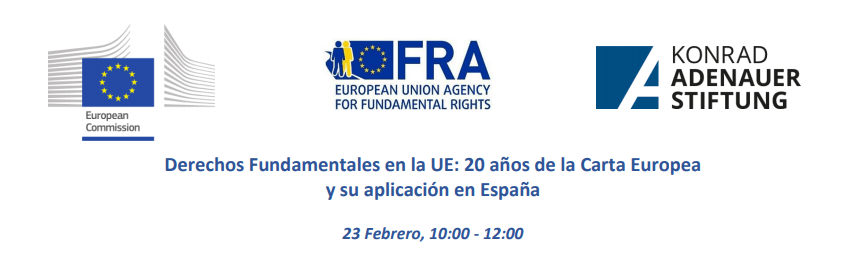
Evento virtual: Derechos Fundamentales en la UE: 20 años de la Carta Europea y su aplicación en España

23 February, 10:00 – 12:00

Registration via ZOOM: → LINK

The European Union (EU) is founded on the values of respect for human dignity, freedom, democracy, equality, the rule of law and respect for human rights, including the rights of persons belonging to minorities. These values are enshrined in Article 2 of the EU Treaty and compliance with them by the Member States is a condition for participation in the European project. The European Charter of Fundamental Rights incorporated these values into EU law.

The Representation of the European Commission in Spain and the Konrad Adenauer Foundation, in collaboration with the European Union Agency for Fundamental Rights, are organising this virtual event to discuss the EU instruments and mechanisms available to ensure that the application of Article 2 and the Charter of Fundamental Rights is not rhetorical, also in the Spanish context.

10:00 Welcome and Introduction

  • Francisco Fonseca, Director of the Representation of the European Commission in Spain
  • Wilhelm Hofmeister, Director of the Konrad Adenauer Foundation office for Spain and Portugal
10.05 Session 1. Fundamental Rights in the European Union: where do we stand and where are we heading?

  • Emmanuel Crabit, Director, Fundamental Rights and Rule of Law, European Commission
  • Ignacio Sola, Secretary General, Ministry of Equality
  • Paloma Biglino, Professor of Constitutional Law at the University of Valladolid

Debate on-line, Q&A

11:05 Session 2: The EU Charter of Fundamental Rights and its application in Spain.

  • Gabriel Toggenburg. Policy Coordinator, EU Charter of Fundamental Rights,
    Institutional Cooperation and Networks Unit
  • Ana Gallego, Director General for International Judicial Cooperation and Human Rights, Ministry of Justice.
  • Yolanda Gomez, CEPC Director, Professor of Constitutional Law at the UNED and Jean Monnet Professor ad personam of the European Union

Debate on-line, Q&A

12:00 End

ZOOM Registration Link: https://zoom.us/webinar/register/WN_YCOPS_zbTTKe-pWjZtwX6g

Publicaciones relacionadas:

Successive amendments to the Polish Law on the National Council of the Judiciary are liable to infringe EU law Commission sends letter of formal notice to the United Kingdom for breach of its obligations Progress in 2020 in the implementation of ECHR rulings despite COVID Finland’s guarantee in favour of the airline Finnair is compatible with EU law Fighting trafficking in human beings



EU News,  Institutional Affairs,  Law

“This is a space for debate. All comments, for or against publication, that are respectful and do not contain expressions that are discriminatory, defamatory or contrary to current legislation will be published”.

Reader Interactions

Leave a Reply Cancel reply

Your email address will not be published. Required fields are marked *

This site uses Akismet to reduce spam. Learn how your comment data is processed.

Primary Sidebar

Footer

  • CDE Almería
  • Biblioteca Nicolás Salmerón – Universidad de Almería
  • Planta: 1ª, Despacho: 1.05.0B.
  • Ctra. Sacramento s/n. Almería (Spain)
  • Teléfono: (+34) 950 015266

HOME
NEWS
DOCUMENTATION
EUROPE ON THE NET
ABOUT US

  • LEGAL NOTICE
  • PRIVACY POLICY
  • COOKIE POLICY
  • ACCESSIBILITY
  • SITEMAP

Copyright © 2026 CDE Almería · Creative Commons LicenseThis work is licensed under a Creative Commons Attribution-NonCommercial 4.0 International License.

<p>El Centro de Documentación Europea de la Universidad de Almería utiliza cookies propias y de terceros para facilitar al usuario la navegación en su página Web y el acceso a los distintos contenidos alojados en la misma. Asimismo, se utilizan cookies analíticas de terceros para medir la interacción de los usuarios con el sitio Web. Pinche el siguiente enlace si desea información sobre el uso de cookies y como deshabilitarlas. </p>

Politica de privacidad

El Centro de Documentación Europea de la Universidad de Almería utiliza cookies propias y de terceros para facilitar al usuario la navegación en su página Web y el acceso a los distintos contenidos alojados en la misma. Asimismo, se utilizan cookies analíticas de terceros para medir la interacción de los usuarios con el sitio Web. Pinche el siguiente enlace si desea información sobre el uso de cookies y como deshabilitarlas. <a href="/politica-de-cookies" rel="noopener" target="_blank">Más información</a>

Cookies estrictamente necesarias

Las cookies estrictamente necesarias tiene que activarse siempre para que podamos guardar tus preferencias de ajustes de cookies.

Básicamente la web no funcionara bien si no las activas.

Estas cookies son:

  • Comprobación de inicio de sesión.
  • Cookies de seguridad.
  • Aceptación/rechazo previo de cookies.
Cookies de terceros

Esta web utiliza Google Analytics, Google Tag Manager y Yandex Metrika para recopilar información anónima tal como el número de visitantes del sitio, o las páginas más populares.

Dejar estas cookies activas nos permite mejorar nuestra web.

Política de cookies

Pinche el siguiente enlace si desea información sobre el uso de cookies y como deshabilitarlas. Más información