
The ten key objectives
For the period 2023-27, the common agricultural policy (CAP) will be built around ten key objectives. Focused on social, environmental and economic goals, these objectives will be the basis upon which EU countries design their CAP strategic plans.
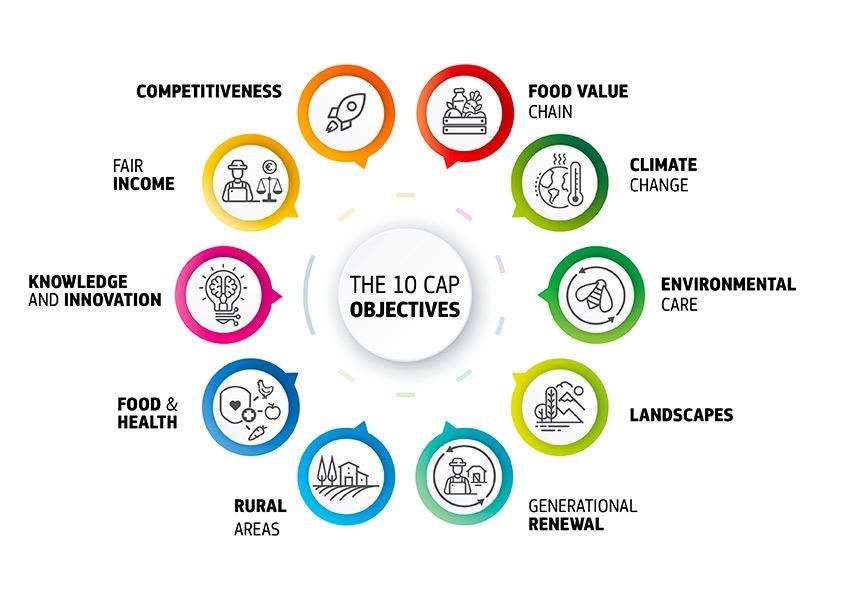
The objectives are:
- to ensure a fair income for farmers;
- to increase competitiveness;
- to improve the position of farmers in the food chain;
- climate change action;
- environmental care;
- to preserve landscapes and biodiversity;
- to support generational renewal;
- vibrant rural areas;
- to protect food and health quality;
- fostering knowledge and innovation.
Analysis of the key policy objectives
To explain the reasoning behind each of these ten objectives, the European Commission has produced a series of briefs. These briefs summarise the main facts about, as well as the policy relevance of, each objective.
Supporting viable farm income
“In 2017, farmers earned on average just under half of what could be gained in other jobs, up from a third a decade ago.”
Key objective: support viable farm income and the resilience of the agricultural sector across the EU, in order to enhance long-term food security and agricultural diversity, as well as to ensure the economic sustainability of agricultural production.
This brief examines the current situation with EU farm income, the role of the CAP in supporting it and the differences among EU countries and sectors. Additionally, it discusses which combination of measures are needed to serve the key objective of supporting viable farm income.
Increasing competitiveness
“Pressures on the EU’s agricultural resource base have increased due to growing food and industrial demand, which is driven by demographic and disposable income changes.”
Key objective: enhance market orientation and increase farm competitiveness both in the short and long term, including greater focus on research, technology and digitalisation.
This brief outlines a number of drivers and policy tools that are available to trigger productivity gains in EU agriculture, such as research and innovation programs, new technologies, rural development and infrastructure, efficient advisory systems and continuous training for farm managers.
Improving farmers’ position in the value chain
“Agriculture is characterised by a stagnant and low share of value added in the value chain, due to high input costs, variation in production and incorporation of new services.”
Key objective: improve farmers’ position in the value chain.
This ;brief examines how the new CAP can strengthen the position of farmers through measures such as strengthening cooperation among farmers, increasing market transparency and ensuring effective mechanisms against unfair trading practices.
Contributing to climate change mitigation
“EU agriculture has a key role to play in helping to reach the commitments of the Paris agreement and EU strategies on sustainability and bioeconomy, by stepping up its ambition in terms of greenhouse gas emissions.”
Key objective: contribute to climate change mitigation and adaptation, including by reducing greenhouse gas emissions and enhancing carbon sequestration, as well as promoting sustainable energy.
This brief examines the role that agriculture can play in the reduction of greenhouse gas emissions through new farm and soil management techniques. Additionally, it explores the risk that climate change poses to agriculture.
Efficient natural resource management
“Agricultural soils in the EU contain the equivalent of 51 billion tonnes of CO2, which is significantly more than the greenhouse gasses emitted annually by EU countries.”
Key objective: foster sustainable development and efficient management of natural resources such as water, soil and air, including by reducing chemical dependency.
The brief focuses on soil as one of the most important natural resources, supplying essential nutrients, water, oxygen and support for plants. It also examines concerns related to soil health and highlights the importance of policies which promote soil protection.
Halting and reversing biodiversity loss
“Just as agricultural activity depends heavily on various types of biodiversity, it also plays an important role in the conservation of farmland-dependent habitats and species.”
Common Agricultural Policy 2023-2027 |
Key objective: contribute to halting and reversing biodiversity loss, enhance ecosystem services and preserve habitats and landscapes.
This brief addresses the topic of biodiversity within the EU, with a particular focus on its links to farmed landscapes and landscape features. With this focus, it recounts some of the changes needed in the farm sector, explains the relevant CAP tools currently available, and asks key related questions about how the CAP should develop in future.
Generational renewal
“A vibrant agricultural sector needs skilled and innovative young farmers to respond to societal demands, from quality food to environmental public goods.”
Key objective: attract and sustain young farmers and new farmers and facilitate sustainable business development in rural areas.
This brief identifies the challenges and needs of young farmers in the EU and outlines how a more targeted system of support, based on needs assessment and more quantifiable expected results, can stimulate generational renewal and encourage the success of young farmers in the agricultural sector.
Jobs, growth and equality in rural areas
“The CAP plays a major role in alleviating some of the unemployment and poverty pressures on rural areas. A recent study by the World Bank demonstrated the positive role played by the policy in reducing poverty.”
Key objective: promote employment, growth, gender equality, including the participation of women in farming, social inclusion and local development in rural areas, as well as the circular bio-economy and sustainable forestry.
This brief explores the role of the CAP in the rural economy and looks at how income support and rural development spending helps maintain employment rates and standards of living.
Responding to societal demands on food & health
“The overall sales of veterinary antimicrobials across 25 European countries have decreased by more than 35% between 2011 and 2018.”
Key objective: improve the response of EU agriculture to societal demands on food and health, including high-quality, safe and nutritious food produced in a sustainable way, to reduce food waste, as well as to improve animal welfare and combat antimicrobial resistance.
This brief focuses on the challenges posed by antimicrobial resistance (AMR) in animal husbandry, the close links between animal welfare, animal health and food-borne diseases, and EU actions that can support farmers and EU countries in the fight against AMR.
Fostering knowledge & innovation
“Support for knowledge exchange, training, advice and innovation is key for securing smart and sustainable agriculture, forestry and rural areas.”
Key objective: modernise agriculture and rural areas through fostering and sharing knowledge, innovation and digitalisation, and by encouraging their uptake by farmers through improved access to research, innovation, knowledge exchange and training.
This brief seeks to modernise agriculture by increasing cooperation and knowledge sharing, and improving agricultural training
Source: European Commission
Publicaciones relacionadas:
 Coronavirus: Commission announces further measures to support the agri-food sector
 Council agrees its position on the next EU common agricultural policy
 A fairer, greener agricultural policy for the period 2023-2027
 Spain asks the European Commission for measures to mitigate the effects of drought on the agricultural sector
 Farmers and livestock farmers will receive 4,856 million euros in direct aid under CAP 2022
Leave a Reply