• Skip to primary navigation
  • Skip to main content
  • Skip to primary sidebar
  • Skip to footer
  • Bluesky
  • Facebook
  • Instagram
  • Twitter
  • YouTube
CDE Almería – Centro de Documentación Europea – Universidad de Almería

CDE Almería - Centro de Documentación Europea - Universidad de Almería

Centro de Documentación Europea de la Universidad de Almería

  • HOME
  • WHAT´S ON
    • EU NEWS
    • Activities
    • EU Calls and Awards
    • Radio Program «Europe with You»
  • DOCUMENTATION
    • EU Media Collection
      • Web Space
      • MEDIATHEQUE REPOSITORY
  • Europe on the net
    • Institutions
    • EU Representation in Spain
    • European information network of Andalusia
  • ABOUT US
    • Presentation
    • Services
    • People
    • Contact
  • Spanish
  • English

ExoMars to take off for the Red Planet in 2022

Inicio » EU News » ExoMars to take off for the Red Planet in 2022

19 de March de 2020

The European Space Agency (ESA) and the Roscosmos Space Corporation have decided to postpone the launch of the second ExoMars mission to study the Red Planet to 2022.
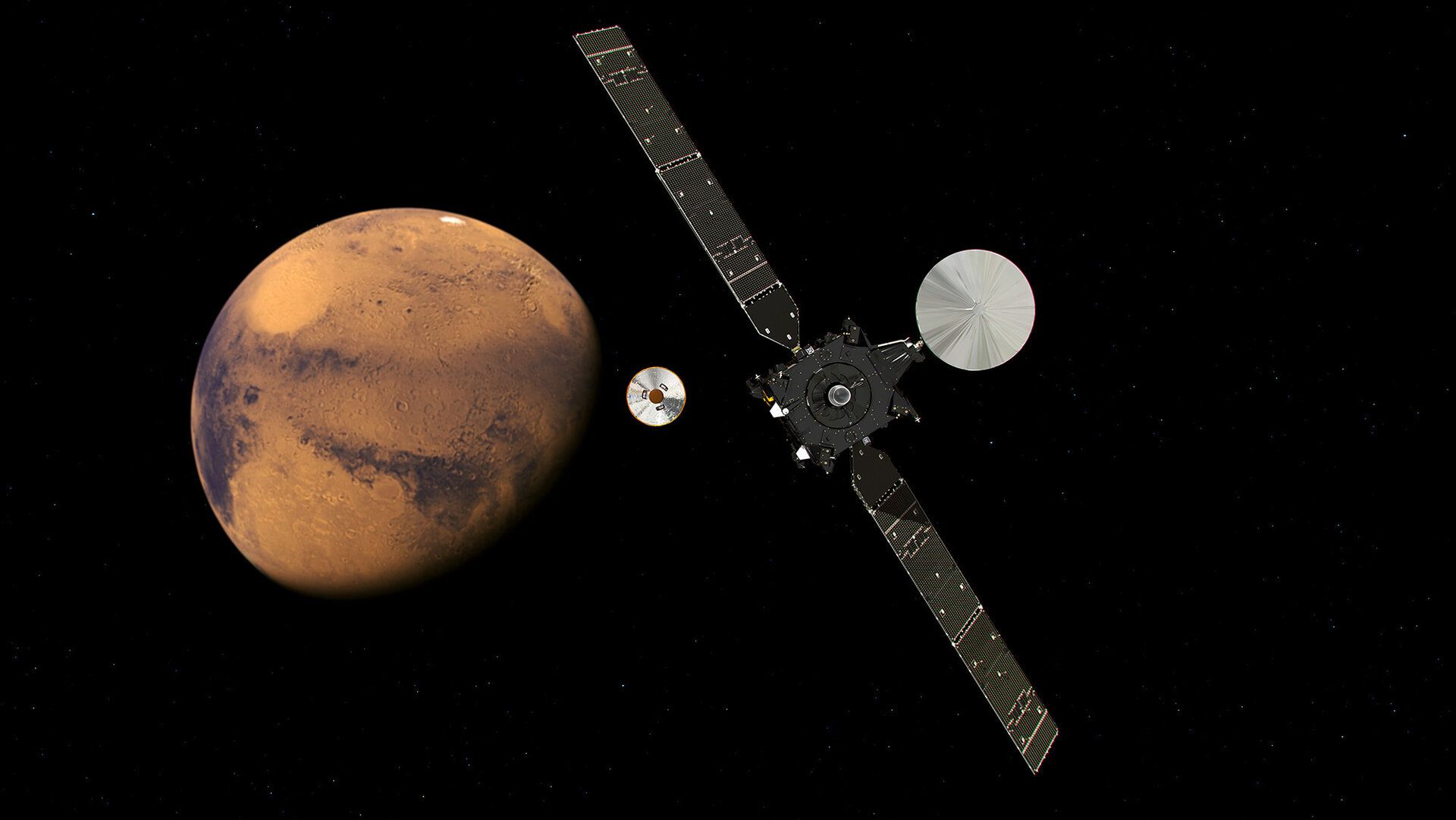
 

The joint ESA-Roscosmos project team evaluated all the activities needed for an authorisation to launch, in order to analyse the risks and schedule. With due consideration of the recommendations provided by European and Russian Inspectors General, ExoMars experts have concluded that tests necessary to make all components of the spacecraft fit for the Mars adventure need more time to complete.

The primary goal of the mission is to determine if there has ever been life on Mars, and to better understand the history of water on the planet. The ExoMars rover, named Rosalind Franklin, includes a drill to access the sub-surface of Mars as well as a miniature life-search laboratory kept within an ultra-clean zone.

In the frame of a dedicated meeting, ESA and Roscosmos heads Jan Wörner and Dmitry Rogozin agreed that further tests to the spacecraft with the final hardware and software are needed. In addition, the parties had to recognise that the final phase of ExoMars activities are compromised by the general aggravation of the epidemiological situation in European countries.

“We have made a difficult but well-weighed decision to postpone the launch to 2022. It is driven primarily by the need to maximise the robustness of all ExoMars systems as well as force majeure circumstances related to exacerbation of the epidemiological situation in Europe which left our experts practically no possibility to proceed with travels to partner industries. I am confident that the steps that we and our European colleagues are taking to ensure mission success will be justified and will unquestionably bring solely positive results for the mission implementation,” said Roscosmos Director General Dmitry Rogozin.

“We want to make ourselves 100% sure of a successful mission. We cannot allow ourselves any margin of error. More verification activities will ensure a safe trip and the best scientific results on Mars,” said ESA Director General Jan Wörner.

To date, all flight hardware needed for the launch of ExoMars has been integrated in the spacecraft. The Kazachok landing platform is fully equipped with thirteen scientific instruments, and the Rosalind Franklin rover with its nine instruments recently passed final thermal and vacuum tests in France.

The latest ExoMars parachutes dynamic extraction tests have been completed successfully at NASA’s Jet Propulsion Laboratory, and the main parachutes are ready for the two final high-altitude drop tests in March in Oregon, US.

The descent module has been undergoing propulsion system qualification in the past month. The ExoMars descent module and landing platform have been undergoing environmental testing in Cannes, France, to confirm the spacecraft is ready to endure the harsh conditions of space on its journey to Mars.

The new schedule foresees a launch between August and October 2022. Celestial mechanics define that only relatively short launch windows (10 days each) every two years exist in which Mars can be reached from Earth.

ExoMars will be the first mission to search for signs of life at depths up to two metres below the martian surface, where biological signatures of life may be uniquely well preserved.

About ExoMars

The ExoMars programme is a joint endeavour between the Roscosmos State Corporation and ESA. Apart from the 2022 mission, it includes the Trace Gas Orbiter launched in 2016. The TGO is already both delivering important scientific results obtained by its own Russian and European science instruments and relaying data from NASA’s Curiosity Mars rover and InSight lander. The module will also relay the data from the ExoMars 2022 mission once it arrives at Mars.


More Information

United space in Europe

Publicaciones relacionadas:

Space19: Road to ESA’s Council at Ministerial Level European Space Week 2019 ESA and EDA will continue their joint research Enigma: a dwarf star produces a supereruption International Day of Human Space Flight: The challenges of long-term space travel

EU News ExoMars,  Mars,  Space

“This is a space for debate. All comments, for or against publication, that are respectful and do not contain expressions that are discriminatory, defamatory or contrary to current legislation will be published”.

Reader Interactions

Leave a Reply Cancel reply

Your email address will not be published. Required fields are marked *

This site uses Akismet to reduce spam. Learn how your comment data is processed.

Primary Sidebar

Footer

  • CDE Almería
  • Biblioteca Nicolás Salmerón – Universidad de Almería
  • Planta: 1ª, Despacho: 1.05.0B.
  • Ctra. Sacramento s/n. Almería (Spain)
  • Teléfono: (+34) 950 015266

HOME
NEWS
DOCUMENTATION
EUROPE ON THE NET
ABOUT US

  • LEGAL NOTICE
  • PRIVACY POLICY
  • COOKIE POLICY
  • ACCESSIBILITY
  • SITEMAP

Copyright © 2026 CDE Almería · Creative Commons LicenseThis work is licensed under a Creative Commons Attribution-NonCommercial 4.0 International License.

<p>El Centro de Documentación Europea de la Universidad de Almería utiliza cookies propias y de terceros para facilitar al usuario la navegación en su página Web y el acceso a los distintos contenidos alojados en la misma. Asimismo, se utilizan cookies analíticas de terceros para medir la interacción de los usuarios con el sitio Web. Pinche el siguiente enlace si desea información sobre el uso de cookies y como deshabilitarlas. </p>

Politica de privacidad

El Centro de Documentación Europea de la Universidad de Almería utiliza cookies propias y de terceros para facilitar al usuario la navegación en su página Web y el acceso a los distintos contenidos alojados en la misma. Asimismo, se utilizan cookies analíticas de terceros para medir la interacción de los usuarios con el sitio Web. Pinche el siguiente enlace si desea información sobre el uso de cookies y como deshabilitarlas. <a href="/politica-de-cookies" rel="noopener" target="_blank">Más información</a>

Cookies estrictamente necesarias

Las cookies estrictamente necesarias tiene que activarse siempre para que podamos guardar tus preferencias de ajustes de cookies.

Básicamente la web no funcionara bien si no las activas.

Estas cookies son:

  • Comprobación de inicio de sesión.
  • Cookies de seguridad.
  • Aceptación/rechazo previo de cookies.
Cookies de terceros

Esta web utiliza Google Analytics, Google Tag Manager y Yandex Metrika para recopilar información anónima tal como el número de visitantes del sitio, o las páginas más populares.

Dejar estas cookies activas nos permite mejorar nuestra web.

Política de cookies

Pinche el siguiente enlace si desea información sobre el uso de cookies y como deshabilitarlas. Más información