
Eurostat, the statistical office of the European Union, published the ‘Sustainable development in the European Union — monitoring report on progress towards the SDGs in an EU context, 2023 edition‘, which provides a statistical overview of progress towards the Sustainable Development Goals (SDGs) in the EU.
The report is published together with the European Semester Spring Package, in order to increase its relevance for policy and that way deliver on the commitment by this Commission to integrate the SDGs in the European Semester, a task entrusted to Commissioner Gentiloni.
The report shows that the EU has made progress towards most goals over the last five years, in line with Commission’s priorities in key policy areas such as the European Green Deal, the 8th Environment Action Programme and the European Pillar of Social Rights Action Plan. The data show the EU has progressed strongly towards many socio-economic goals, while more progress is expected in the environmental domain as Member States implement the ambitious targets of the European Green Deal.
For the first time, the report analysed the short-term impact of current crises on the SDGs. This includes the energy crisis in the context of Russia’s war against Ukraine and the aftershocks of the pandemic. The report also features a chapter with an improved analysis of the spillover effects of EU consumption on the rest of the world.
Sustainable development in the European Union – Monitoring report on progress towards the SDGs in an EU context – 2023 edition |
Key findings
The report shows that, over the last five years, the EU has made significant progress towards three SDGs and moderate progress toward most others. In particular:
- The EU made the most progress towards ensuring decent work and economic growth (SDG 8). In 2022, the EU’s employment rate reached a new record high of 74.6 %, while the EU’s long-term unemployment rate fell to a new record low.
- Significant progress was also made towards the goals of reducing poverty (SDG 1) and improving gender equality (SDG 5). The share of people overburdened by their housing costs has fallen since 2015 and women’s hourly earnings are catching up with those of men.
- There was also good progress towards reducing inequalities (SDG 10), ensuring quality education (SDG 4), and fostering peace and personal security within the EU’s territory and improving access to justice and trust in institutions (SDG 16). The income gaps between the richer and the poorer population groups narrowed and the EU is well on track to meet its target of a share of 45% of the population with tertiary studies. Life in the EU has become safer over the past few years, as deaths due to homicide or assault and the perceived occurrence of crime, violence and vandalism in European neighbourhoods have fallen considerably. Moreover, the EU has seen positive progress towards the goals of health and well-being (SDG 3) despite the setbacks caused by the COVID-19 pandemic, and on innovation and infrastructure (SDG 9).
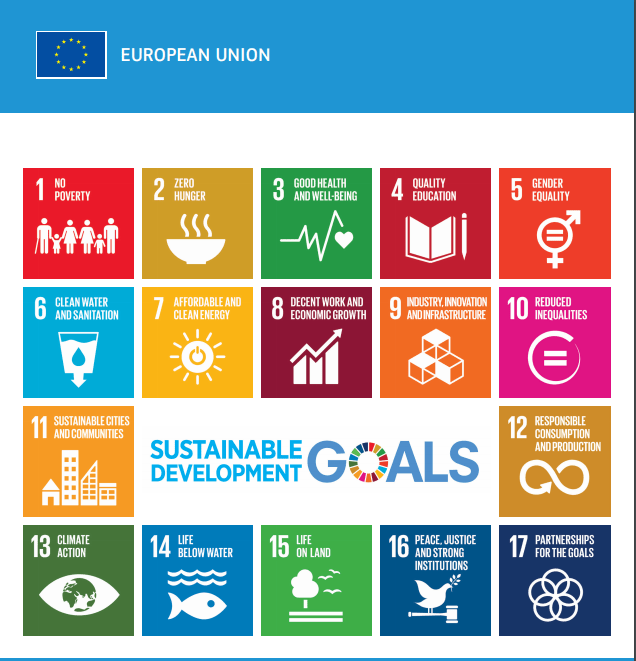
- Progress was moderately favourable for trends in the areas of responsible consumption and production (SDG 12), sustainable cities and communities (SDG 11), life below water (SDG 14), zero hunger (SDG 2), clean water and sanitation (SDG 6) and affordable and clean energy (SDG 7).
- More progress is expected for three goals – climate action (SDG 13), life on land (SDG 15) and global partnerships (SDG 17) – as EU Member States are set to implement the higher level of ambition in the environmental targets set at EU level. Regarding climate action (SDG 13), the EU has set very ambitious and unparalleled climate targets for 2030 and, as compared to past trends, they will require more efforts. The EU has already put in place the policy measures to deliver these additional efforts, notably via the ‘Fit for 55‘ package, with a revision of the EU emissions trading system (ETS), and the Effort Sharing Regulation that sets binding annual greenhouse gas emissions targets for Member States. In the area of energy, the EU has also set more ambitious targets for 2030. This implies that stronger progress is expected to be visible in the coming years in the area of energy efficiency and renewable energies in the EU, as well. Concerning life on land (SDG 15), even though terrestrial protected areas have increased since 2013, the EU continues to face steady declines in common bird and grassland butterfly populations. Additional efforts needed to reverse the degradation of ecosystems are envisaged in the EU 2030 Biodiversity Strategy, in the EU forest strategy for 2030 launched this year and in the EU Soil Strategy, which sets a 2030 objective on restoring degraded land and soil and combatting desertification. Regarding partnerships for the goals (SDG 17), the trend partially reflects cyclical effects and notably the increase in public debt resulting from the COVID-19 crisis.
More information: European Commission
Publicaciones relacionadas:
 New plan to support green and digital transition and EU recovery
 Building a Climate-Resilient Future – A new EU Strategy on Adaptation to Climate Change
 The ancient holm oak of Lecina European Tree of the Year 2021!
 Global emissions cuts in line with Paris Agreement mean near-term benefits for Earth
 Commission launches EU missions to tackle major challenges
Leave a Reply