
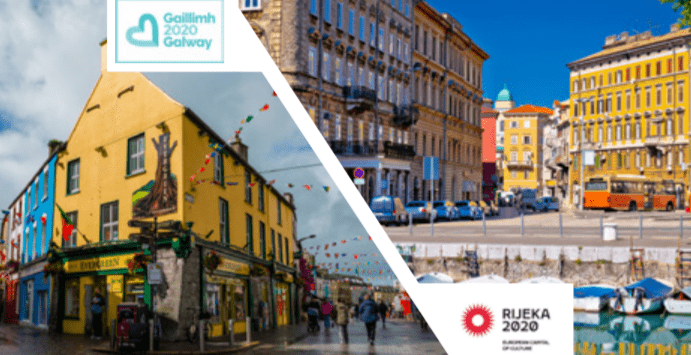
As of 1 January 2020, Rijeka (Croatia) and Galway (Ireland) will hold the title of European Capital of Culture for one year.
Rijeka
First Croatian European Capital of Culture bringing it international visibility, which will extend to the rest of the Western Balkan region. ‘Port of Diversity’ will be the motto, with hundreds of projects among 250 partners from 40 countries. Rijeka’s cultural programme focuses on:
- water,
- work
- migration
The opening exhibition will feature Rijeka’s famous artist, David Maljković, with other highlights including ‘The Sea is Glowing’ exhibition; a world music and gastronomy festival – ‘Porto Etno’; and new permanent installations of contemporary art on the coastline.
Opening celebrations will take place on 1-2 February 2020.
Galway
Third city in Ireland to hold the European Capital of Culture title (after Dublin in 1991 and Cork in 2005). Galway’s cultural programme motto is ‘Let the Magic In’, exploring quintessential local themes of:
- language,
- landscape
- migration – with a European and universal relevance and resonance.
The ‘Hope it rains’ theme will use Galway weather as a source of creativity; while other highlights include a celebration of world literature – with a dramatic interpretation of the world’s oldest surviving literary epic, the story of Gilgamesh; and excerpts from Homer’s Odyssey, read on Galway beaches. Meanwhile, new installations will celebrate the beauty of Connemara and County Galway. Galway 2020 will begin in February 2020, at the start of Imbolc – the first Celtic season in Ireland’s ancient, pre-Christian calendar.
Background
Melina Mercouri, then Greek Minister of Culture, took the initiative to start the European Capital of Culture in 1985. It has since become one of the most high-profile cultural initiatives in Europe. Cities are selected based on a cultural programme that must have a strong European dimension – promoting participation and active involvement by city inhabitants, communities and various stakeholders; and it must contribute to the long-term development of the city and its surrounding region.
Holding the title of European Capital of Culture gives cities the chance to boost their image, put themselves on the world map, promote sustainable tourism and rethink their development through culture. The title has a long-term impact, not only on culture but also in social and economic terms, both for the city and the region.
More information
Rijeka 2020 – European Capital of Culture
Galway 2020 – European Capital of Culture
European Capitals of Culture factsheet
European Capitals of Culture – Thirty years of achievements brochure
Publicaciones relacionadas:
 EUROPEANA: From earth goddess festival to family feast: the roots and guises of ‘Mother’s Day’
 EU Prize for Literature 2019 winners announced
 LUX Prize: discover the finalists competing for Parliament’s film award
 Africa-Europe cookbook: the ultimate diplomatic tool to bring two continents to the table
 Protecting endangered languages, key to save millennia-old cultures
Leave a Reply