
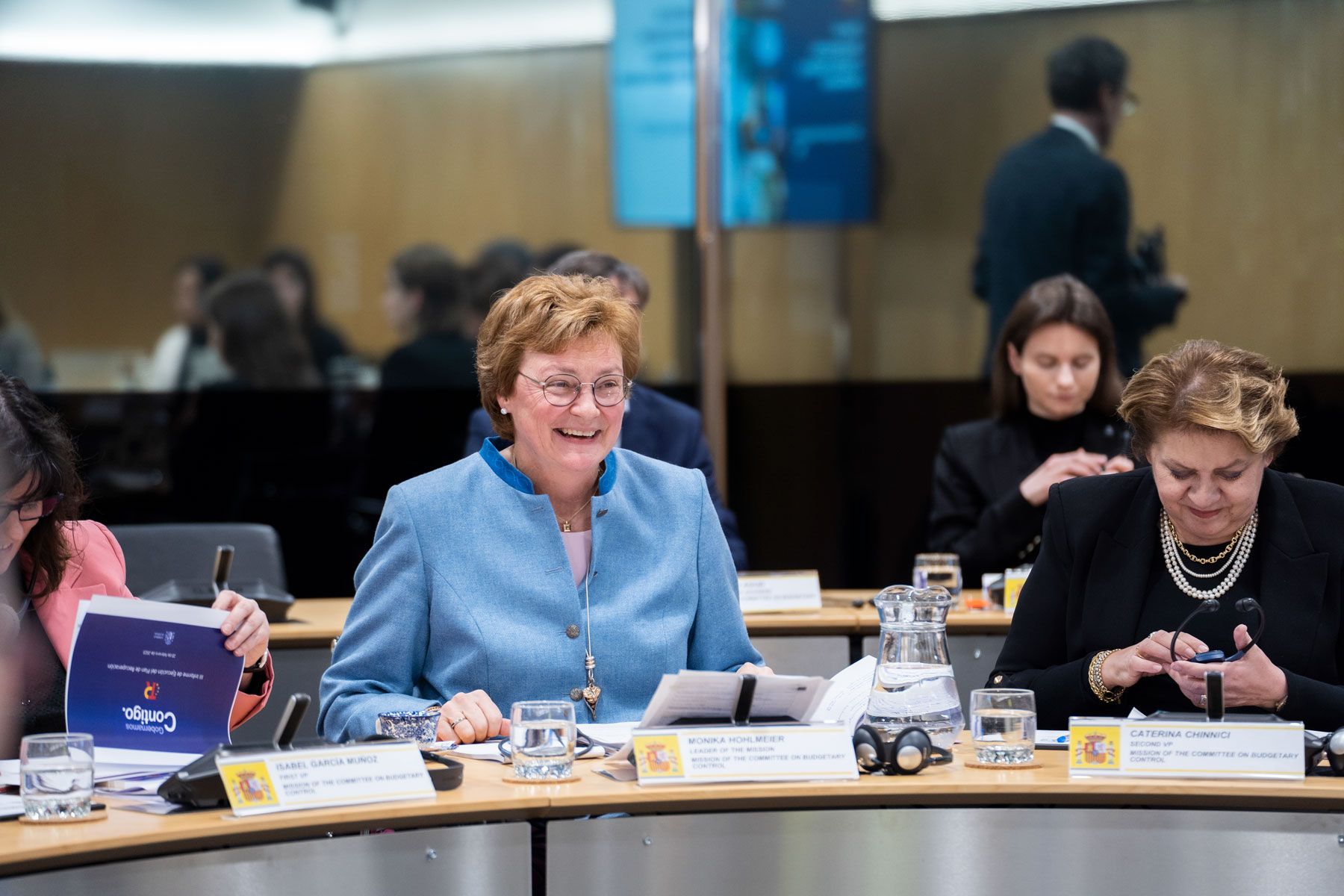
The delegation met with members of the Spanish Government, including Nadia Calvinho, First Vice-President and Minister of Economy and Digital Transformation; María Jesús Montero, Minister of Finance and Public Administrations; and José Luis Escrivá, Minister of Inclusion, Social Security and Immigration. They also met with parliamentarians from Castilla-La Mancha, Madrid, Extremadura, Andalusia and Aragon, as well as representatives of employers’ and workers’ associations, digital stakeholders, companies and consultancies. The agencies exchanged views and joined the investigative reporters. MEPs also learned about a project funded by the National Recovery Programme: the Spanish National Neurotechnology Centre.
At the closing press conference, Monika Hohlmeier (EPP, DE), speaking on behalf of the delegation, highlighted that Spain was the first country to receive results-based payments from the Recovery and Resilience Fund (RRF) and that “it is a leading country in implementation”. Hohlmeier reiterated that the objective of the BCC in Spain is “to understand how the intermediate goals and objectives of the RRF are achieved, how they are met and how the full use of the funds and the protection of EU financial resources interests are ensured”.

A delegation of MEPs will travel to Madrid today to assess the use of recovery funds |
Transparency and control
On transparency and availability of information on project payments and reforms, according to Hohlmeier, the delegation found that “data is available but difficult to find for the public and journalists” and recommended that the Spanish authorities provide “more timely, structured and accessible” information, including information on dissemination and on the final recipients of the funds”.
The delegation acknowledged the “great efforts of the Spanish authorities” to set up the internal control system (COFFEE) and the system for preventing conflicts of interest (Minerva), which were “operational, functional and mostly implemented”, and recommended facilitating their interoperability with other systems and ensuring that they “contribute to the publication of useful data at a wider level”.
In addition, MEPs called on the Spanish authorities to give permanent access to the control systems to the European Court of Auditors, and stressed their confidence in the “close cooperation of the Spanish authorities” with the European Public Prosecutor’s Office and the European Anti-Fraud Office regarding their access to data and reporting of suspected offences related to the MRRF.
Administrative burden
Referring to conversations with regional governments, civil society, business and other partners, she pointed to complaints on administrative burdens and complex tenders. She stressed the need to ensure that “funds reach the citizens and the economy in a quick, safe and performing way”.
They called to remove impediments to “give more support to the self-employed and small and medium enterprises”, which play a key role in the Spanish economy, and guarantee their “fair, fast and comprehensive access” to RRF funds “without endangering the financial interest of the EU”.
Cooperation with regional governments
In the name of MEPs delegation she called on the central and regional governments to deepen the dialogue and cooperation in the design and implementation of the RRF, “in order to ensure the success of this instrument”.
Zero-tolerance to corruption
On behalf of the Budgetary Control committee, she referred to the recent changes in Spanish penal code and asked the Spanish government “to guarantee that its legislation is aligned with this principle of zero tolerance against corruption and to ensure that there is no exception”.
Spain Neurotech Center
She finally referred to MEPs visit to Spain Neurotech Center as “a great example of collaboration and success at all levels”. “This project, with substantive funding from the three sources, and future funding from public and private sources, including 200 million more, will create a lighthouse project with international relevance for the Union”.
More information
Publicaciones relacionadas:
 Nearly 70 billion euros in Spain’s Recovery Plan
 EU’s long-term budget
 Statement by the EC on the proposal made by France and Germany
 Economic and Investment Plan to support the economic recovery and convergence of the Western Balkans
 Agreement between the European Parliament and EU Member States on Europe’s next long-term budget and NextGenerationEU
Leave a Reply