
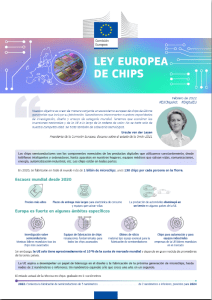
The Council and the European Parliament have reached a provisional political agreement on the regulation to strengthen Europe’s semiconductor ecosystem, better known as the ‘Chips Act’. The deal is expected to create the conditions for the development of an industrial base that can double the EU’s global market share in semiconductors from 10% to at least 20% by 2030.
The three pillars
The Commission proposed three main lines of action, or pillars, to achieve the Chips’ Act objectives
- The “Chips for Europe Initiative”, to support large-scale technological capacity building
- A framework to ensure security of supply and resilience by attracting investment
- A Monitoring and Crisis Response system to anticipate supply shortages and provide responses in case of crisis.
The Chips for Europe Initiative is expected to mobilise €43 billion in public and private investments, with €3,3 billion coming from the EU budget. These actions will be primarily implemented through a Chips Joint Undertaking, a public-private partnership involving the Union, the member states and the private sector.
Ley Europea de Chips
|
Main elements of the compromise
On pillar one, the compromise reached today reinforces the competences of the Chips Joint Undertaking which will be responsible for the selection of the centres of excellence, as part of its work programme.
On pillar two, the final compromise widens the scope of the so called ‘First-of-a-kind’ facilities to include those producing equipment used in semiconductor manufacturing. ’First-of-a-kind’ facilities contribute to the security of supply for the internal market and can benefit from fast-tracking of permit granting procedures. In addition, design centres that significantly enhance the Union’s capabilities in innovative chip design may receive a European label of ‘design centre of excellence’ which will be granted by the Commission. Member states may apply support measures for design centres that receive this label according to existing legislation.
The compromise also underlines, the importance of international cooperation and the protection of intellectual property rights as two key elements for the creation of an ecosystem for semiconductors.

The Chip Act to secure EU digital sovereignty |
Budget
A new semiconductor objective is created within the Digital Europe Programme which will support capacity building in the Chips-sector and funds are also mobilised within the research framework Horizon Europe, amounting to a total of €3.3 billion for the ‘Chips for Europe Initiative’. The financing solution was found within the limits of the existing interinstitutional agreement on the Multiannual Financial Framework and comes on top of resources already allocated to similar objectives within the MFF and through the digital strand in the Recovery and Resilience Facility.
More information: European Council
Publicaciones relacionadas:
 New EU mechanism to protect local craft and industrial products
 303 workers made redundant from Alu Ibérica in Galicia receive 1.2 million euros in aid
 EUROPEAN AGENDA: Internal Market & Industry
 Europe’s raw materials supply: Commission announces actions to make supply more secure and sustainable
 Updating the 2020 Industrial Strategy
Leave a Reply