• Skip to primary navigation
  • Skip to main content
  • Skip to primary sidebar
  • Skip to footer
  • Bluesky
  • Facebook
  • Instagram
  • Twitter
  • YouTube
CDE Almería – Centro de Documentación Europea – Universidad de Almería

CDE Almería - Centro de Documentación Europea - Universidad de Almería

Centro de Documentación Europea de la Universidad de Almería

  • HOME
  • WHAT´S ON
    • EU NEWS
    • Activities
    • EU Calls and Awards
    • Radio Program «Europe with You»
  • DOCUMENTATION
    • EU Media Collection
      • Web Space
      • MEDIATHEQUE REPOSITORY
  • Europe on the net
    • Institutions
    • EU Representation in Spain
    • European information network of Andalusia
  • ABOUT US
    • Presentation
    • Services
    • People
    • Contact
  • Spanish
  • English

Subjective poverty in the European Union is higher among people with lower educational attainment

Inicio » Noticias UE » Research and Innovation » Subjective poverty in the European Union is higher among people with lower educational attainment

22 de November de 2023

In 2022, almost one third (29.5%) of the EU population with a low educational attainment level (International Standard Classification of Education (ISCED), levels 0-2) was considered poor.

The rate was more than 3 times lower (9.2%) for people with high education (ISCED levels 5-8) while the share for people with a medium educational attainment level (ISCED levels 3 and 4) was 18.0%.

26 EU members reported higher rates of people with a low education level who are considered poor, compared with people with medium and high education levels. Finland was the exception, with a slightly higher rate among people with a medium education level.
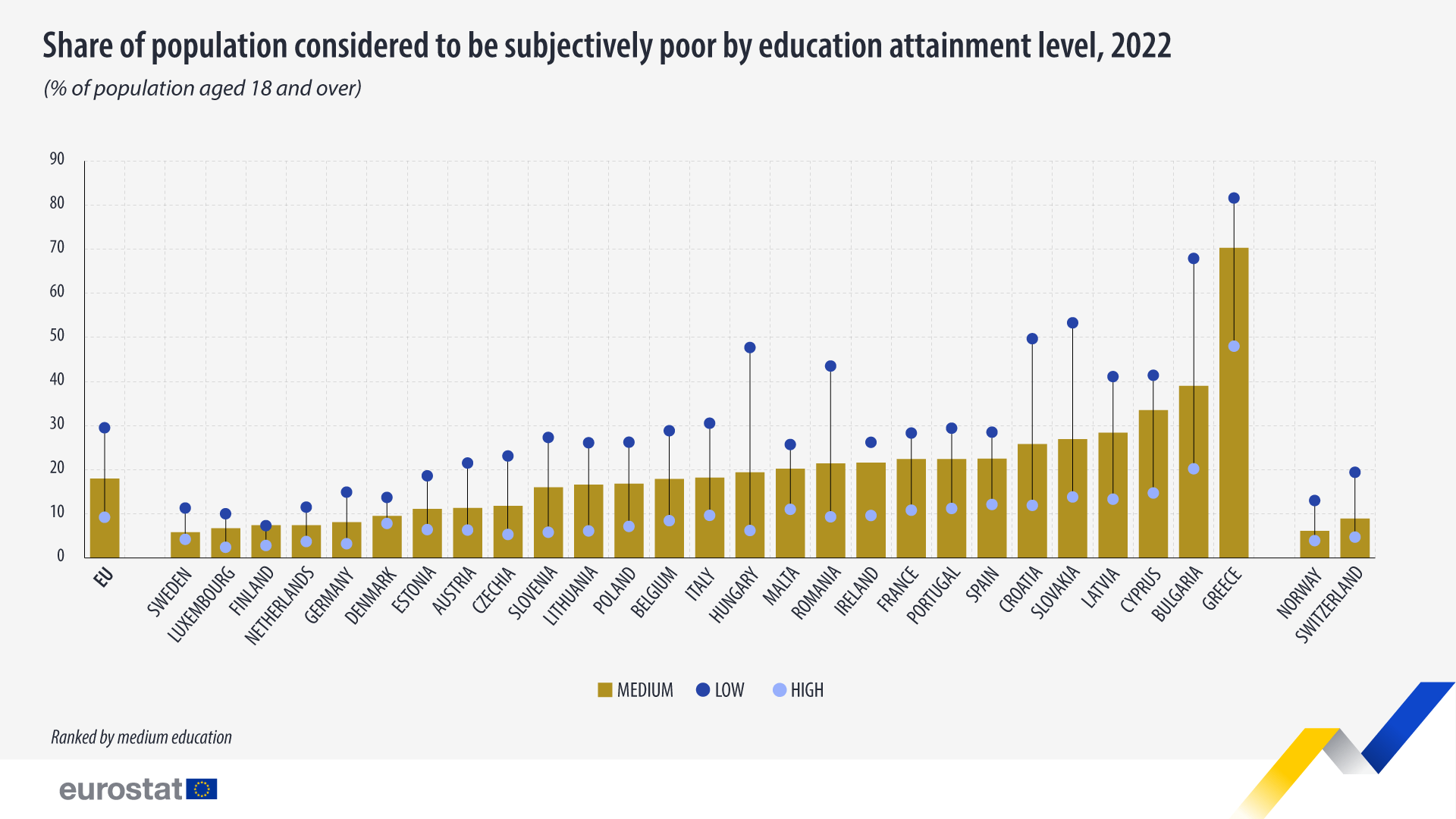
Among the EU countries, Greece had the highest share of people with a low education level (four fifths; 81.6%) considered poor. This was followed by Bulgaria (67.9%) and Slovakia (53.3%). The lowest numbers were registered in Finland (7.3%), Luxembourg (10.0%) and Sweden (11.3%).

Most of the EU members reported significant differences between high and low-educated population groups. The difference was at least 20 percentage points (pp) in 12 countries. The most notable differences were in Bulgaria (47.7 pp), Hungary (41.5 pp) and Slovakia (39.5 pp) and the lowest in Finland (4.5 pp), Denmark (5.9 pp) and Sweden (7.1 pp).

The EU Commission calls for more effective support to fight poverty and promote employment

More information: Eurostat

Publicaciones relacionadas:

International Day of Human Space Flight: The challenges of long-term space travel cyber-security-EU-ENISABoosting the EU’s research and innovation potential with a state-of-the-art IT ecosystem Establishing a culture of research integrity with innovative educational methods Upskilling for life after the pandemic: Commission launches new digital competence guidelines Conference on the Future of Europe: launch of the multilingual digital platform




Education and Culture,  EU News,  Research and Innovation Eurostat,  lower educated,  Poverty,  Subjective poverty

“This is a space for debate. All comments, for or against publication, that are respectful and do not contain expressions that are discriminatory, defamatory or contrary to current legislation will be published”.

Reader Interactions

Leave a Reply Cancel reply

Your email address will not be published. Required fields are marked *

This site uses Akismet to reduce spam. Learn how your comment data is processed.

Primary Sidebar

Footer

  • CDE Almería
  • Biblioteca Nicolás Salmerón – Universidad de Almería
  • Planta: 1ª, Despacho: 1.05.0B.
  • Ctra. Sacramento s/n. Almería (Spain)
  • Teléfono: (+34) 950 015266

HOME
NEWS
DOCUMENTATION
EUROPE ON THE NET
ABOUT US

  • LEGAL NOTICE
  • PRIVACY POLICY
  • COOKIE POLICY
  • ACCESSIBILITY
  • SITEMAP

Copyright © 2026 CDE Almería · Creative Commons LicenseThis work is licensed under a Creative Commons Attribution-NonCommercial 4.0 International License.

<p>El Centro de Documentación Europea de la Universidad de Almería utiliza cookies propias y de terceros para facilitar al usuario la navegación en su página Web y el acceso a los distintos contenidos alojados en la misma. Asimismo, se utilizan cookies analíticas de terceros para medir la interacción de los usuarios con el sitio Web. Pinche el siguiente enlace si desea información sobre el uso de cookies y como deshabilitarlas. </p>

Politica de privacidad

El Centro de Documentación Europea de la Universidad de Almería utiliza cookies propias y de terceros para facilitar al usuario la navegación en su página Web y el acceso a los distintos contenidos alojados en la misma. Asimismo, se utilizan cookies analíticas de terceros para medir la interacción de los usuarios con el sitio Web. Pinche el siguiente enlace si desea información sobre el uso de cookies y como deshabilitarlas. <a href="/politica-de-cookies" rel="noopener" target="_blank">Más información</a>

Cookies estrictamente necesarias

Las cookies estrictamente necesarias tiene que activarse siempre para que podamos guardar tus preferencias de ajustes de cookies.

Básicamente la web no funcionara bien si no las activas.

Estas cookies son:

  • Comprobación de inicio de sesión.
  • Cookies de seguridad.
  • Aceptación/rechazo previo de cookies.
Cookies de terceros

Esta web utiliza Google Analytics, Google Tag Manager y Yandex Metrika para recopilar información anónima tal como el número de visitantes del sitio, o las páginas más populares.

Dejar estas cookies activas nos permite mejorar nuestra web.

Política de cookies

Pinche el siguiente enlace si desea información sobre el uso de cookies y como deshabilitarlas. Más información