
At the last plenary session of the Congress of Deputies, the Organic Law on Measures for the Efficiency of the Public Justice Service and theLaw establishing a Supplementary Tax to guarantee an overall minimum level of taxation for multinational groups and large national groups, a Tax on the interest and commission margins of certain financial institutions and a Tax on liquids for electronic cigarettes and other tobacco-related products, and amending other tax regulations, both of which include the transposition into Spanish law of European directives aimed at standardising the taxation of tobacco products.the transposition into Spanish law of European directives aimed at standardising the tax rate for multinational companies in the EU and reinforcing the protection of consumer interests.
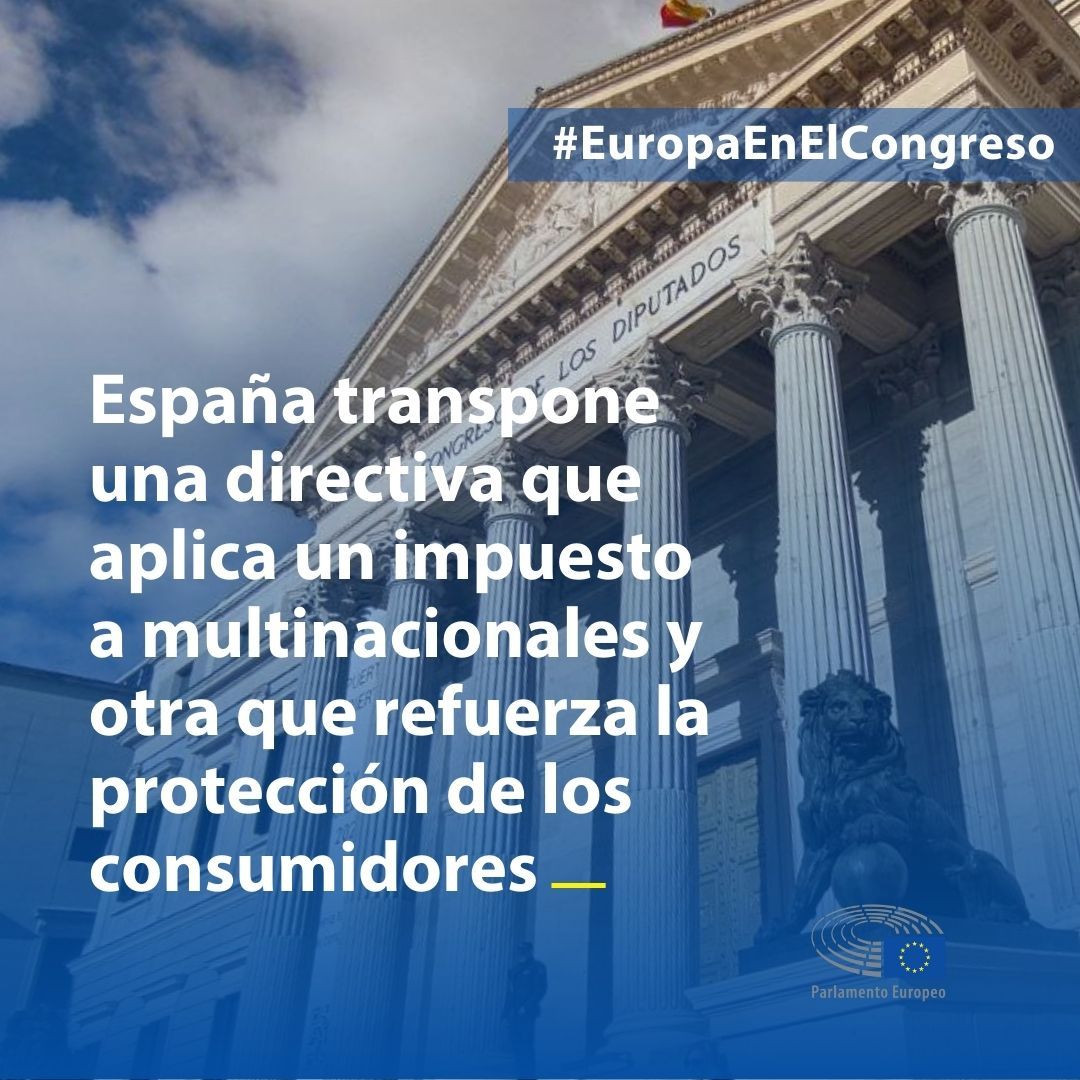
Tax on multinationals
The plenary has given the green light to the law transposing Directive (EU) 2022/2523, which establishes an overall minimum tax rate of 15% for large multinational and national groups of companies in the European Union. According to European legislation, “when the effective tax rate” of these business groups “is lower than 15%, an additional tax shall be levied”, and allows Member States to “apply a supplementary national tax on entities established in their territory”.
The overall minimum tax rate of 15% will apply to companies or corporate groups with a net turnover of 750 million euros or more.
In this way, the European Directive aims to help combat aggressive tax planning by large companies, preventing them from shifting profits to low or non-taxed territories, thus damaging the income of the country of origin.
Consumer protection
The Organic Law on Measures for the Efficiency of the Public Justice Service, which reforms judicial organisation, introduces collective actions in defence of consumers and promotes alternative methods of conflict resolution, has also been definitively approved.
Among the measures proposed to bring the judicial system closer to citizens, the Law proposes the creation of Courts of First Instance, which will replace the current single-person courts, and justice offices in small municipalities and rural areas so that citizens can carry out procedural procedures from their locality, without having to travel to the court of first instance.
The Law also implements collective actions for the defence of consumers: to this end, it transposes Directive (EU) 2020/1828 which ensures that all Member States have at least one effective procedural mechanism for consumer organisations to bring actions against companies that infringe EU consumer law.
Finally, the new Organic Law includes Alternative Dispute Resolution (ADR) methods to encourage negotiation between the parties to a dispute and ease the workload of courts and tribunals.
More information: European Parliament.
Publicaciones relacionadas:
 Final vote on the Digital Services Act and the Digital Markets Act
 European Parliament identifies worrying trends in rule of law on specific issues affecting Spain, Greece and Malta
 European Commission publishes April infringement proceedings package for Spain
 European Parliament approves Europe’s first ever rules on crypto-assets
 Spain amends tax law to improve European tax cooperation
Leave a Reply