
Belgium holds the presidency of the Council of the European Union in the first half of 2024, from 1 January to 30 June. Here are the six priorities of the Belgian presidency for this semester.

Defending rule of law, democracy, and unity
The European Union is based on the respect for fundamental rights, the rule of law and democratic values, paving the way for cohesion, the protection of individual freedoms, equality and non-discrimination, and our citizens’ well-being. Defending the principles of democracy, the rule of law and fundamental rights will be an essential element in the work of the Belgian Presidency of the Council.
The Presidency will strengthen the empowerment and inclusion of citizens, with a special focus on youth participation, as well as work on the European education area, quality of education, lifelong learning, mobility and sport. It will promote democratic values by reinforcing media freedom and pluralism, stimulating the digital transformation of the cultural and creative sectors, and exploring the links between culture, heritage and European identity. In this regard, working together at different levels of government will enable us to respond effectively to a diverse range of needs and challenges, while respecting the principles of subsidiarity and proportionality.
Enlarging our Union must make us all stronger. The Presidency is therefore committed to support candidate countries in their efforts to join our Un-ion. At the same time, it will be crucial to prepare the Union’s policies, resources, and decision-making structures in view of future accessions.
Strengthening our competitiveness
In light of evolving geopolitical realities and the rapid development of new technologies such as artificial intelligence, the EU must prioritise its long-term competitiveness and industrial policies. The EU must ensure a level playing field for businesses, especially SMEs, enabling them to compete fairly both within Europe and on the global stage. A coherent, predictable and simplified regulatory framework is key. The EU must lead the way in creating a sustainable, innovative, and resilient digital ecosystem that empowers citizens and benefits businesses.
The Belgian Presidency will work to strengthen the EU’s internal market and industrial future and continue the work to complete the capital markets union and the energy union. Particular attention will be given to enhancing our economic security, reducing harmful dependencies, and promoting our technological leadership in critical sectors.
The Presidency aims to enhance the role of research, development, and innovation to become a frontrunner in developing and commercialising tailored solutions that boost key EU value chains’ resilience and competitiveness. It will work towards a labour market shaped for the future that enhances employment rates and stimulates growth. It will underscore the significance of both public and private investments. It will also underscore the significance of cohesion policy as an essential long-term investment instrument, as a catalyst for transformation and convergence, and as cement for the European Union. It will pay specific attention to our food production autonomy. The Presidency will focus on coherence between the EU’s internal and external policies.
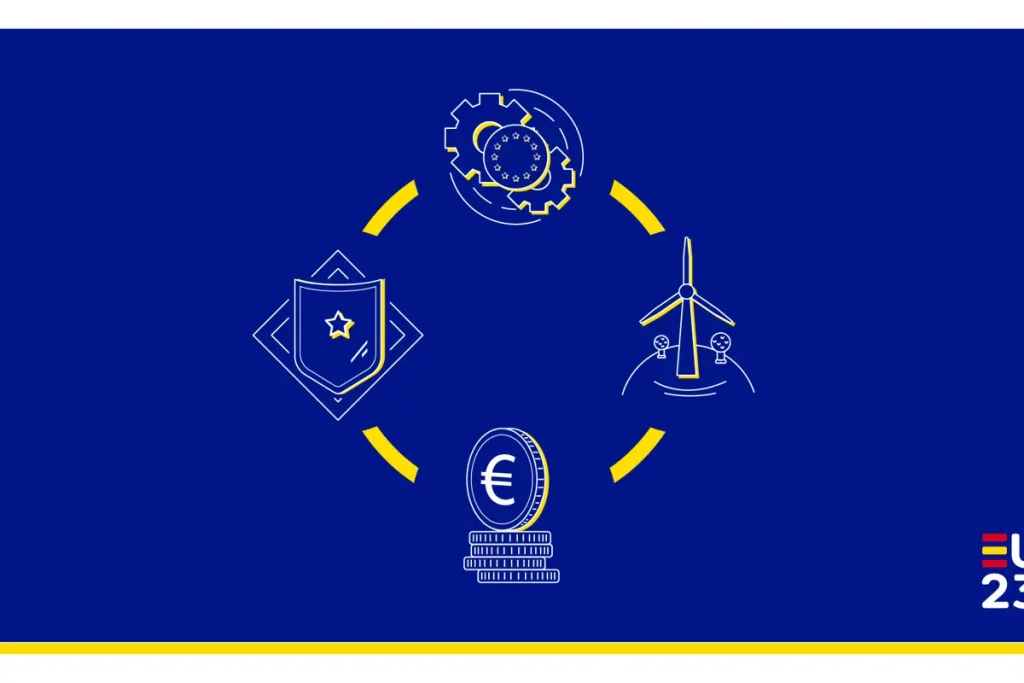
Priorities of the Spanish Presidency of the Council of the European Union |
Pursuing a green and just transition
The EU’s ambitious transition agenda is driven by the urgent need to address the triple crisis of climate change, biodiversity loss, and pollution. The Belgian Presidency underscores the importance of decisive and holistic action, leaving no one behind.
Carrying on with the Green Deal, the Presidency will place the energy and climate transition at the heart of its priorities. To reduce vulnerabilities to climate change, the Presidency will strive to enhance the Union’s circular economy and adaptive and preparedness capacities. It will also promote sustainable water management.
Geopolitical and extreme climate events have highlighted the need for an accelerated and inclusive energy transition. This transition should deliver affordable energy to citizens and companies, ensure strong and reliable security of supply, and contribute to the objective of climate neutrality. The EU must fully leverage its energy efficiency potential across the entire economy and rapidly advance the development of renewable and low-carbon energy sources and carriers. Increased investments to deliver a flexible, integrated European energy network are essential to this end.
Reinforcing our social and health agenda
Building on the European Pillar of Social Rights, the Belgian Presidency aims to equip the EU with an ambitious social agenda to foster a European society that is more inclusive, gender-equal and fair for all.
The Presidency will seek to strengthen social dialogue at all levels, promote fair labour mobility, mental health at work as well as access to sustainable social protection. It aims to strengthen the social dimension of the European semester – with particular attention to the first implementation of the Social Convergence Framework and the potential of social investments – and to promote a framework conducive to the development of the social economy. The Presidency will also advocate for increased political actions in order to guarantee access to decent and affordable housing for all.
Furthermore, the Presidency will support the evaluation of the EU’s crisis preparedness, strengthen the security of medicines supply, and develop a strategy to boost the EU’s health and care workforce. To improve citizens’ access to affordable medicines, the Presidency will work to better address unmet medical needs.
Protecting people and borders
The Presidency aims to address all remaining legislative files associated with the new European pact on migration and asylum. The Pact will reinforce trust between Member States in a spirit of responsibility and solidarity, bring legal clarity to people arriving in the EU, and ensure EU citizens of the humane and effective management of migration, in line with our values and international law. It will also offer a common and fast reaction to migration crises and improve legal pathways to the EU.
The Presidency will work to strengthen the external dimension of migration and asylum, especially by working closely with our African partners, as part of our broader effort to continue to develop a mutually beneficial partnership between our two continents, in full respect of international law.
The Presidency will pay particular attention to the fight against organised crime, preventing and tackling terrorism and violent extremism, and bolstering the EU’s resilience to crises and to new and hybrid challenges.
Safeguarding our citizens necessitates discussions on the future of European security and defence, moving towards a more integrated Union approach. The focus will be on strengthening the European defence technological and industrial base, including by exploring the possibility of developing a European Defence Industry Strategy.
Promoting a global Europe
The multilateral system and the rules-based international order face increasing strain from geopolitical confrontation, including the return of open war on the European continent. To adapt to this reality, the Presidency will vigorously pursue the efforts made by the EU to strengthen its resilience and autonomy and defend its interests and values.
In this more assertive approach, the Presidency will also emphasise that openness, dialogue, and cooperation are at the heart of the EU’s conception of its interests. To achieve its foreign policy goals, the EU must fully mobilise its economic, security and defence capabilities, as well as its development and humanitarian assistance capacity. This includes an ambitious and balanced trade policy that is open, sustainable and assertive. This will require a reinforced rules-based multilateral trading system. In line with the 2030 Agenda, the Presidency will promote health care system strengthening as a basis to reach universal health coverage, while ensuring equitable access to innovative, resilient, sustainable, and high-quality health care services and products for all.
More information: Belgian presidency
Publicaciones relacionadas:
 President von der Leyen and the College of Commissioners will participate in the inauguration of the Spanish Presidency of the Council of the EU in Madrid
 Get involved in the State of the European Union – 16 September 2020
 SOTEU 2020: President Von der Leyen sets the course for Europe
 Main results of the European Council, 10-11 December 2020
 How Maastricht changed Europe
Leave a Reply