
Following up rapidly on the REPowerEU Communication and the Versailles Declaration, the Commission has set out ideas last 23rd March, for collective European action to address the root causes of the problem in the gas market and ensure security of supply at reasonable prices for next winter and beyond. Leaders will continue the discussion on these options at this week’s European Council.
Commissioner for Energy, Kadri Simson, said: “Global and European energy markets are going through turbulent times, particularly since the Russian invasion of Ukraine. Europe needs to take swift action to ensure our energy supply for next winter, and to alleviate the pressure of high energy bills on our citizens and businesses. Today’s proposals are another step forward in our intensive work on this front.”
The Commission is tabling a legislative proposal today, introducing a minimum 80% gas storage level obligation for next winter to ensure security of energy supply, rising to 90% for the following years. To address concerns about continued high energy prices, the Commission has also adopted a Communication setting out the options for market intervention at European and national level, and assessing the pros and cons of each option.
EU partnerships with third countries to collectively purchase gas and hydrogen can improve resilience and bring down prices. The Commission stands ready to create a Task Force on common gas purchases at EU level. By pooling demand, the Task Force would facilitate and strengthen the EU’s international outreach to suppliers to help secure well-priced imports ahead of next winter. The Task Force would be supported by Member States representatives in a Steering Board. A joint negotiation team led by the Commission would hold talks with gas suppliers, and would also prepare the ground for future energy partnerships with key suppliers, looking beyond LNG and gas. It would be inspired by the experience from the COVID-19 pandemic, where EU wide action was crucial to guarantee sufficient supplies of vaccines for all.
A legislative proposal for securing winter gas storage
The Commission has accelerated its work since the Versailles Summit and presented today a legislative proposal requiring Member States to ensure that their underground gas storage is filled up to at least 80% of capacity by 1 November 2022, rising to 90% for the following years, with intermediary targets from February to October. Operators of storage sites should report the filling levels to national authorities. Member States should monitor the filling levels on a monthly basis and report to the Commission.
Gas storage facilities are critical infrastructure to ensure security of supply. A new mandatory certification of all storage system operators will avoid potential risks resulting from outside influence over critical storage infrastructure, meaning that non-certified operators will have to give up ownership or control of EU gas storage facilities. In addition, for a gas storage facility to close down its operations it would need to have an authorisation from the national regulator. To incentivise the refilling of EU gas storage facilities, the Commission is proposing a 100% discount on capacity-based transmission tariffs at entry and exit points of storage facilities.
Emergency measures on energy prices and gas storage
The Commission has been taking action since last Summer to mitigate the impact of high energy prices on households and businesses. Two weeks ago, President von der Leyen committed to present concrete exceptional short-term options by the end of the month to tackle the contagion of gas prices on the electricity market. The Commission has brought forward its work to feed into this week’s meeting of the European Council, and presented today a Communication setting out those options.
Several options for emergency measures to limit the impact of high electricity prices have been put forward by Member States. However, all options on the table carry costs and drawbacks. The short-term options on the electricity price can be broadly grouped in two categories:
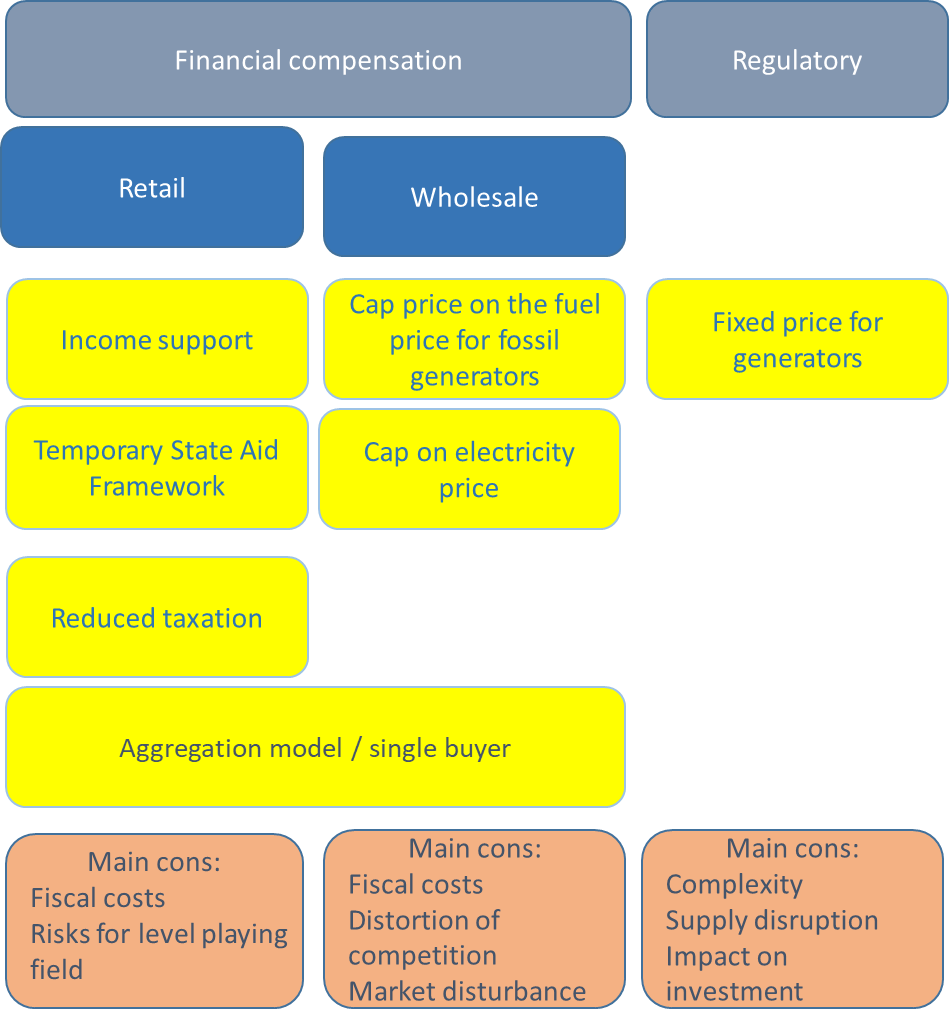
As the Communication notes, there is no single easy answer to tackle high electricity prices, given the diversity of situations among Member States in terms of their energy mix, market design, and interconnection levels. The Commission is laying out the pros and cons of different approaches for the further consideration of European Leaders, and is ready to take forward its work as appropriate. While many of the options above address the symptoms, it is important to tackle the root causes of the current high electricity prices, with collective European action on the gas market.
The Commission will table its detailed REPowerEU plan and assess options to optimise the electricity market design in May, and stands ready to propose an EU energy savings plan. The Commission is also considering providing guidance to Member States on how to make best use of targeted country-specific derogations under the Energy Taxation Directive.
Source: European Commission
Publicaciones relacionadas:
 EU mobilises €10 million more to respond to severe Desert Locust outbreak in East Africa
 E-commerce: Council adopts new rules for exchange of VAT payment data
 The European Commission welcomes the cooperation agreement concluded between the European Central Bank, the Eurosystem and Sveriges Riksbank
 Commission and European Investment Fund unlock €8 billion in finance for 100,000 small and medium-sized businesses
COVID-19: statement of EU ministers of finance on continuing bank lending and on maintaining a well-functioning insurance sector
Commission and European Investment Fund unlock €8 billion in finance for 100,000 small and medium-sized businesses
COVID-19: statement of EU ministers of finance on continuing bank lending and on maintaining a well-functioning insurance sector
Leave a Reply