
On Tuesday, MEPs backed plans to secure the EU supply of chips by boosting production and innovation, and setting up emergency measures against shortages.
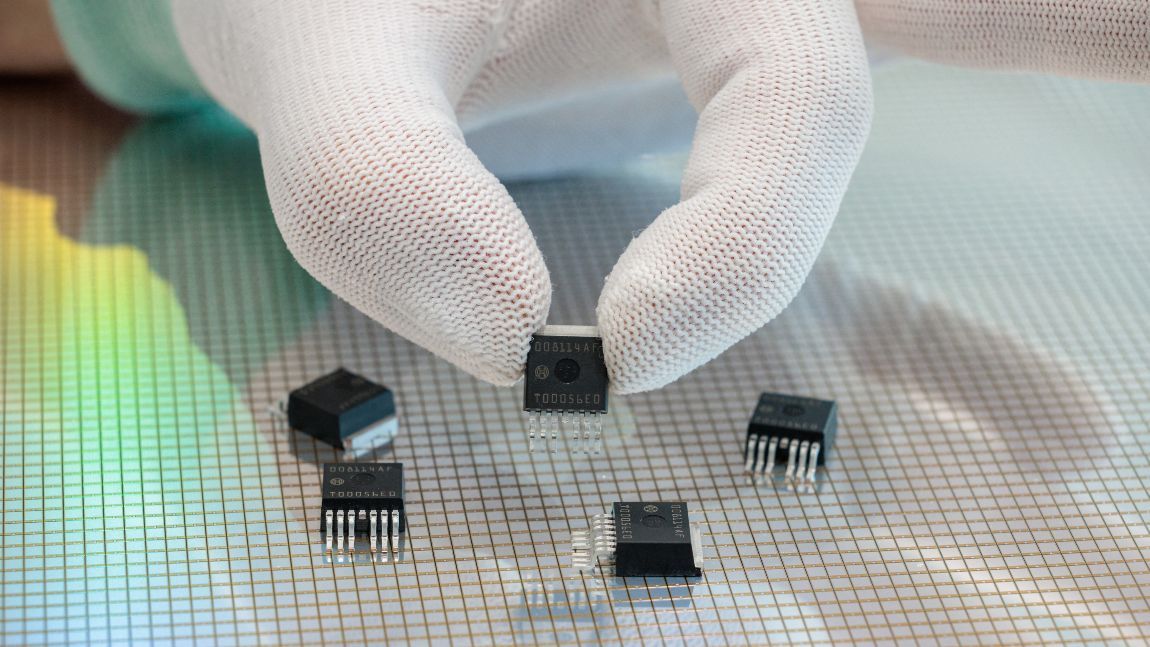
The Industry and Energy Committee adopted two draft bills: one on the “Chips Act” that aims to bolster technological capacity and innovation in the EU Chips ecosystem and a second one on the Chips Joint Undertaking to increase investments for developing this type of European ecosystem.
In their amendments to the Chips Act, MEPs focussed more on next-generation semiconductor and quantum chips. A network of competence centres would be created to address the skills shortage and attract new talent on research, design and production. The legislation would also support projects aiming to boost the EU’s security of supply by attracting investment and building up production capacity.

EU-US Trade and Technology Council addresses common challenges and responds to global crises |
Measures to respond to future shortages
A crisis response mechanism would be set up, with the Commission assessing the risks to the EU supply of semiconductors and early warning indicators in member states that could trigger an EU-wide alert. This would allow the Commission to implement emergency measures such as prioritising the supply for products particularly affected, or carry out common purchasing for member states. MEPs stress that the chips supply chain should be mapped out to identify possible bottlenecks.
MEPs also highlight the importance of international cooperation with partners such as the US, Japan, South Korea and Taiwan. The Commission should establish a chips diplomacy initiative to address any future disruption to supply chains.
The legislative report on the Chips Act was adopted with 67 votes in favour to one against, with four abstentions. The committee also voted on the mandate to enter into inter-institutional negotiations with 70 votes to one against, with one abstention.
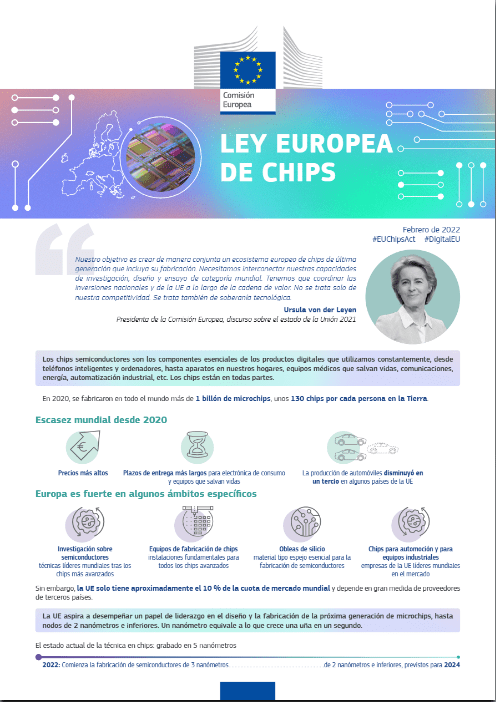
Ley Europea de Chips
|
“Chips for Europe” initiative
In a separate vote, MEPs adopted with 68 votes in favour, none against and four abstentions, the Chips Joint Undertaking proposal, implementing the measures foreseen under a “Chips for Europe” initiative. The scheme aims to support large-scale capacity building through investment into EU-wide and openly accessible research, development and innovation infrastructure. It would also enable the development of cutting-edge and next-generation semiconductor technologies. MEPs highlight that to boost innovation, fresh money will be needed, as well as a reallocation of funds from Horizon Europe.
Quotes
Rapporteur on the Chips Act Dan Nica (S&D, RO) said: “We want the EU Chips Act to establish Europe as an important player in the global semiconductors arena. Not only does the budget need to be commensurate with the challenges and funded through fresh money, but we want to ensure that the EU is leading in research and innovation, that it has a business-friendly environment, a fast permitting process and invests in a skilled work force for the semiconductor sector. Our goal is to ensure growth in Europe, prepare for future challenges and have in place the right mechanisms for future crises”.
Rapporteur on the Chips Joint Undertaking Eva Maydell (EPP, BG) said: “Microchips are integral to the EU’s digital and green transitions as well as our geopolitical agenda. We are calling for fresh funding that reflects the strategic importance of Europe’s Chips sector. Europe’s partners and competitors are also investing heavily in their semiconductor facilities, skills and innovation. We may not have the enormous financial firepower of the US, but the budget offered by the Commission and Council needs to reflect the seriousness of the challenge”.
Next steps
On the Chips Act, the mandate for negotiations will be announced at the opening of the 13-16 February plenary session in Strasbourg. If there is no request to put the decision to enter into negotiations to the plenary vote, Parliament will be able to start talks with the Council. Parliament will hold a vote on the Chips Joint undertaking proposal during the same session.
More information: European Parliament





Leave a Reply