• Skip to primary navigation
  • Skip to main content
  • Skip to primary sidebar
  • Skip to footer
  • Bluesky
  • Facebook
  • Instagram
  • Twitter
  • YouTube
CDE Almería – Centro de Documentación Europea – Universidad de Almería

CDE Almería - Centro de Documentación Europea - Universidad de Almería

Centro de Documentación Europea de la Universidad de Almería

  • HOME
  • WHAT´S ON
    • EU NEWS
    • Activities
    • EU Calls and Awards
    • Radio Program «Europe with You»
  • DOCUMENTATION
    • EU Media Collection
      • Web Space
      • MEDIATHEQUE REPOSITORY
  • Europe on the net
    • Institutions
    • EU Representation in Spain
    • European information network of Andalusia
  • ABOUT US
    • Presentation
    • Services
    • People
    • Contact
  • Spanish
  • English

International Day for the Elimination of Racial Discrimination

Inicio » EU News » Social Affairs » Equality » International Day for the Elimination of Racial Discrimination

21 de March de 2024

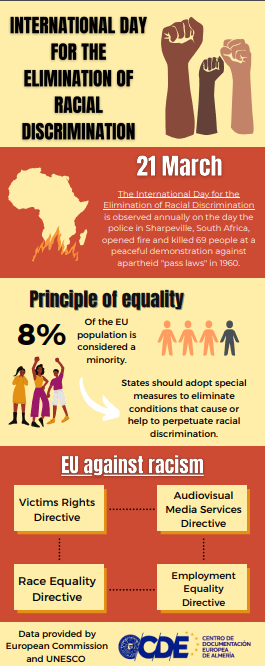
The International Day for the Elimination of Racial Discrimination commemorates the victims of the Sharpeville massacre of 21 March 1960, in which peaceful demonstrators against apartheid were senselessly killed. While this tragic event marked a turning point and ultimately ushered in the transition to democracy and equality in South Africa, the fight against racism continues to this day, everywhere.

Racial discrimination not only inflicts profound harm on individual victims, but also undermines the very fabric of peaceful and democratic societies. In a year where more than 2 billion voters are set to go to the polls it remains particularly important to address racial discrimination in the context of elections. Comprehensive efforts are required to safeguard voting rights, enhance diversity in political representation and fight hate speech on the campaign trial.

Our work needs to start at home. While the European Union unequivocally prohibits discrimination based on racial or ethnic origin, recent reports from the EU Agency for Fundamental Rights reveal distressing levels of such discrimination within our societies. The EU Anti-Racism Action Plan 2020-2025 calls for enhanced enforcement of European law and concrete measures defined in national action plans. The EU Anti-Racism Coordinator remains essential to this joint work, alongside the full and meaningful participation of civil society.

Concerted action is needed from all of us to convert our legal frameworks into lived realities, in particular to ensure full implementation of the International Convention on the Elimination of All Forms of Racial Discrimination (ICERD). Around the world, our EU Delegations serve as our advocates on the ground and actively contribute to endeavours aimed at realising this obligation.

In far too many places, racial discrimination continues to erode the foundations of peace and security, by fuelling conflict, inequality and injustice. Every member of society benefits when racism is eradicated. On this day, let us renew our collective commitment to stand against racial discrimination in all its forms.
More information

Council of the European Union

Infographic – CDE Almería

Publicaciones relacionadas:

Día Internacional de la mujerInternational Women’s Day 2020: Beijing Declaration 25 years after planeta mundo worldCountries led by women coped better with COVID-19 igualdad de género , UE , Europa , políticaImpact of gender quotas on EU politics and business Spotlight initiative provides data on violence against young people in Honduras banderas paísesWorld Cup in Qatar: FIFA should help compensate families of dead migrant workers




Equality,  EU News,  Institutional Affairs Consejo Europeo,  council of the european union,  European Council,  intertational day,  Racism

“This is a space for debate. All comments, for or against publication, that are respectful and do not contain expressions that are discriminatory, defamatory or contrary to current legislation will be published”.

Reader Interactions

Leave a Reply Cancel reply

Your email address will not be published. Required fields are marked *

This site uses Akismet to reduce spam. Learn how your comment data is processed.

Primary Sidebar

Footer

  • CDE Almería
  • Biblioteca Nicolás Salmerón – Universidad de Almería
  • Planta: 1ª, Despacho: 1.05.0B.
  • Ctra. Sacramento s/n. Almería (Spain)
  • Teléfono: (+34) 950 015266

HOME
NEWS
DOCUMENTATION
EUROPE ON THE NET
ABOUT US

  • LEGAL NOTICE
  • PRIVACY POLICY
  • COOKIE POLICY
  • ACCESSIBILITY
  • SITEMAP

Copyright © 2026 CDE Almería · Creative Commons LicenseThis work is licensed under a Creative Commons Attribution-NonCommercial 4.0 International License.

<p>El Centro de Documentación Europea de la Universidad de Almería utiliza cookies propias y de terceros para facilitar al usuario la navegación en su página Web y el acceso a los distintos contenidos alojados en la misma. Asimismo, se utilizan cookies analíticas de terceros para medir la interacción de los usuarios con el sitio Web. Pinche el siguiente enlace si desea información sobre el uso de cookies y como deshabilitarlas. </p>

Politica de privacidad

El Centro de Documentación Europea de la Universidad de Almería utiliza cookies propias y de terceros para facilitar al usuario la navegación en su página Web y el acceso a los distintos contenidos alojados en la misma. Asimismo, se utilizan cookies analíticas de terceros para medir la interacción de los usuarios con el sitio Web. Pinche el siguiente enlace si desea información sobre el uso de cookies y como deshabilitarlas. <a href="/politica-de-cookies" rel="noopener" target="_blank">Más información</a>

Cookies estrictamente necesarias

Las cookies estrictamente necesarias tiene que activarse siempre para que podamos guardar tus preferencias de ajustes de cookies.

Básicamente la web no funcionara bien si no las activas.

Estas cookies son:

  • Comprobación de inicio de sesión.
  • Cookies de seguridad.
  • Aceptación/rechazo previo de cookies.
Cookies de terceros

Esta web utiliza Google Analytics, Google Tag Manager y Yandex Metrika para recopilar información anónima tal como el número de visitantes del sitio, o las páginas más populares.

Dejar estas cookies activas nos permite mejorar nuestra web.

Política de cookies

Pinche el siguiente enlace si desea información sobre el uso de cookies y como deshabilitarlas. Más información