
• Skip to primary navigation
  • Skip to main content
  • Skip to primary sidebar
  • Skip to footer
  • Bluesky
  • Facebook
  • Instagram
  • Twitter
  • YouTube
CDE Almería – Centro de Documentación Europea – Universidad de Almería

CDE Almería - Centro de Documentación Europea - Universidad de Almería

Centro de Documentación Europea de la Universidad de Almería

  • HOME
  • WHAT´S ON
    • EU NEWS
    • Activities
    • EU Calls and Awards
    • Radio Program «Europe with You»
  • DOCUMENTATION
    • EU Media Collection
      • Web Space
      • MEDIATHEQUE REPOSITORY
  • Europe on the net
    • Institutions
    • EU Representation in Spain
    • European information network of Andalusia
  • ABOUT US
    • Presentation
    • Services
    • People
    • Contact
  • Spanish
  • English

How to improve the legal response to the “invisible” victims of femicide

Inicio » EU News » Social Affairs » Equality » How to improve the legal response to the «invisible» victims of femicide

7 de February de 2023


mujer en una vaya con aspecto pensativo

In recent weeks, killings of a woman or girl because of her gender (femicide) in a few EU Member States show the urgency to better respond to this phenomenon.

Today EIGE publishes the report Improving legal responses to counter femicide in the European Union: Perspectives from victims and professionals.

The report follows on EIGE’s package to help EU countries gather solid data to classify and measure femicide.

The spate of femicide cases in 2021 puts victims’ rights into sharp focus

According to UN Women, 45,000 women and girls worldwide were killed by their intimate partners or other family members. This means that, on average, more than five women or girls are killed every hour by someone in their own family.

This needs to change.

The international human rights framework obliges States to follow the due diligence principle when shaping responses to violence against women. This means they must prevent, investigate and punish all acts of violence against women as well as protect the victims and provide holistic reparations to help heal their trauma.
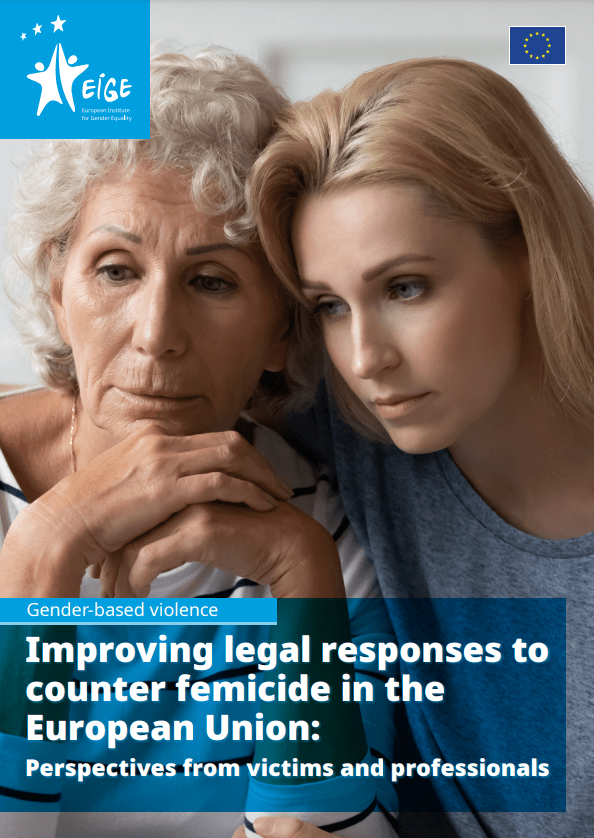
Improving legal responses to counter femicide in the European Union: Perspectives from victims and professionals

But we also need to acknowledge that the victims of femicide go beyond one person

Family members of murdered women – children, parents and other close family members – are hidden in plain sight. However, their experiences with law enforcement and the justice sector are often painful.

This is due to insufficient information on their rights, a lack of victim-oriented, trauma-informed approach and a lack of legal recognition of their role during legal proceedings negatively affecting their access to justice.

In this new report, EIGE gives a voice to both legal professionals and victims who speak about their experiences on what it’s like to deal with the fallout of femicide. Interviews provide an authentic picture into the flaws of the legal systems – such as insufficient immediate action following a report of violence.

To change the way we perceive femicide, legislation must lead by example

Member States can improve legal procedures and reduce the number of victims by:

  • Ensuring a coordinated response to femicide. Member States need to have national strategies on violence against women and develop specific measures to prevent femicide.
  • Strengthening legal responses. Femicide needs to be seen as a separate criminal offence. This entails adopting investigative protocols for law enforcement officers and guidelines for prosecutors.
  • Improving the collection of data on femicide cases. Data is a crucial tool to not only capture the scale of the phenomenon but for designing and monitoring prevention and response measures.
  •  Ensuring full access to compensation and reparation. This includes a victim’s right to money granted by the state when the perpetrator cannot do so, and reparation such as supporting victims to heal their trauma with counselling.
  • Improving the protection of victim’s rights. Ensure that at least the minimum standards on the rights, support and protection of victims established by the victims’ rights directive are fully recognized in the Member States.

More information

EIGE

Publicaciones relacionadas:

Women’s rights in the EU The EU has been awarded for its strategy on gender equality Femicide: Name it, count it, end it! How is gender-based violence addressed in the EU? Eradicating women’s poverty in Europe

Equality,  EU News,  Social Affairs EU,  femicide,  legal,  rights,  victims

“This is a space for debate. All comments, for or against publication, that are respectful and do not contain expressions that are discriminatory, defamatory or contrary to current legislation will be published”.

Reader Interactions

Leave a Reply Cancel reply

Your email address will not be published. Required fields are marked *

This site uses Akismet to reduce spam. Learn how your comment data is processed.

Primary Sidebar

Footer

  • CDE Almería
  • Biblioteca Nicolás Salmerón – Universidad de Almería
  • Planta: 1ª, Despacho: 1.05.0B.
  • Ctra. Sacramento s/n. Almería (Spain)
  • Teléfono: (+34) 950 015266

HOME
NEWS
DOCUMENTATION
EUROPE ON THE NET
ABOUT US

  • LEGAL NOTICE
  • PRIVACY POLICY
  • COOKIE POLICY
  • ACCESSIBILITY
  • SITEMAP

Copyright © 2026 CDE Almería · Creative Commons LicenseThis work is licensed under a Creative Commons Attribution-NonCommercial 4.0 International License.

<p>El Centro de Documentación Europea de la Universidad de Almería utiliza cookies propias y de terceros para facilitar al usuario la navegación en su página Web y el acceso a los distintos contenidos alojados en la misma. Asimismo, se utilizan cookies analíticas de terceros para medir la interacción de los usuarios con el sitio Web. Pinche el siguiente enlace si desea información sobre el uso de cookies y como deshabilitarlas. </p>

Politica de privacidad

El Centro de Documentación Europea de la Universidad de Almería utiliza cookies propias y de terceros para facilitar al usuario la navegación en su página Web y el acceso a los distintos contenidos alojados en la misma. Asimismo, se utilizan cookies analíticas de terceros para medir la interacción de los usuarios con el sitio Web. Pinche el siguiente enlace si desea información sobre el uso de cookies y como deshabilitarlas. <a href="/politica-de-cookies" rel="noopener" target="_blank">Más información</a>

Cookies estrictamente necesarias

Las cookies estrictamente necesarias tiene que activarse siempre para que podamos guardar tus preferencias de ajustes de cookies.

Básicamente la web no funcionara bien si no las activas.

Estas cookies son:

  • Comprobación de inicio de sesión.
  • Cookies de seguridad.
  • Aceptación/rechazo previo de cookies.
Cookies de terceros

Esta web utiliza Google Analytics, Google Tag Manager y Yandex Metrika para recopilar información anónima tal como el número de visitantes del sitio, o las páginas más populares.

Dejar estas cookies activas nos permite mejorar nuestra web.

Política de cookies

Pinche el siguiente enlace si desea información sobre el uso de cookies y como deshabilitarlas. Más información