
Loneliness, the feeling of lacking meaningful social interactions, has been identified as a serious public health concern and linked to a number of factors, including poor health and low social connectedness.

The increased risk of loneliness associated with prolonged lockdowns and self-isolation during the COVID-19 pandemic has drawn even more attention to the issue, with media reports outlining an “epidemic of loneliness”. Loneliness is not just a private and individual issue. Loneliness may impede social cohesion and should be regarded as a social problem and addressed as such.
Higher incidence of loneliness among young people
The Pilot Project on Loneliness has involved gathering data on loneliness across the EU, synthesising and enhancing existing evidence, and exchanging on best practices on intervention measures to combat loneliness. The survey was conducted in 2022 on more than 25.000 respondents.
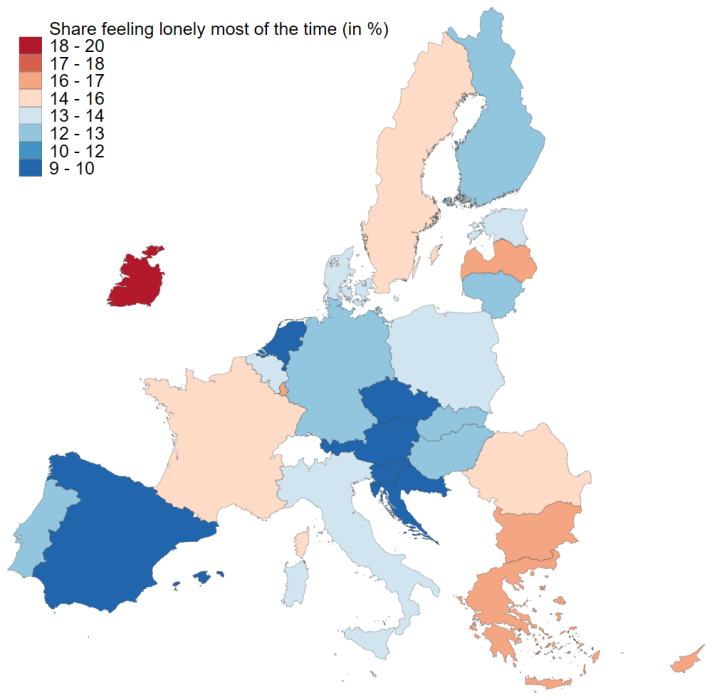
According to data, approximately 13% of respondents report feeling lonely most of the time or all of the time. Loneliness is most prevalent in Ireland with over 20% of respondents reporting feeling lonely. Luxemburg, Bulgaria and Greece follow. The lowest levels are observed in the Netherlands, Czech Republic, Croatia and Austria (all below 10%).
Loneliness is not only a problem among the elderly. Young people have actually a higher incidence of loneliness compared to older generations. This finding, in line with previous research, does not imply that loneliness among the elderly is not a problem, as the consequences of loneliness can vary by age.
Risk factors for loneliness
The findings provide valuable insights into the risk factors for loneliness. Favourable economic situations, as well as the quantity and quality of social interactions, are key when it comes to preventing loneliness, whereas major life events, such as the loss of a partner or a job, can disrupt one’s social network and significantly raise the risk of loneliness.
According to data, people who are lonely all or most of the time are about 20 percentage points more likely to suffer from depressive symptoms. Similarly, loneliness is linked to poorer physical health outcomes and unhealthy behaviour. It is unclear though to what extent loneliness causes health problems or whether it is the other way around.
An additional finding from the survey pinpoints the correlation between social media use and loneliness, which has raised questions about how social media affects loneliness. The survey shows that intense use of social networking sites is associated with an increase in loneliness, suggesting that social networking sites replace offline relationships with online ones, lacking the intimacy and quality of offline interactions.

Effectiveness of interventions tackling loneliness A literature review |
Tackling loneliness
Coordinated actions at local, national and international levels are needed to foster the development of targeted policy solutions. But how to prevent and mitigate loneliness? Understanding the degree of awareness of level interventions, who is supposed to provide help, and whether there is stigma associated with such interventions, is very relevant when it comes to designing effective policies.
The data reveal that 43% of respondents reported being aware of the existence of loneliness interventions, yet large cross-country differences exist. In three Member States (Lithuania, Portugal and Slovenia), more than 60% were aware of interventions in their country, while in seven countries (Sweden, Romania, Hungary, Belgium, Italy, Cyprus and Bulgaria) 35% or less were aware. The survey also includes information about people’s views on the role that different actors should play in supporting those who feel lonely in their country. Overall, the great majority (73%) think that individuals and families should play a major role in this regard.
The views about the role of actors vary by both stigma and loneliness status. Respondents who stigmatise lonely people overall tend to believe to a lesser extent that different actors should provide support for lonely individuals. This result demonstrates the harmfulness of social stigma for the development of loneliness interventions.
More information: Joint Research Center – European Commission
Publicaciones relacionadas:
 European Cancer Plan: EU countries spent almost €170 billion on cancer care
 Commission secures agreement with BioNTech-Pfizer on the delivery of COVID-19 vaccines
 European Parliament calls for prudent use of antibiotics and more support for research
 The European Commission will support Member States putting people and their mental health first
 Medical sensors boost response to Italy’s COVID-19 crisis
Leave a Reply