
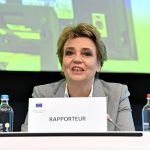
Three parliamentary committees on Tuesday examined Teresa Ribera, nominee for vice-president of the European Commission for Clean, Fair and Competitive Transition.

The European Commission’s vice-presidential candidate for Clean, Fair and Competitive Transition, Teresa Ribera, was examined by three parliamentary committees on Tuesday.
During her opening speech, Ms Ribera paid tribute to the victims of the floods around Valencia. She pledged to continue working within the framework of the European Green Pact to achieve the agreed climate targets and advocated a new approach to competition policy that supports European businesses to achieve a level playing field globally.
Fighting climate change
Referring to the floods in Valencia, several MEPs asked how Ribera plans to improve Europe’s ability to prepare for increasing climate-related risks. She stressed the need to do more and better to strengthen the EU’s resilience to extreme weather events, including early warning systems and response capacity, and promised a new European Climate Adaptation Plan. She also pledged to make water resilience a priority.
Ribera announced that she will continue to work for the implementation of the 2030 climate and energy targets, as well as to set ambitious targets for 2040 to reduce greenhouse gas emissions by 90% below 1990 levels, so that the EU will be carbon neutral by mid-century.
MEPs also asked about the environment and the circular economy and in particular the global climate and biodiversity negotiations.
A clean and just transition
The Commission vice-presidential candidate called for support for the decarbonisation of industry, promoting a just transition including access to housing and quality jobs, and capitalising on the benefits of the green and digital transition.
MEPs asked Ribera about the role of nuclear energy in European policy. She insisted that the choice of energy mix is the prerogative of national authorities. On the automotive industry and its decarbonisation targets, the candidate favoured working with the sector to ensure that it achieves the transition. She also pledged to address the issue of support for motor subcontractors.
A new approach to competition policy
The Commission vice-presidential candidate called for a reform to speed up the application of competition rules, simplify the regulatory framework on state aid and restrict takeovers, which stifle innovation. MEPs asked what Ribera will do to tackle the rising cost of living and the housing crisis and how competition policy can help the development of Europe’s leading global companies. She agreed that there is scope to respond better to abusive price hike tactics and to some extent to the housing crisis.
MEPs also asked what Ribera will do to ensure the predictability of competition rules as they are reformed, how to improve the implementation of the Digital Markets Act (DMA), as well as her priorities in the competition field.
Ribera stressed that the Commission must have the powers to better enforce the DMA. Among her priorities, she cited simplification of the rules and made clear that she will focus on the worst offenders of competition law and on supporting the green transition.
You can watch a recording of the hearing.
Press statements
At the end of the hearing, the chairmen of the Environment, Public Health and Food Safety Committee, Antonio Decaro (S&D, Italy) and the Economic and Monetary Affairs Committee, Aurore Lalucq (S&D, France), made statements to journalists. You can watch their statements again.
Next steps
The chairs of the three responsible committees – Environment, Economic Affairs and Industry – and the coordinators of the political groups in those committees will meet without delay after the hearing to assess Ribera’s candidacy and decide whether she is qualified to be a member of the college of Commissioners and to carry out the specific tasks assigned to her.
The evaluation criteria, as well as the procedure to be followed in case no consensus is reached to endorse or reject her candidature, are set out in Annex VII of the EP Rules of Procedure.
Within 24 hours of the evaluation, the coordinators shall send a confidential letter of recommendation, which shall be examined by the Conference of Committee Chairs and then forwarded to the Conference of Presidents.
After the completion of all hearings, the EP Conference of Presidents (which brings together President Roberta Metsola and the political group leaders) should conclude the process, in principle, on 21 November – at which time the evaluation letters will be made public.
After the conclusion of the hearings, Commission President-elect Ursula von der Leyen will present her team and programme in plenary, followed by a debate with MEPs. The full Commission needs the approval of the Parliament, by a majority of the votes cast, by roll-call vote. The vote is scheduled for the 25-28 November plenary session in Strasbourg.
Once approved by the Parliament, the Commission must be formally appointed by the European Council by qualified majority.
Further information: European Parliament.
Publicaciones relacionadas:
 Europeans need more information to prepare for emergencies, says Eurobarometer survey
 Independent national advisory bodies can reinforce the role of science in climate policy
 The EU’s ecological transition must be grounded on a strong social acceptability
 Environment Council: Climate Summit COP 27
 European Commission funds 171 new LIFE environment and climate projects
Leave a Reply