• Skip to primary navigation
  • Skip to main content
  • Skip to primary sidebar
  • Skip to footer
  • Bluesky
  • Facebook
  • Instagram
  • Twitter
  • YouTube
CDE Almería – Centro de Documentación Europea – Universidad de Almería

CDE Almería - Centro de Documentación Europea - Universidad de Almería

Centro de Documentación Europea de la Universidad de Almería

  • HOME
  • WHAT´S ON
    • EU NEWS
    • Activities
    • EU Calls and Awards
    • Radio Program «Europe with You»
  • DOCUMENTATION
    • EU Media Collection
      • Web Space
      • MEDIATHEQUE REPOSITORY
  • Europe on the net
    • Institutions
    • EU Representation in Spain
    • European information network of Andalusia
  • ABOUT US
    • Presentation
    • Services
    • People
    • Contact
  • Spanish
  • English

Fishing for 2024 in the Mediterranean and Black Seas

Inicio » EU News » Agriculture, Livestock Farming and Fisheries » Fishing for 2024 in the Mediterranean and Black Seas

10 de October de 2023

The Commission adopted its proposal for fishing opportunities for 2024 for the Mediterranean and the Black Seas. The proposal promotes the sustainable management of fish stocks in the Mediterranean and the Black Seas and delivers on the political commitments made in the MedFish4Ever and Sofia Declarations.
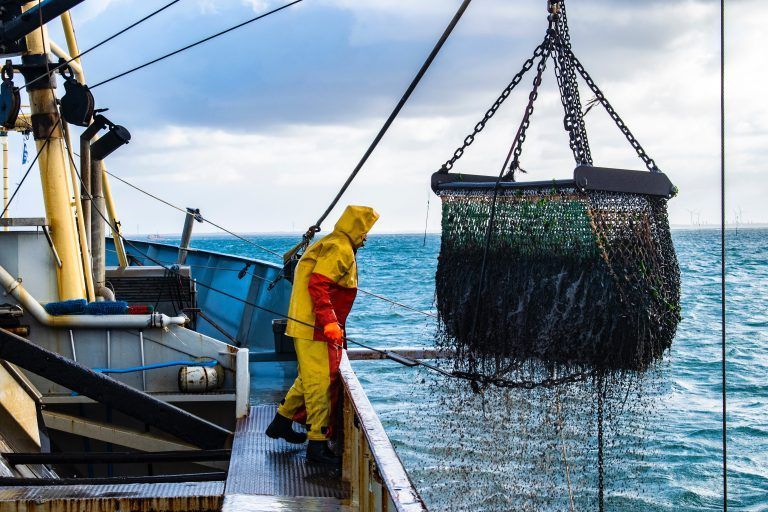
barco de pesca

The Commission proposes to use the same tools that were introduced in the 2022 and 2023 fishing opportunities, based on the latest available scientific advice. These tools include fishing effort for trawlers and longliners as well as catch limits for deep-water shrimps. These measures were established under the Western Mediterranean multiannual management plan (MAP) for demersal stocks, with the aim of reaching by 1 January 2025 at the latest the maximum sustainable yield (MSY), i.e., the maximum amount of fish that fishers can take out of the sea without compromising the regeneration and future productivity of the stock.

Most fishing opportunities will be proposed at a later stage, based on the results of the General Fisheries Commission for the Mediterranean (GFCM) annual session (6-10 November 2023) and the scientific advice for demersal stocks covered by the Western Mediterranean Multiannual Management Plan (MAP), which is expected towards the end of October.

In the Mediterranean Sea, the proposal keeps unchanged measures for red coral. For blackspot seabream and deep-water shrimps this year’s proposal continues a gradual reduction in catches for both species, in line with the newly agreed GFCM management plans from 2022. The proposal for common dolphinfish and other stocks with GFCM transitional measures that expire at the end of 2023 will be updated after the 2023 GFCM annual session.
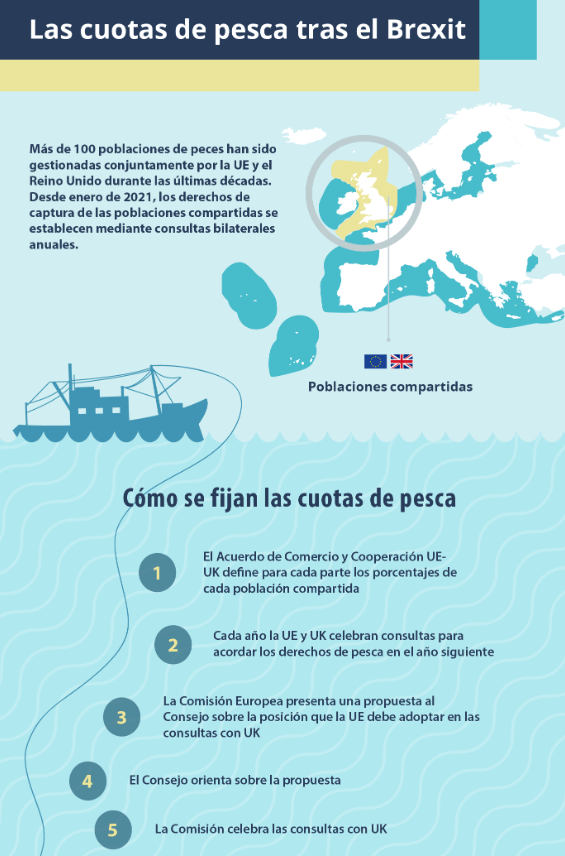
 

Infografía – Las cuotas de pesca tras el Brexit

In the Adriatic Sea, the proposal continues the implementation of the GFCM MAP for demersal stocks and the GFCM MAP for small pelagic stocks. For small pelagic stocks, the proposal continues the implementation of a third transitional year of the MAP. For demersal stocks, it proposes to continue the implementation of the fishing effort regime in line with the goal to reach MSY by 2026. The GFCM is expected to adopt decisions on further implementation of both Adriatic MAPs at the 2023 GFCM annual session.

In the Black Sea, the proposal includes catch limits and quotas for sprat and turbot. For sprat, the Commission proposes to maintain the 2023 catch limit. For turbot, the levels of total allowable catches (TAC) and quotas will be set and adopted at the 2023 GFCM annual session.

The proposal demonstrates the Commission’s objective to make fisheries in these two sea basins sustainable, in line with the 2030 Strategy of the General Fisheries Commission for the Mediterranean (GFCM), which is the regional fisheries management organisation competent for the conservation and management of fish stocks in the Mediterranean and the Black Seas.

Next steps

The Council will discuss the Commission’s proposal on 11 and 12 December and establish the allocation of fishing opportunities. The regulation should apply as of 1 January 2024.

More information: European Commission
Publicaciones relacionadas:

manos sujetan pescado1 million for the landmark WTO fisheries subsidies agreement barco de pescaFishing opportunities for 2024 in the Baltic Sea barcos de pesca en la orilla del marBaltic Sea fishing: Council agrees on 2021 catch limits Smart tech for more sustainable seas The specific control campaign of the bluefin tuna purse seine and traps kicks off

Agriculture, Livestock Farming and Fisheries,  EU News Black Seas,  European Commission,  fishing,  fishing opportunities,  MedFish4Ever,  Mediterranean

“This is a space for debate. All comments, for or against publication, that are respectful and do not contain expressions that are discriminatory, defamatory or contrary to current legislation will be published”.

Reader Interactions

Leave a Reply Cancel reply

Your email address will not be published. Required fields are marked *

This site uses Akismet to reduce spam. Learn how your comment data is processed.

Primary Sidebar

Footer

  • CDE Almería
  • Biblioteca Nicolás Salmerón – Universidad de Almería
  • Planta: 1ª, Despacho: 1.05.0B.
  • Ctra. Sacramento s/n. Almería (Spain)
  • Teléfono: (+34) 950 015266

HOME
NEWS
DOCUMENTATION
EUROPE ON THE NET
ABOUT US

  • LEGAL NOTICE
  • PRIVACY POLICY
  • COOKIE POLICY
  • ACCESSIBILITY
  • SITEMAP

Copyright © 2026 CDE Almería · Creative Commons LicenseThis work is licensed under a Creative Commons Attribution-NonCommercial 4.0 International License.

<p>El Centro de Documentación Europea de la Universidad de Almería utiliza cookies propias y de terceros para facilitar al usuario la navegación en su página Web y el acceso a los distintos contenidos alojados en la misma. Asimismo, se utilizan cookies analíticas de terceros para medir la interacción de los usuarios con el sitio Web. Pinche el siguiente enlace si desea información sobre el uso de cookies y como deshabilitarlas. </p>

Politica de privacidad

El Centro de Documentación Europea de la Universidad de Almería utiliza cookies propias y de terceros para facilitar al usuario la navegación en su página Web y el acceso a los distintos contenidos alojados en la misma. Asimismo, se utilizan cookies analíticas de terceros para medir la interacción de los usuarios con el sitio Web. Pinche el siguiente enlace si desea información sobre el uso de cookies y como deshabilitarlas. <a href="/politica-de-cookies" rel="noopener" target="_blank">Más información</a>

Cookies estrictamente necesarias

Las cookies estrictamente necesarias tiene que activarse siempre para que podamos guardar tus preferencias de ajustes de cookies.

Básicamente la web no funcionara bien si no las activas.

Estas cookies son:

  • Comprobación de inicio de sesión.
  • Cookies de seguridad.
  • Aceptación/rechazo previo de cookies.
Cookies de terceros

Esta web utiliza Google Analytics, Google Tag Manager y Yandex Metrika para recopilar información anónima tal como el número de visitantes del sitio, o las páginas más populares.

Dejar estas cookies activas nos permite mejorar nuestra web.

Política de cookies

Pinche el siguiente enlace si desea información sobre el uso de cookies y como deshabilitarlas. Más información