• Skip to primary navigation
  • Skip to main content
  • Skip to primary sidebar
  • Skip to footer
  • Bluesky
  • Facebook
  • Instagram
  • Twitter
  • YouTube
CDE Almería – Centro de Documentación Europea – Universidad de Almería

CDE Almería - Centro de Documentación Europea - Universidad de Almería

Centro de Documentación Europea de la Universidad de Almería

  • HOME
  • WHAT´S ON
    • EU NEWS
    • Activities
    • EU Calls and Awards
    • Radio Program «Europe with You»
  • DOCUMENTATION
    • EU Media Collection
      • Web Space
      • MEDIATHEQUE REPOSITORY
  • Europe on the net
    • Institutions
    • EU Representation in Spain
    • European information network of Andalusia
  • ABOUT US
    • Presentation
    • Services
    • People
    • Contact
  • Spanish
  • English

Eurostat: Plastic bag use continues to fall in the European Union

Inicio » Noticias UE » Research and Innovation » Eurostat: Plastic bag use continues to fall in the European Union

10 de November de 2023

In 2021, each person living in the EU consumed on average 77 lightweight plastic carrier bags (LPCBs), which is 11 bags less per person, compared with 2020. Overall, 34.2 billion (bn) lightweight plastic carrier bags were consumed in the EU in 2021 (-4.8 bn bags compared with 2020). 
This information comes from data on lightweight plastic carrier bags published by Eurostat today. The article presents a handful of findings from the more detailed Statistics Explained article.
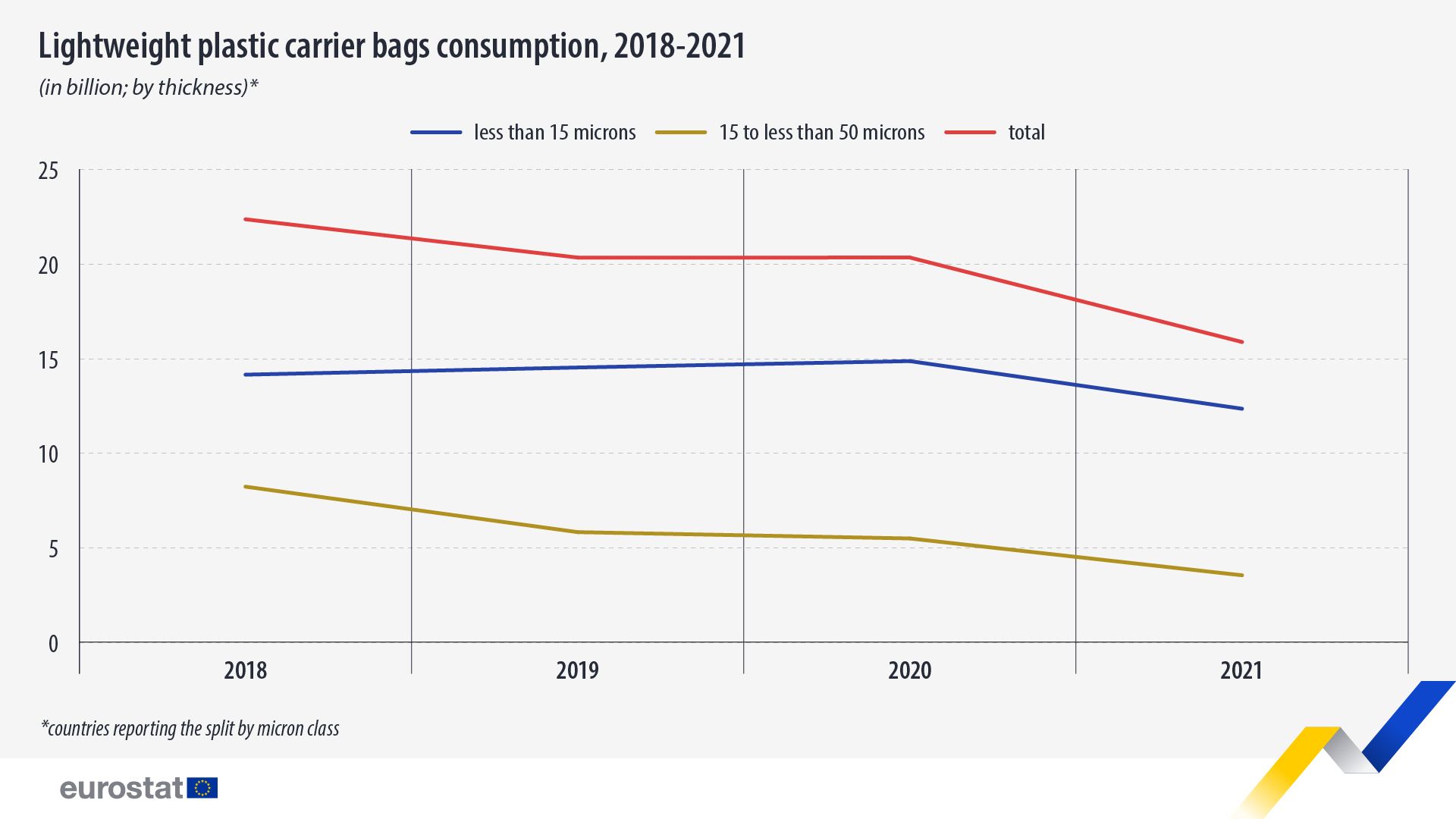
2021 was the first year in which EU consumption of very lightweight plastic carrier bags (i.e., bags with a wall thickness of less than 15 micrometres (microns)) decreased. In 2021, the EU inhabitants consumed 12.3 bn very light plastic carrier bags (VLPCBs), less than in any of the years before (since the data collection started in 2018): 14.1 bn in 2018; 14.5 bn in 2019; 14.9 bn in 2020).

Since 2018, the consumption of LPCBs between 15 to less than 50 microns thick has steadily decreased: from 8.2 bn in 2018 to 3.5 bn in 2021.

All EU countries now have consumption reduction measures in place as required by the plastic bags directive, which aims to reduce the consumption of LPCBs to not exceed 40 bags per person by 31 December 2025. However, this target does not include VLPCBs.
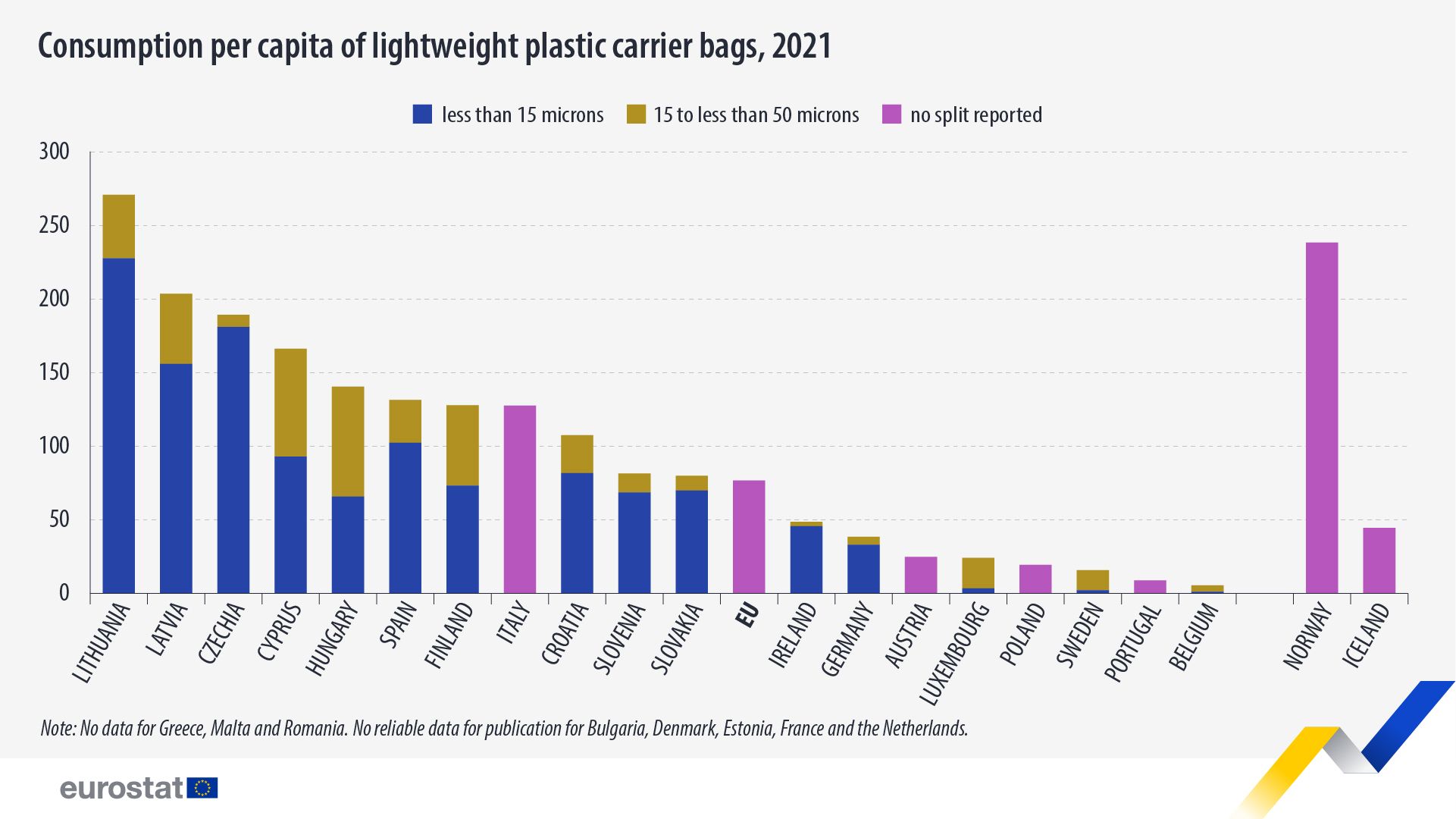
Among the EU countries with available data, the countries that reported the highest consumption of LPCBs per person in 2021 were Lithuania (271 bags per person), Latvia (204) and Czechia (189), with the majority of the consumption relating to VLPCBs.

At the other end of the scale, the countries that reported the lowest consumption were Belgium (5 bags per person), Portugal (9) and Sweden (16). In Belgium, the per capita consumption of VLPCBs was 1 bag, and 2 bags in Sweden. Portugal did not report the split.

The wide range seen in per capita consumption is primarily attributable to differences in the effectiveness of the measures, depending on economic, social, and policy factors. Another reason is that some countries introduced consumption reduction measures during the 2018–2021 period, but others had the measures in place longer than that. A third potential explanation is the different calculation methodologies used by EU countries.
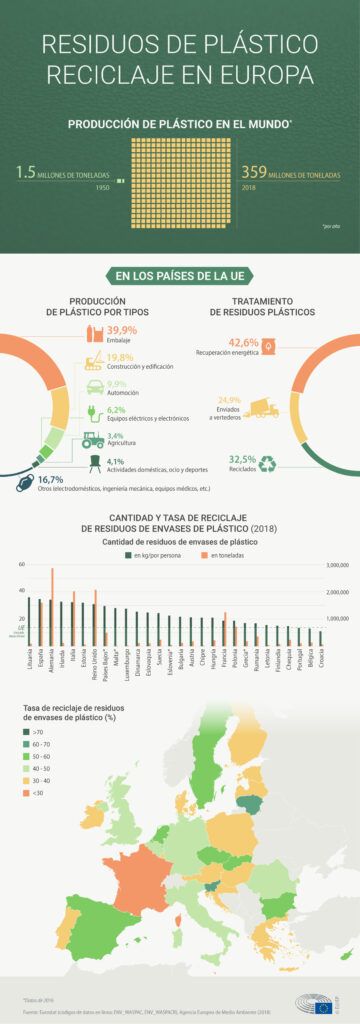
Plastic waste and recycling in the EU: facts and figures

More information: Eurostat

Publicaciones relacionadas:

Come to the European Researchers’ Night on September 24th! premio nobel medallaMeet the 2021 Nobel Prize Laureates Artificial Intelligence and Internet of Things in EU enterprises The number of ICT workers in the EU rose in 2022 New project to improve biological detection, identification & monitoring equipment

EU News,  Research and Innovation 2021,  Eurostat,  plastic bags

“This is a space for debate. All comments, for or against publication, that are respectful and do not contain expressions that are discriminatory, defamatory or contrary to current legislation will be published”.

Reader Interactions

Leave a Reply Cancel reply

Your email address will not be published. Required fields are marked *

This site uses Akismet to reduce spam. Learn how your comment data is processed.

Primary Sidebar

Footer

  • CDE Almería
  • Biblioteca Nicolás Salmerón – Universidad de Almería
  • Planta: 1ª, Despacho: 1.05.0B.
  • Ctra. Sacramento s/n. Almería (Spain)
  • Teléfono: (+34) 950 015266

HOME
NEWS
DOCUMENTATION
EUROPE ON THE NET
ABOUT US

  • LEGAL NOTICE
  • PRIVACY POLICY
  • COOKIE POLICY
  • ACCESSIBILITY
  • SITEMAP

Copyright © 2026 CDE Almería · Creative Commons LicenseThis work is licensed under a Creative Commons Attribution-NonCommercial 4.0 International License.

<p>El Centro de Documentación Europea de la Universidad de Almería utiliza cookies propias y de terceros para facilitar al usuario la navegación en su página Web y el acceso a los distintos contenidos alojados en la misma. Asimismo, se utilizan cookies analíticas de terceros para medir la interacción de los usuarios con el sitio Web. Pinche el siguiente enlace si desea información sobre el uso de cookies y como deshabilitarlas. </p>

Politica de privacidad

El Centro de Documentación Europea de la Universidad de Almería utiliza cookies propias y de terceros para facilitar al usuario la navegación en su página Web y el acceso a los distintos contenidos alojados en la misma. Asimismo, se utilizan cookies analíticas de terceros para medir la interacción de los usuarios con el sitio Web. Pinche el siguiente enlace si desea información sobre el uso de cookies y como deshabilitarlas. <a href="/politica-de-cookies" rel="noopener" target="_blank">Más información</a>

Cookies estrictamente necesarias

Las cookies estrictamente necesarias tiene que activarse siempre para que podamos guardar tus preferencias de ajustes de cookies.

Básicamente la web no funcionara bien si no las activas.

Estas cookies son:

  • Comprobación de inicio de sesión.
  • Cookies de seguridad.
  • Aceptación/rechazo previo de cookies.
Cookies de terceros

Esta web utiliza Google Analytics, Google Tag Manager y Yandex Metrika para recopilar información anónima tal como el número de visitantes del sitio, o las páginas más populares.

Dejar estas cookies activas nos permite mejorar nuestra web.

Política de cookies

Pinche el siguiente enlace si desea información sobre el uso de cookies y como deshabilitarlas. Más información