• Skip to primary navigation
  • Skip to main content
  • Skip to primary sidebar
  • Skip to footer
  • Bluesky
  • Facebook
  • Instagram
  • Twitter
  • YouTube
CDE Almería – Centro de Documentación Europea – Universidad de Almería

CDE Almería - Centro de Documentación Europea - Universidad de Almería

Centro de Documentación Europea de la Universidad de Almería

  • HOME
  • WHAT´S ON
    • EU NEWS
    • Activities
    • EU Calls and Awards
    • Radio Program «Europe with You»
  • DOCUMENTATION
    • EU Media Collection
      • Web Space
      • MEDIATHEQUE REPOSITORY
  • Europe on the net
    • Institutions
    • EU Representation in Spain
    • European information network of Andalusia
  • ABOUT US
    • Presentation
    • Services
    • People
    • Contact
  • Spanish
  • English

Europol helps arrest 50 people for trafficking hashish and cocaine via African route

Inicio » Noticias UE » Defensa y Seguridad » Crime » Europol helps arrest 50 people for trafficking hashish and cocaine via African route

21 de April de 2023

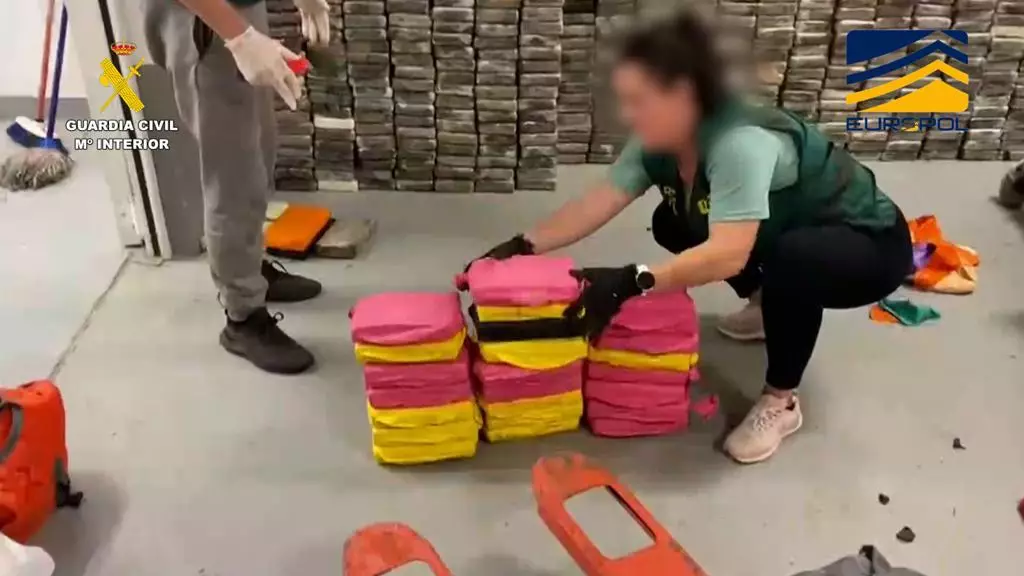
Europol supported the Spanish Civil Guard (Guardia Civil) and the Portuguese Judiciary Police (Policia Judiciaria) and National Guard (Guarda Nacional Republicana) in dismantling a criminal network involved in trafficking large quantities of cocaine and hashish to the European Union via the African route. The investigation also involved law enforcement authorities from France and the United Kingdom.

Overall results include:

  • 50 arrests
  • Seizures of almost 5 tonnes of hashish and 2 tonnes of cocaine
  • Seizure of equipment, including boats, 350HP engines, almost 4 000 litres of gasoline, vehicles, trailers, jams detectors and beacons used for tracking shipments.
19 arrested in Spanish-Swedish raid on drug traffickers supported by Europol

The year-long investigation discovered that the criminal network had established a multi-product trafficking scheme with a two-way supply chain. This consisted of the trafficking of hashish from Morocco to South America, and cocaine back across the Atlantic and via the west coast of Africa before being transported to the Spanish mainland. The cocaine was smuggled in containers and transported using fast boats that were also used for smuggling hashish.

Initially, the investigators identified members of the organisation, based in Huelva and the Gibraltar area, as being involved in maritime drug trafficking throughout the Iberian Peninsula. The investigation revealed that the leaders of the organisation were also based in these two areas, while other members were operating in Morocco, Portugal and the Canary Islands. This investigation shed light on a new development: hashish-trafficking networks have established links with cocaine-trafficking organisations and are using their existing supply chain to diversify their drug portfolio and optimise their logistics in the drive for higher profits.

Europol facilitated the exchange of information and provided continuous analytical support to the investigation. On the two action days, Europol deployed experts to Spain to cross-check operational information in real time and provide leads to officers in the field.

More information

EUROPOL

Publicaciones relacionadas:

Corona Crimes: Suspect Behind €6 Million Face Masks And Hand Sanitisers Scam Arrested Thanks To International Police Cooperation Viral Marketing: Counterfeits in the Time of Pandemic 101 Arrested And 19,000 Stolen Artefacts Recovered In International Crackdown On Art Trafficking medicinas y drogasDoping Trafficking Ring with Professional Athletes Dismantled in Italy Spain dismantle a terrorist organisation recruiting and indoctrinating women



Crime,  Defence & Security,  EU News African route,  Europol,  Spanish Civil Guard,  trafficking

“This is a space for debate. All comments, for or against publication, that are respectful and do not contain expressions that are discriminatory, defamatory or contrary to current legislation will be published”.

Reader Interactions

Leave a Reply Cancel reply

Your email address will not be published. Required fields are marked *

This site uses Akismet to reduce spam. Learn how your comment data is processed.

Primary Sidebar

Footer

  • CDE Almería
  • Biblioteca Nicolás Salmerón – Universidad de Almería
  • Planta: 1ª, Despacho: 1.05.0B.
  • Ctra. Sacramento s/n. Almería (Spain)
  • Teléfono: (+34) 950 015266

HOME
NEWS
DOCUMENTATION
EUROPE ON THE NET
ABOUT US

  • LEGAL NOTICE
  • PRIVACY POLICY
  • COOKIE POLICY
  • ACCESSIBILITY
  • SITEMAP

Copyright © 2026 CDE Almería · Creative Commons LicenseThis work is licensed under a Creative Commons Attribution-NonCommercial 4.0 International License.

<p>El Centro de Documentación Europea de la Universidad de Almería utiliza cookies propias y de terceros para facilitar al usuario la navegación en su página Web y el acceso a los distintos contenidos alojados en la misma. Asimismo, se utilizan cookies analíticas de terceros para medir la interacción de los usuarios con el sitio Web. Pinche el siguiente enlace si desea información sobre el uso de cookies y como deshabilitarlas. </p>

Politica de privacidad

El Centro de Documentación Europea de la Universidad de Almería utiliza cookies propias y de terceros para facilitar al usuario la navegación en su página Web y el acceso a los distintos contenidos alojados en la misma. Asimismo, se utilizan cookies analíticas de terceros para medir la interacción de los usuarios con el sitio Web. Pinche el siguiente enlace si desea información sobre el uso de cookies y como deshabilitarlas. <a href="/politica-de-cookies" rel="noopener" target="_blank">Más información</a>

Cookies estrictamente necesarias

Las cookies estrictamente necesarias tiene que activarse siempre para que podamos guardar tus preferencias de ajustes de cookies.

Básicamente la web no funcionara bien si no las activas.

Estas cookies son:

  • Comprobación de inicio de sesión.
  • Cookies de seguridad.
  • Aceptación/rechazo previo de cookies.
Cookies de terceros

Esta web utiliza Google Analytics, Google Tag Manager y Yandex Metrika para recopilar información anónima tal como el número de visitantes del sitio, o las páginas más populares.

Dejar estas cookies activas nos permite mejorar nuestra web.

Política de cookies

Pinche el siguiente enlace si desea información sobre el uso de cookies y como deshabilitarlas. Más información