

On 27 March, the European Commission published the Regional Competitiveness Index (RCI), a completely revised version of a tool long used to measure different dimensions of competitiveness in EU regions.
The fully revised RCI 2.0 shows that large disparities persist between EU regions, but it also shows that the competitiveness of less developed regions has improved. The index also shows that Utrecht, South Holland and the Ile-de-France region of the French capital are the most competitive regions in the EU.
Less developed regions are catching up
Between the 2016 and the 2022 editions of the index, regional competitiveness has improved in the less developed regions, while the performance of transition regions has been more mixed. More developed regions continue to be the top performers.
The lowest values are, nonetheless, still concentrated in the less developed regions of the eastern EU Member States.
All the regions in eastern EU Member States improved their performance between the 2016 and the 2019 editions, while the performance in the southern EU regions, which also present relatively low levels of competitiveness, was mixed. Between the 2019 and 2022 editions, most eastern EU regions continued to catch up, including in the Baltic States, Croatia, Hungary, Poland, and Slovenia. However, parts of Czechia, Romania, Slovakia, and Bulgaria moved further away from the EU average.
In the southern EU, the regions in Portugal, Spain and most of Greece improved their performance (albeit the latter from very low levels), but most of the regions in Italy and Cyprus moved away from the EU average.
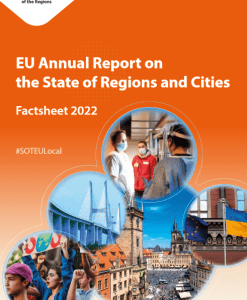
EU annual report on the state of regions and cities (Disponible en Español) |
Capital regions are almost always the most competitive, but the gap is lower in more competitive Member States
Capital city regions are the most competitive in all Member States but Germany, Italy, and the Netherlands. The gap with the other regions can be wide and is particularly high in France, Romania and Slovakia.
More competitive countries tend to have a smaller gap between their capital city region and the other regions. This underlines that public policies and investments should promote upward convergence, which help less competitive regions to improve their performance and catch up, while ensuring that the most competitive regions continue to thrive.
More competitive regions have significant advantages
In more competitive regions, GDP per head is higher. In these regions, women have better framework conditions, hence can achieve better results and fewer young women are neither in employment, nor in education or training (NEET rates). Finally, more competitive regions are particularly attractive for recent graduates, as it is easier to find a job there.
The importance of Cohesion Policy for EU regional competitiveness
The results of the RCI 2.0 show how EU regions still need EU support to improve their competitiveness and narrow gaps between them. Cohesion Policy is the EU’s main investment policy to support regions when it comes to job creation, business competitiveness, economic growth, sustainable development, and to improve citizens’ quality of life.
Background
Launched in 2010 and published every three years, the RCI allows EU regions to monitor and assess their development over time and in comparison with other regions. It is an important tool that provides a European perspective on the competitiveness of regions based on 68 indicators.
The 2022 edition of the RCI uses a fully revised methodology and recalculates the previous two editions. This RCI 2.0 is composed of 3 sub-indices ‘Basic’, ‘Efficiency’ and ‘Innovation’ and of 11 pillars on the different aspects of competitiveness: ‘Institutions’, ‘Macroeconomic stability’, ‘Infrastructures’, ‘Health’, ‘Basic education’, ‘Higher education, training and lifelong learning’, ‘Labour-market efficiency’, ‘Market size’, ‘Technological readiness’, ‘Business sophistication’ and ‘innovation’.
The RCI 2.0 is based on the statistical NUTS 2 (Nomenclature of Units for Territorial Statistics) regions. All indicators predate the war in Ukraine. This is the first edition of the RCI without the United Kingdom.
More information
Publicaciones relacionadas:
 EU Cohesion Policy: €37.3 billion to Spain
 European Commission’s May infringement proceedings package against Spain
 Rule of Law Report 2022: Specific Recommendations for Spain
 July infringements package: key decisions related to Spain and Environmental matters
 UNGA 77: EU Delegation to defend rules-based order
Leave a Reply