
EU leaders discussed continued support for Ukraine, notably sustainable military and financial support, and how to boost long-term economic strength and resilience in the EU.
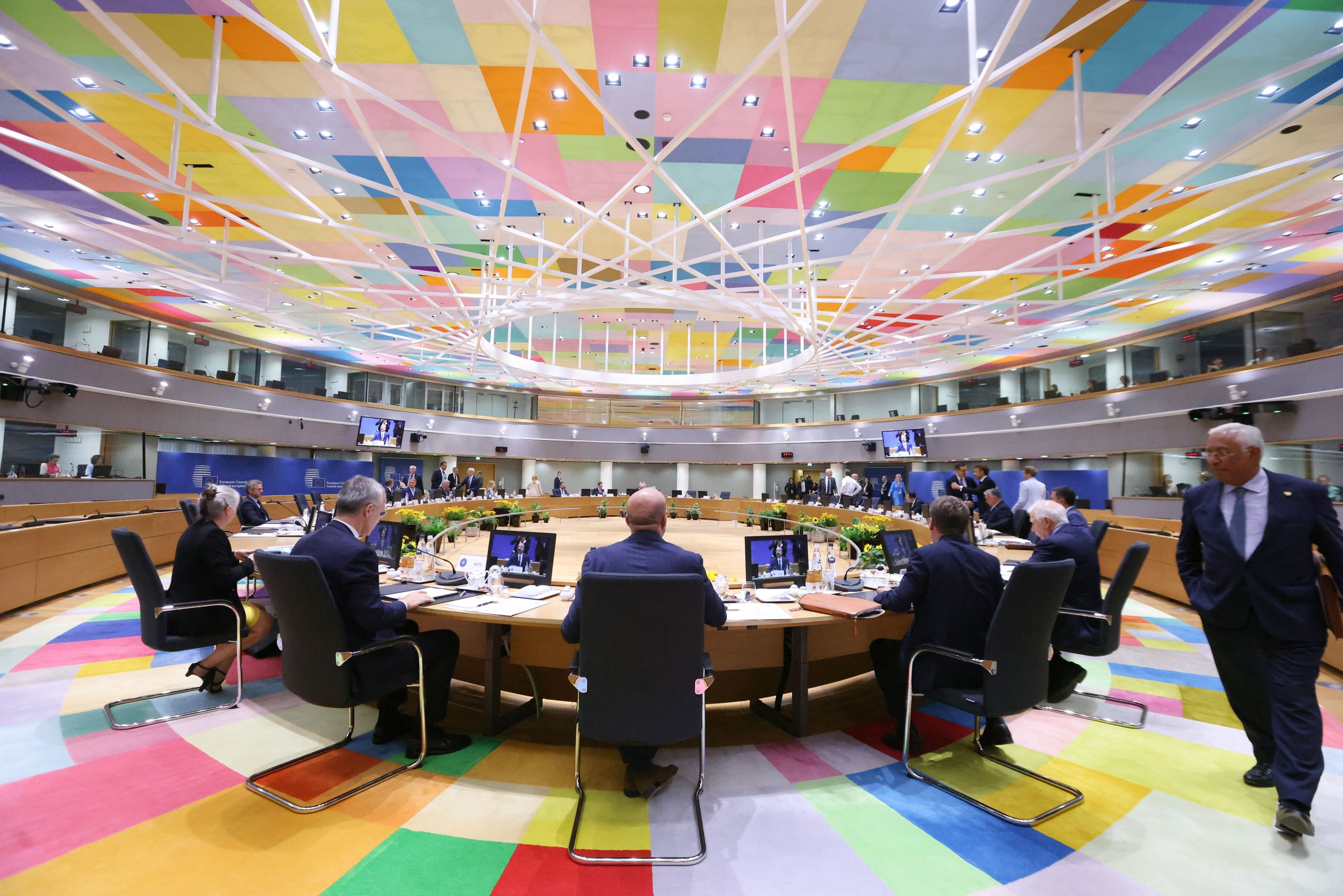
They also discussed migration, the EU-China relationship and external relations.
The EU leaders were joined by NATO Secretary-General, Jens Stoltenberg, for a working lunch to discuss EU-NATO cooperation and Euro-Atlantic security. The President of Ukraine, Volodymyr Zelenskyy, addressed the leaders via video conference.
EU response to Russia’s war of aggression against Ukraine
EU leaders reiterated their resolute condemnation of Russia’s war and unwavering solidarity with Ukraine and its people.
So far, the EU and its member states have provided over €77 billion to Ukraine. They will continue to strongly support Ukraine’s economy, society, armed forces and future reconstruction. The EU will also provide flexible financial assistance to reinforce support for displaced persons in Ukraine and in the EU.
Military support
The EU is ready to provide sustainable military support to Ukraine for as long as it takes, particularly through its dedicated military assistance mission to Ukraine and the European Peace Facility, an off-budget fund to prevent conflicts and build peace.
In this regard, EU leaders took stock of progress on the delivery and joint procurement of ammunition to Ukraine.
They underlined the importance of continuing efforts to help meet Ukraine’s pressing military and defence needs, while also taking into account member states’ security and defence policies. The EU and its member states stand ready to contribute to future security commitments to ensure long-term stability in Ukraine.
Destruction of the Kakhovka dam
EU leaders condemned in the strongest terms the deliberate destruction of the dam at the Kakhovka hydroelectric power plant, which has devastating humanitarian and ecological repercussions and puts at risk the safety and security of the Zaporizhzhia nuclear power plant.
Leaders welcomed the emergency assistance for relief efforts at EU level.
Reconstruction of Ukraine
Firmly committed to the repair, recovery and reconstruction of Ukraine, EU leaders underlined the need to ensure stable, predictable and sustainable financial support in the years to come. They called on the relevant EU and international actors to:
- step up support for Ukraine’s most urgent infrastructure needs
- take forward work on Russia’s frozen assets
To achieve a just and lasting peace in Ukraine, the EU offers its full support to the country’s peace formula.
Accountability of perpetrators
The EU is firmly committed to ensuring that Russia is held fully accountable for its war. In this regard, EU leaders welcomed progress in setting up the International Centre for the Prosecution of the Crime of Aggression Against Ukraine (ICPA) and called for work to continue on the:
- tribunal for the prosecution of the crime of aggression against Ukraine
- international cooperation on the investigation and prosecution of the most serious crimes
- register of damage
EU leaders also called for the immediate safe return of Ukrainian civilians, including children, who have been unlawfully deported to Russia and Belarus.
Sanctions against Russia
EU leaders reviewed efforts to further increase pressure on Russia in order to weaken its ability to wage its war, including through the effective implementation of sanctions as well as the prevention of their circumvention.
In this context, they welcomed the adoption of the 11th sanctions package and called on the Council of the EU and the European Parliament to swiftly finalise work on the proposed rules to approximate criminal offences and penalties for the violation of EU restrictive measures.
Belarus and Iran
EU leaders condemned the continued military support for Russia provided by Iran and Belarus.
Priorities of the Spanish Presidency of the Council of the European Union |
Global food security
Russia continues to use food as a weapon, thereby undermining global food security. EU leaders expressed their deep concern for the continued slowdown in the implementation of the Black Sea Grain Initiative and called for the swift and full resumption of its operations. They also acknowledged that the EU’s solidarity lanes are instrumental in bolstering global food security.
A strong and resilient economy
EU leaders stressed the need to enhance the EU’s economic resilience and security to defend its values globally while preserving an open economy.
The EU is committed to a future-proof and robust economy in line with the green and digital transitions. With a view to strengthening its industrial policy and reducing strategic dependencies, EU leaders called on the relevant EU institutions to advance work on:
- the net-zero industry and critical raw materials acts
- the development of strategic technologies
- artificial intelligence
- the production and availability of the most critical medicines
- a toolbox on demographic challenges
- the economic governance review
- the proposed revision of the multi-annual financial framework, the EU’s long-term budget
- the assessment of the United States’ inflation reduction act
EU leaders also welcomed the entry into force of the unified patent court agreement and held a discussion on the country-specific recommendations as discussed by the Council, thus allowing for the conclusion of the 2023 European Semester. The Semester is the EU’s annual cycle of economic, fiscal, labour and social policy coordination.
Security and defence
The EU is committed to taking more responsibility for its own security and increasing its capacity to act autonomously while acknowledging the transatlantic relationship and EU-NATO cooperation as key to the EU’s overall security.
EU leaders took stock of the progress made in implementing past conclusions, notably the Versailles declaration, in which leaders outlined measures to bolster the EU’s defence capabilities. They also welcomed the progress made in implementing the Strategic Compass, which defines a coherent set of actions to help secure EU interests and protect European citizens.
A strong European defence sector
EU leaders underlined the need to strengthen the technological and industrial base of the European defence sector.
They welcomed the agreement on the European defence industry reinforcement through the common procurement act and called for swift action on:
- the delivery and joint procurement of ammunition
- a proposal for a European defence investment programme
EU proposes comprehensive new on Climate-Security nexus
|
European Peace Facility
EU leaders welcomed the decision to further increase the financial ceiling of the European Peace Facility (EPF).
This financial top-up will help to:
- preserve the facility’s global geographical scope
- continue to provide military support for Ukraine
- maintain the EU’s ability to prevent and swiftly respond to crises
- build capacity through training missions
EU-China relationship
EU leaders held a strategic discussion on China, which is simultaneously a partner, a competitor and a systemic rival of the EU. The EU and China have a shared interest in pursuing constructive and stable relations, anchored in respect for the rules-based international order, balanced engagement and reciprocity.
The EU is committed to its ‘One China’ policy and will continue to engage with China:
- to tackle global challenges such as climate change, pandemic preparedness and the Russian war on Ukraine
- to ensure a level playing field for the economy and trade
EU leaders expressed concern about growing tensions in the Taiwan Strait and the situation in Tibet and Xinjiang, as well as concern over the treatment of human rights defenders and persons belonging to minorities.
External relations
Latin America and the Caribbean
The upcoming EU-CELAC summit will bring together EU leaders and leaders from the regional bloc of Latin American and Caribbean states.
The European Council stressed the importance of the EU and CELAC together addressing:
- the global climate and environmental crises
- rising inequalities
- threats to global security and the rules-based order
Southern Neighbourhood
EU leaders held a strategic discussion on how to strengthen EU relations with partners in the Southern Neighbourhood, which covers 10 countries: Algeria, Egypt, Israel, Jordan, Lebanon, Libya, Morocco, Palestine, Syria and Tunisia.
In this context, they welcomed the work done on the partnership package with Tunisia and supported the resumption of political dialogue in the framework of the EU-Tunisia association agreement. They also stressed the importance of developing similar strategic partnerships with other partners in the region.
Kosovo*
Leaders condemned the recent violent incidents in the north of Kosovo* and called for an immediate de-escalation of the situation, stating that failure to do so would have negative consequences.
They stressed the importance of resuming the EU-facilitated talks and of implementing the agreement on the path to normalisation between Kosovo and Serbia.
* This designation is without prejudice to positions on status, and is in line with UNSCR 1244/1999 and the ICJ Opinion on the Kosovo declaration of independence
African Union
The European Council supports the reinforced presence of the African Union in international forums, notably in the G20.
Eastern Mediterranean
Cyprus
The European Council remains fully committed to a comprehensive settlement on Cyprus in accordance with the relevant resolutions from the UN Security Council and in line with the EU founding principles of respect for human rights, democracy and the rule of law.
EU leaders called for the speedy resumption of negotiations and stated their readiness to play an active role in supporting the UN-led process.
Türkiye
EU leaders invited the High Representative and the European Commission to submit a report on the state of play of EU-Türkiye relations.
EU response to crises
EU leaders acknowledged the challenges posed by cross-sectoral and cross-border crises, many of which are exacerbated by climate change and the evolving security landscape. In this regard, they underlined the importance of building resilience in strategic areas and strengthening EU preparedness and response mechanisms.
Migration
President Charles Michel noted that the European Council expressed its profound sorrow for the terrible loss of life as a result of the recent tragedy in the Mediterranean.
In February 2023, discussions on migration focused on external aspects, such as increased external action, effective control of external borders and financing mechanisms. Building on the progress so far:
- work will be stepped up on all strands of action along all migratory routes, in line with international law
- the Council and the Commission will continue the work and report back accordingly, including on mobilisation of existing EU funds in support of temporary protection
President Michel took further note that Poland and Hungary declared that, in the context of the ongoing work on the pact on migration and asylum, there is a need to find consensus on an effective migration and asylum policy.
More information: European Council
Publicaciones relacionadas:
 Coordinated maritime policies: Gulf of Guinea and northwestern Indian Ocean
 Council adopts additional €1 billion assistance to Ukraine
 Main results of the European Council meeting, 15-16 October 2020
 European Peace Facility backs African Union with 600 million euros
 Council adopts legislation entrusting new tasks to the Europol
Leave a Reply