
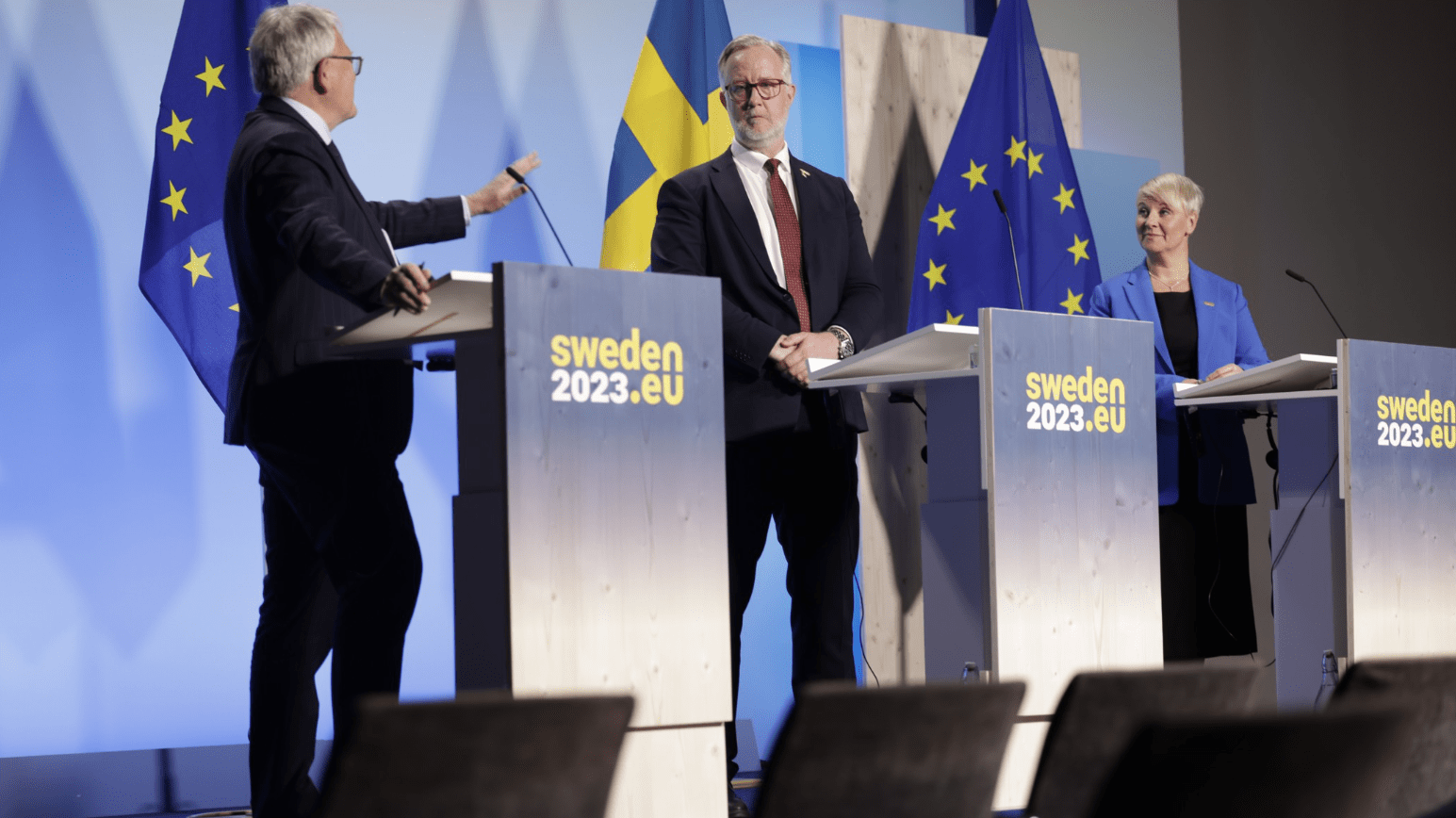
The EU’s employment and social affairs ministers met on May 3 and 4 to talk about how ageing populations and labour market changes impact social security systems.
Participants included EU Commissioners, members of the European Parliament, ministers from EFTA nations, representatives of the social partners, and members of civil society in addition to EU employment and social affairs ministers. The Swedish Government was represented by Ministers Anna Tenje, Paulina Brandberg, and Johan Pehrson.
The economy is undergoing huge transformations, and we need people’s skills to keep up with labour market developments. The European Year of Skills aims to change the training mindset in the EU. And while poverty levels have been decreasing in the past decade, inequalities have not. The report by the High-level Group on the future of social protection and the welfare state gives us a lot of food for thought on how to make sure our social safety nets are robust and future-proof.
Minister for Employment and Integration Johan Pehrson chaired the discussion on how transitions are influencing the labour market and how the EU can prevent mismatch between skills and jobs. The participants highlighted the importance of investing in lifelong learning, not least for groups in vulnerable situations.
EU Member States have many interesting initiatives to prevent mismatch between skills and employers’ needs. Exchanging ideas and experiences has been very valuable.
The EU expects to create 1.3 million jobs through its cohesion policy |
The afternoon session focused on how the aging population in Europe can influence our social security systems. Member states shared experiences from national reforms aimed at addressing the sustainability of social security systems. During the meeting, several delegates raised the importance of strengthening incentives for older people to work longer to maintain pension levels and welfare. The need to recruit staff to the health and social care sector as we live longer and longer was also something that was highlighted.
As holder of the Presidency of the Council of the EU, Sweden has placed issues concerning older and ageing populations at the top of the agenda. Minister for Older People and Social Security Anna Tenje emphasised that the trend of an older and healthier population is very positive and creates opportunities, but also puts pressure on the social security systems. The session particularly highlighted issues concerning enabling a longer and more sustainable working life and meeting the increasing need for elderly care.
Older women and men who want and are able to work should be encouraged and given the opportunity to continue in their professions. This would not only help more people to improve their own financial situation and increase their pension, it would also improve skills supply. At the same time, there needs to be a safety net for those who cannot work to an advanced age, as well as reliable health and elderly care.
During the day, the Swedish social partners informed about the Swedish transition package, which was designed to create better long-term flexibility, adaptability and security in the labour market. The package is based on an agreement between trade unions and employers within the private sector.
More information
Publicaciones relacionadas:
 Women’s employment must increase at least three times faster than men’s to meet EU targets
 Fair minimum wages: second-stage consultation of social partners
 Reasons to consider seasonal work abroad in 2021
 What is an EU Blue Card?
 A group of Member States committed to contribute €270 million to the ALMA initiative
Leave a Reply