• Skip to primary navigation
  • Skip to main content
  • Skip to primary sidebar
  • Skip to footer
  • Bluesky
  • Facebook
  • Instagram
  • Twitter
  • YouTube
CDE Almería – Centro de Documentación Europea – Universidad de Almería

CDE Almería - Centro de Documentación Europea - Universidad de Almería

Centro de Documentación Europea de la Universidad de Almería

  • HOME
  • WHAT´S ON
    • EU NEWS
    • Activities
    • EU Calls and Awards
    • Radio Program «Europe with You»
  • DOCUMENTATION
    • EU Media Collection
      • Web Space
      • MEDIATHEQUE REPOSITORY
  • Europe on the net
    • Institutions
    • EU Representation in Spain
    • European information network of Andalusia
  • ABOUT US
    • Presentation
    • Services
    • People
    • Contact
  • Spanish
  • English

EU high-speed rail lines grew to 8 556 km in 2023

Inicio » Noticias UE » Medio Ambiente » Transport » EU high-speed rail lines grew to 8 556 km in 2023

10 de February de 2025

In 2023, the EU railway network had 200 947 km of railway lines, with the highest densities being found  in and around main cities and other population hubs.
The highest railway network density was registered in Czechia, with 123.2 metres of railway lines per km². Other EU countries with high densities included Belgium (119.2 m/km²), Germany (109.5 m/km²) and Luxembourg (104.8 m/km²).

On the other end, the lowest railway network densities were found in Greece (14.0 m/km²) and Finland (19.4 m/km²). Low densities were also recorded in Sweden (26.8 m/km²), Estonia (27.2 m/km²), Portugal (27.8 m/km²), Latvia (28.9 m/km²) and Ireland (29.8 m/km²).


Expansion of high-speed railway lines in the EU

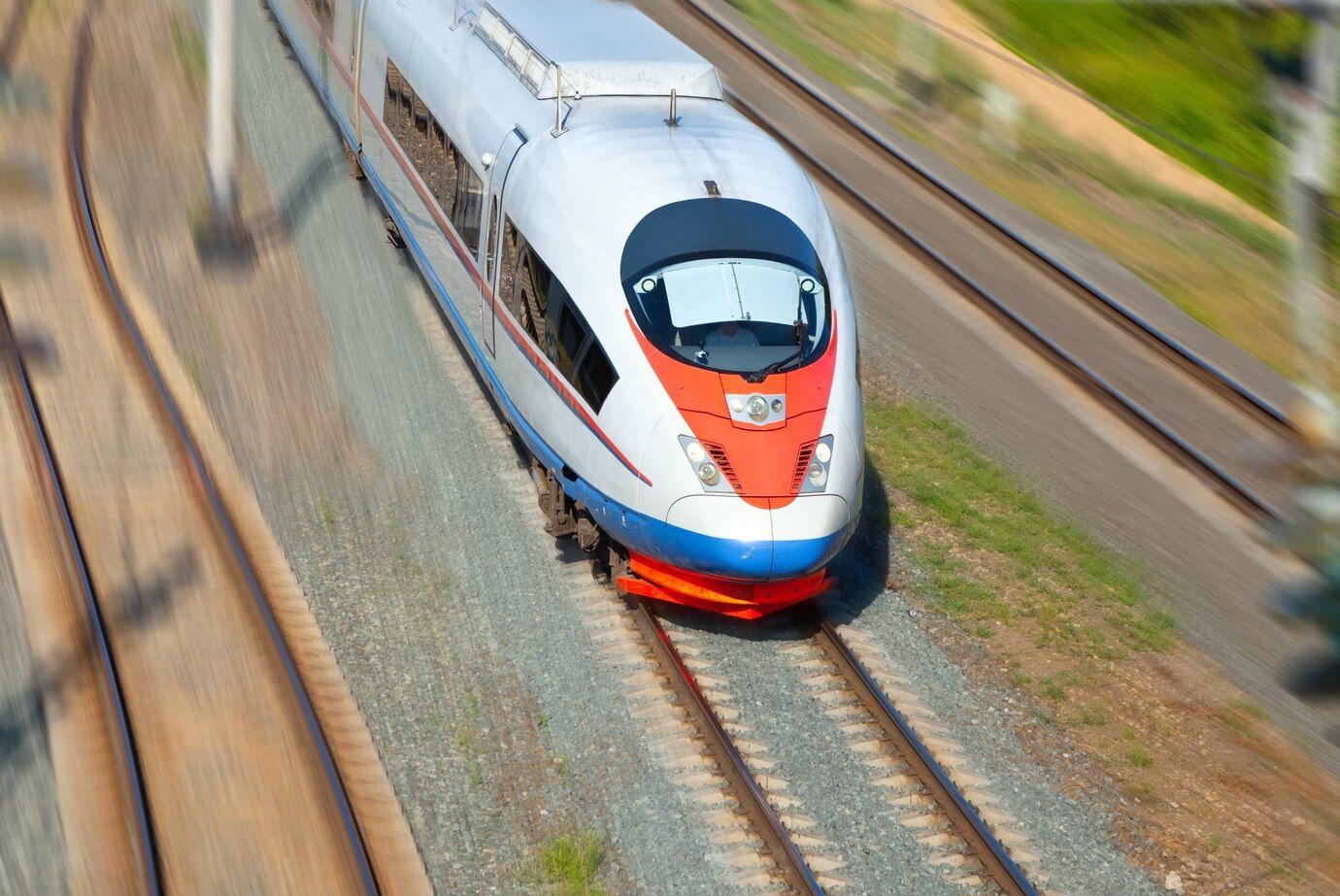
In the EU railway network, high-speed railway lines designed for speed of 250 km/h or more often span national borders, facilitating seamless high-speed travel across the EU. This interoperable network has seen significant growth over the past decade. From 2013 to 2023, it expanded by 2 744 km (+47.2%) to 8 556 km.

In 2023, Spain led the way with 3 190 km of high-speed lines, an increase of 66% from 1 919 km in 2013, followed by France with 2 748 km (+35% from 2 036 km), Germany with 1 163 km (+32% from 881 km) and Italy with 1 097 km (+63% from 675 km). Belgium recorded 211 km of high-speed lines and the Netherlands 90 km (both unchanged from 2013). Denmark accounts for 57 km, inaugurated in 2019.
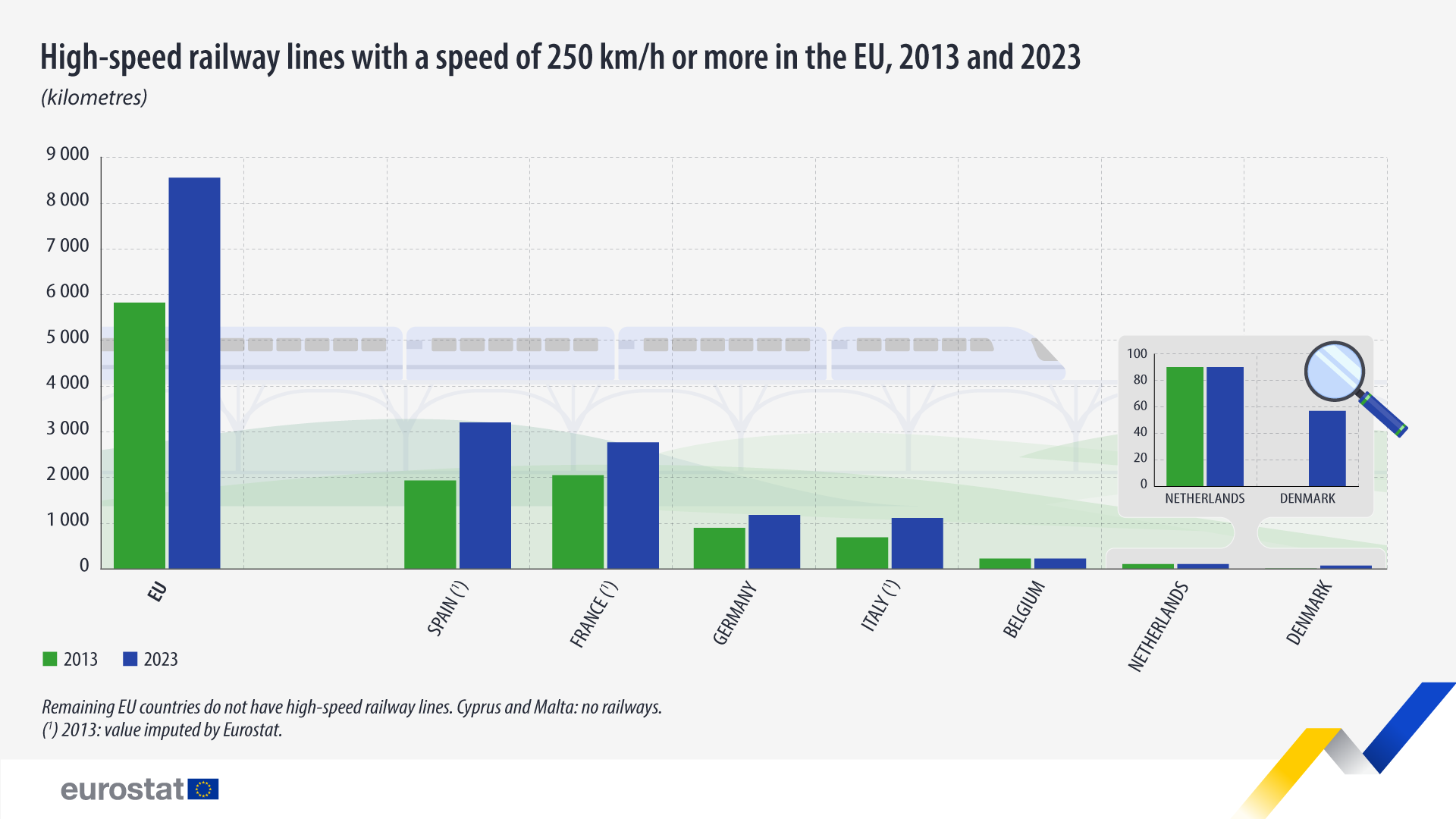
High-speed railway lines with a speed of 250 km/h or more in the EU, 2013 and 2023. Bar chart. See link to full dataset below.

More information Eurostat.

Publicaciones relacionadas:

European Commission approves up to €1.4 billion for fourth major project of common European interest in the hydrogen value chain EU cohesion policy: 77 million euros for green transport in Andalusia Commission proposes more flexible exceptions regime and targeted relief to airlines Spain: 285 million euros to contribute to rail freight development ruedas de camionesEU-funded project converts traditional lorries into zero-emission trucks



Environmental Affairs,  Transport 2013-2023,  250 km/h,  Belgium,  Denmark,  EU,  France,  Germany,  growth,  high-speed railway lines,  increase,  interoperability,  Italy,  km,  national borders,  Netherlands,  railway network,  Spain,  transportation,  Transporte

“This is a space for debate. All comments, for or against publication, that are respectful and do not contain expressions that are discriminatory, defamatory or contrary to current legislation will be published”.

Reader Interactions

Leave a Reply Cancel reply

Your email address will not be published. Required fields are marked *

This site uses Akismet to reduce spam. Learn how your comment data is processed.

Primary Sidebar

Footer

  • CDE Almería
  • Biblioteca Nicolás Salmerón – Universidad de Almería
  • Planta: 1ª, Despacho: 1.05.0B.
  • Ctra. Sacramento s/n. Almería (Spain)
  • Teléfono: (+34) 950 015266

HOME
NEWS
DOCUMENTATION
EUROPE ON THE NET
ABOUT US

  • LEGAL NOTICE
  • PRIVACY POLICY
  • COOKIE POLICY
  • ACCESSIBILITY
  • SITEMAP

Copyright © 2026 CDE Almería · Creative Commons LicenseThis work is licensed under a Creative Commons Attribution-NonCommercial 4.0 International License.

<p>El Centro de Documentación Europea de la Universidad de Almería utiliza cookies propias y de terceros para facilitar al usuario la navegación en su página Web y el acceso a los distintos contenidos alojados en la misma. Asimismo, se utilizan cookies analíticas de terceros para medir la interacción de los usuarios con el sitio Web. Pinche el siguiente enlace si desea información sobre el uso de cookies y como deshabilitarlas. </p>

Politica de privacidad

El Centro de Documentación Europea de la Universidad de Almería utiliza cookies propias y de terceros para facilitar al usuario la navegación en su página Web y el acceso a los distintos contenidos alojados en la misma. Asimismo, se utilizan cookies analíticas de terceros para medir la interacción de los usuarios con el sitio Web. Pinche el siguiente enlace si desea información sobre el uso de cookies y como deshabilitarlas. <a href="/politica-de-cookies" rel="noopener" target="_blank">Más información</a>

Cookies estrictamente necesarias

Las cookies estrictamente necesarias tiene que activarse siempre para que podamos guardar tus preferencias de ajustes de cookies.

Básicamente la web no funcionara bien si no las activas.

Estas cookies son:

  • Comprobación de inicio de sesión.
  • Cookies de seguridad.
  • Aceptación/rechazo previo de cookies.
Cookies de terceros

Esta web utiliza Google Analytics, Google Tag Manager y Yandex Metrika para recopilar información anónima tal como el número de visitantes del sitio, o las páginas más populares.

Dejar estas cookies activas nos permite mejorar nuestra web.

Política de cookies

Pinche el siguiente enlace si desea información sobre el uso de cookies y como deshabilitarlas. Más información