
Following the holding of the referendum on self-determination on 1 October 2017 in Catalonia (Spain), the Spanish Public Prosecutor’s Office, the Spanish State Counsel and the VOX political party brought criminal proceedings against a number of individuals, including Carles Puigdemont i Casamajó (then President of the Generality of Catalonia), Antoni Comín i Oliveres and Clara Ponsatí i Obiols (then members of the Autonomous Government of Catalonia).
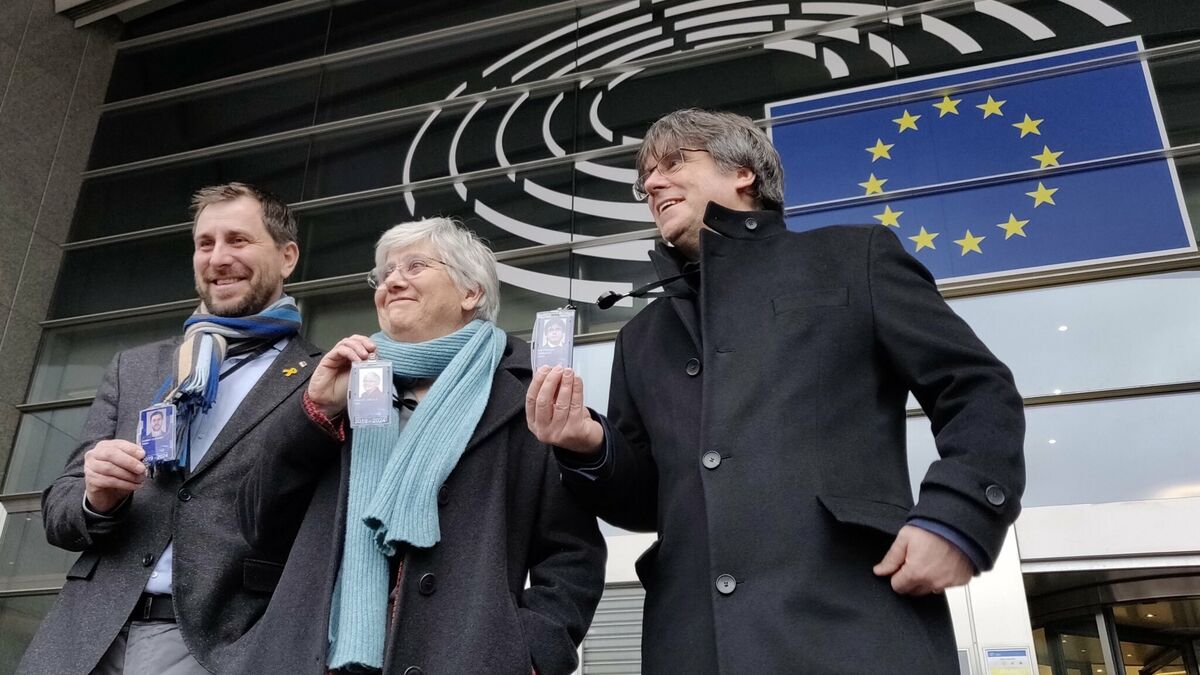
In March 2018, the Spanish Supreme Court issued an order charging Mr Puigdemont, Mr Comín and Ms Ponsatí with the alleged offences of insurgency and misuse of public funds. By order of 9 July 2018, the Spanish Supreme Court declared that they had refused to appear following their flight from Spain and stayed the criminal proceedings instituted against them until such time as they are found.
Mr Puigdemont, Mr Comín and Ms Ponsatí subsequently applied to stand as candidates in the elections to the European Parliament held in Spain on 26 May 2019. As a result, Mr Puigdemont and Mr Comín were elected. However, their names were not on the list of candidates elected in Spain because they had not taken the oath or promised to respect the Spanish Constitution required by national law. Their seats were therefore declared vacant, and all the prerogatives to which they might be entitled by virtue of their duties were suspended until such time as they took that oath or made that promise.
By email of 10 October 2019, the Member of the European Parliament, Ms A, acting inter alia on behalf of Mr Puigdemont and Mr Comín, asked the European Parliament to defend their parliamentary immunity.
In the meantime, arrest warrants against Mr Puigdemont, Mr Comín and Ms Ponsatí were issued by the investigating judge of the Criminal Chamber of the Spanish Supreme Court, so that they might be tried in the criminal proceedings at issue.
By letter of 10 December 2019 addressed to Ms A, the President of the Parliament replied to the request for defence of the immunity of Mr Puigdemont and Mr Comín, drawing attention to the fact that the Parliament could not regard them as Members of the Parliament in the absence of official notification of their election by the Spanish authorities. Mr Puigdemont and Mr Comín ask the General Court of the European Union to annul the decision of the President of the Parliament allegedly contained in that letter.

European justice again refuses to restore Puigdemont’s immunity |
Following delivery of the judgment of the Court of Justice of the European Union of 19 December 2019, Junqueras Vies, the Parliament took note, at the plenary session of 13 January 2020, of the election to the Parliament of Mr Puigdemont and Mr Comín with effect from 2 July 2019. On the same day, the Spanish Supreme Court asked the Parliament to waive the parliamentary immunity of Mr Puigdemont and Mr Comín.
Following the withdrawal of the United Kingdom of Great Britain and Northern Ireland from the European Union on 31 January 2020, Ms Ponsatí also became a Member with effect from 1 February 2020. The Spanish Supreme Court requested the waiver of her immunity on 10 February 2020, the same day as the Parliament took note of her election.
By decisions of 9 March 2021, the Parliament decided to waive the immunity of Mr Puigdemont, Mr Comín and Ms Ponsatí. The three Members ask the General Court of the European Union to annul those decisions.
By its judgment delivered today in Case T-115/20, the General Court dismisses the action brought by Mr Puigdemont and Mr Comín.
The General Court considers that, by the decision contained in his letter of 10 December 2019, the President of the Parliament, in essence, implicitly refused to announce in Parliament the request for the defence of the parliamentary immunity of Mr Puigdemont and Mr Comín and to refer that request to the committee responsible for examination. However, the Court considers that the defence decision requested was not in any event capable of producing binding legal effects, so that (much like such a decision, had it been adopted) that implied refusal does not constitute an act open to challenge. The Parliament cannot adopt decisions to defend immunity which produce binding legal effects with regard to the Spanish judicial authorities, either on the basis of its exclusive competence to waive that immunity or on the basis of the national law to which EU law refers.
By its judgment delivered today in Case T-272/21, the General Court dismisses the action brought by Mr Puigdemont, Mr Comín and Ms Ponsatí against the Parliament’s decisions to grant the requests for waiver of their immunity.
The General Court rejects all the pleas put forward by the three Members, in particular their arguments that the Parliament erred in concluding that the legal proceedings at issue were not brought with the intention of damaging the Members’ activities. In reaching that conclusion, the Parliament relied on a number of factors, considered together, namely the fact that the alleged offences were committed in 2017, whereas the applicants acquired the status of Members of the Parliament on 13 June 2019 and the facts that, first, they were charged on 21 March 2018, that is to say, at a time when the acquisition of the status of Member of the European Parliament was hypothetical and, second, that that indictment also covered other persons who were not Members of the Parliament. According to the General Court, during its examination of a request for waiver of immunity, the Parliament is not required to examine the legality of the Spanish judicial acts. That question falls exclusively within the competence of the national authorities.
The three Members also claimed that the Parliament infringed the principle of impartiality. The General Court points out in that regard that the equal rotation of the position of rapporteur does not preclude the appointment of a single rapporteur to examine a number of connected immunity cases where, as is the case here, the requests for waiver of immunity concern Members who are the subject of the same criminal proceedings.
Furthermore, the rapporteur’s task is entrusted to a Member who, by definition, is not politically neutral. However, that Member, who is part of a given political group, acts in the context of a committee whose composition reflects the balance of political groups within the Parliament. The Court notes that the rapporteur responsible for the request for waiver of Mr Puigdemont’s immunity was appointed by the Committee on Legal Affairs, in accordance with the equal rotation of roles established between the political groups.
The General Court states that the fact that the rapporteur responsible for examining requests for waiver of immunity belongs to the European Conservatives and Reformists political group (ECR) is therefore, in principle, irrelevant to the assessment of his impartiality. It is true that that political group also includes the Members of the VOX political party, who are behind the criminal proceedings brought against the three Members. However, that special situation concerns Members of that party and cannot extend, as a matter of principle, to all the members of the ECR on the sole ground that, since they belong to the same group, they share political affinities.
Source: CURIA
Publicaciones relacionadas:
 European justice again refuses to restore Puigdemont’s immunity
 Judgment of the ECJ on the imposition of compensation claims for flight delays
 Poland, Hungary and the Czech Republic have failed to fulfil their obligations under European Union law
 Judgment of the CJEU on homophobic discrimination in the workplace
 Judgment of the CJEU on the sale of vehicles unlawfully manipulated by the manufacturer
Leave a Reply