
Ten years ago, EIGE introduced the Gender Equality Index as a marker for the status quo of gender equality in the EU. Each edition came with more or less the same conclusion: progress is at a snail’s pace. However, in this year’s edition we see the biggest annual jump in the overall score in the history of the Index ever: the EU is at 70.2 points out of 100!
Unpacking 70.2 – no room for complacency
Top performing countries such as Sweden, the Netherlands and Denmark continue to lead the way in the Index – as they have done over a decade.
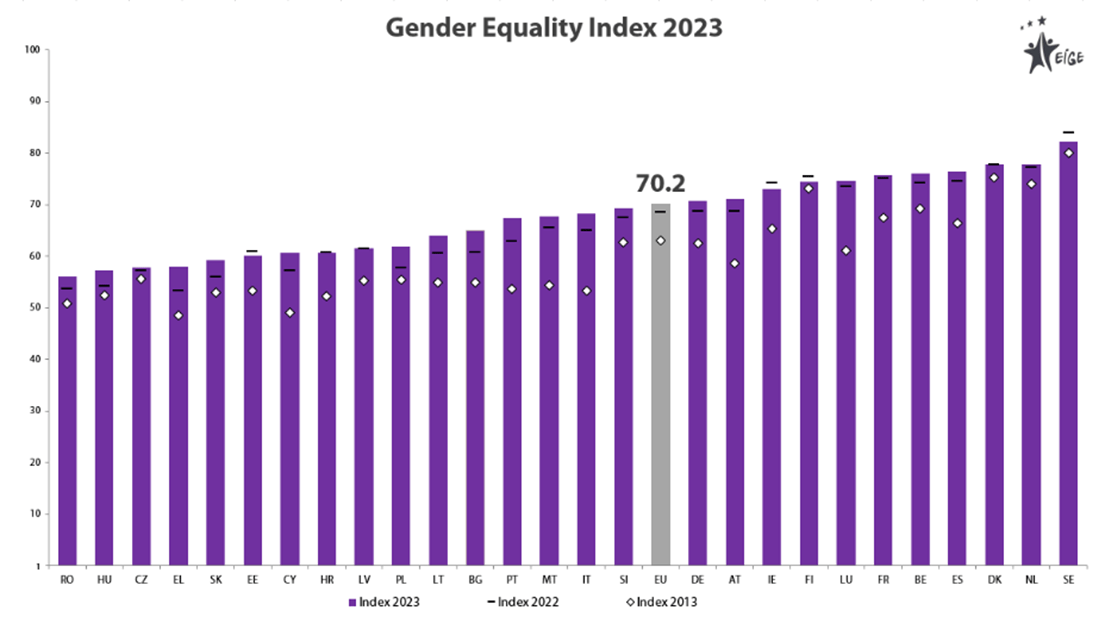
Yet, either their progress has plateaued, or they have suffered a slip in points – as we see in countries such as Finland or France. This clearly shows that gains cannot be taken for granted. They need to be anchored and supported by measures to maintain progress.
On the other end, we see countries like Italy, Portugal, Luxembourg and Malta who despite scoring below the EU average, have made vast improvements in gender equality in the last 10 years. So, when countries put in place measures, the pace in progress picks up.
Taking a closer look at change
About Time – unpaid care is still uneven between women and men
The gender care gap is shrinking. But not because men are shouldering more of the care work. Women are doing less. Assisting technologies, home delivery services or increased women’s employment could have contributed to this change. But technology can only support some change by outsourcing a portion of care duties. Structural change will be needed to go the last mile – as Claudia Goldin, professor of economics and 2023 Nobel Prize winner, puts it “We’re never going to have gender equality until we also have couple equity”.
Push for Power – progress on company boards, not so much in national parliaments
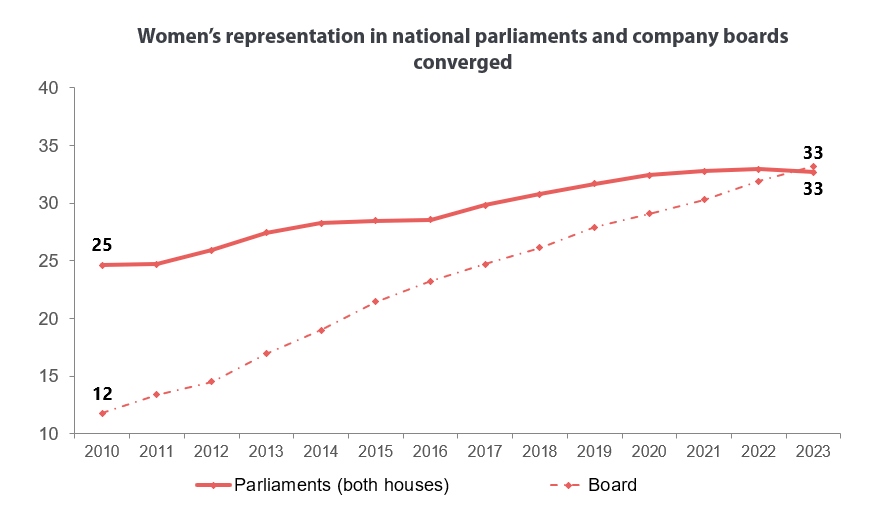
For the first time in 10 years, the number of women in parliaments and women on boards has converged at 33%.
Legislation leads the way for significant change. Legislated quotas in eight EU Member States helped to break the glass ceiling in companies, seeing more women at the top – bringing more innovation, creativity and productivity to the boardrooms. The Gender Balance on Corporate Boards Directive – approved last year –will hopefully keep the momentum up and have a spillover effect on other EU Member States.
Now, we need more targeted action in parliaments to speed up progress in the political sphere – especially with the European Parliamentary elections in 2024.
Work To Be Done – gender-segregation in the labour market hasn’t moved an inch
There has been progress in the area of work, particularly regarding flexible working opportunities. But it is striking that the labour market remains as gender segregated today as it was 10 years ago.
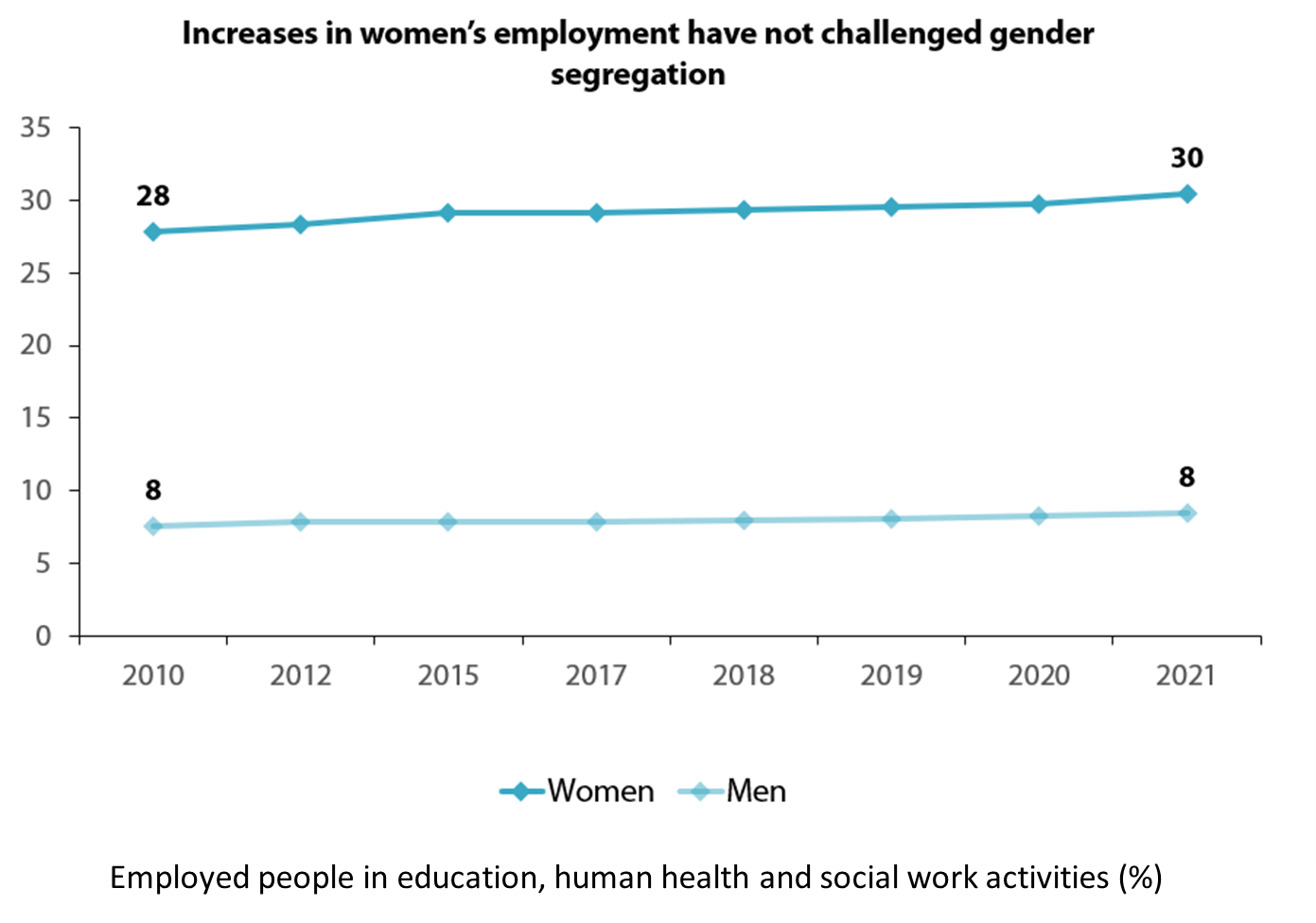
As the digital and green transition takes shape, more and more new jobs are created – requiring reskilling and upskilling to meet new and evolving demands in the labour market. Women are not as involved as they could be. They are step by step catching up with science technology, engineering and mathematics (STEM) job demands, but the share of men in education, health and welfare (EHW) occupations is frozen. The green transition will not just create the demand for STEM skills, but it will also create new demands in the care sector where there is a shortage of people.
Far From the Finish Line?
This year’s Gender Equality Index shows that progress is possible, but it remains fragile when not backed up by actions in all areas of life, across all EU Member States. The work here is not done. We need to go further. Going the distance means having an intersectional perspective – especially in climate change where gender disparities are experienced by different individuals and groups. Knowledge leads to change.
More inforation: EIGE
Publicaciones relacionadas:
 Covid-19 and gender-based violence: Has the pandemic taught us anything?
 Gender Equality Index 2021: Fragile gains, big losses
 How Spain and the EU can take steps forward for gender equality
 4 in 5 NATO Council Representatives are Men: The Need for More Female Representation
 International Women’s Day 2020: Beijing Declaration 25 years after
Leave a Reply