
The new CORDIS Synergy Info Pack on Delivering growth and the green transition highlights how projects coming from different countries, sectors and funding programmes are all working towards the same shared goal: delivering the European Green Deal and its commitment to a climate-neutral future that benefits everyone.
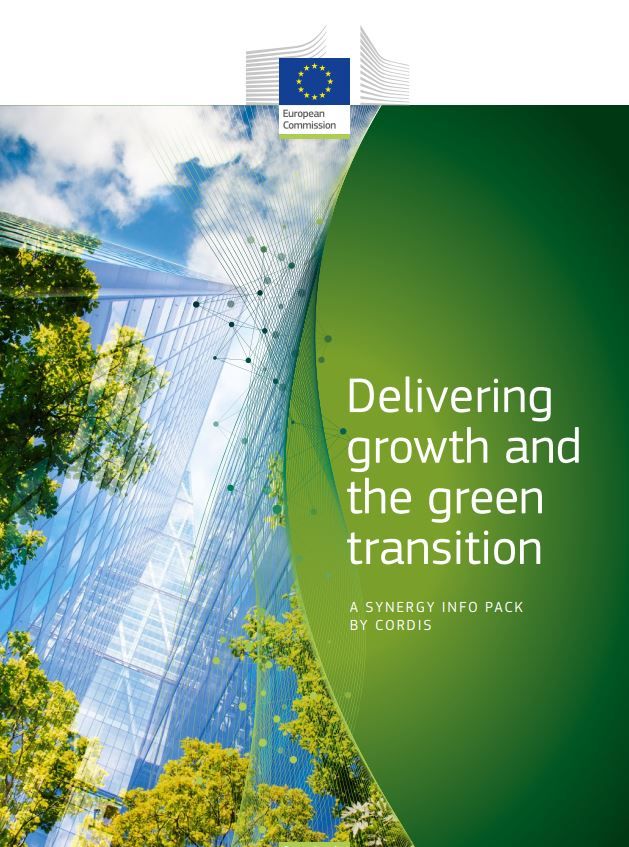
The European Green Deal is the EU’s commitment to lead the way on climate action, and to shape a green transition that benefits citizens and industries. It sets a goal of reducing net greenhouse gas emissions by at least 55 % by 2030 and, ultimately, becoming the world’s first climate-neutral continent. While the European Green Deal provides the blueprint for how to transform our economy and societies, it is EU-funded projects that deliver this change, as showcased by the 35 unique ones highlighted in a new CORDIS Synergy Info Pack.
Making transport sustainable
Take for example transportation. The backbone of European businesses and global supply chains, Europe’s transport systems contribute around 5 % to the EU GDP and employ over 10 million people. But with transport responsible for nearly a quarter of the EU’s total greenhouse gas emissions, these numbers come at a price. Working to reduce this carbon footprint are a range of EU-funded projects. These include everything from a comprehensive network of ultra-fast charging stations across Europe, to innovative wind propulsion systems on commercial ships that can reduce both fuel consumption and CO2 emissions by as much as 45 %.
Nature-based solutions
Europe’s natural environments provide a bounty of natural and economic wealth, as well as a key resource in climate mitigation and adaptation efforts. The EU aims to leverage nature-based solutions to position Europe as a leader in building more sustainable societies. In the Netherlands, EU-funded research helped to provide farmers with a new generation of organic, plant-derived bio-stimulants, while work underway in Germany’s peatlands aims to revive their potential to act as carbon sinks.
A clean energy transition
Also at the heart of the European Green Deal is the transition to clean energy – a transition made possible in part by the projects highlighted in Chapter 3. Among those projects is a 20 megawatt solar energy park in Finland that will reduce CO2 emissions by approximately 1 540 tonnes per year. Meanwhile in Iceland, the CarbFix 2 project is showing how CO2 can be stored permanently underground as carbonate rock.
Decarbonising heavy industry
EU-funded research is also at the heart of Europe’s green industrial revolution. Chapter 4 covers such key topics as decarbonising challenging industries such as steel and electricity generation. Here you can read about a project supporting a blast furnace fuelled by green hydrogen. Last but not least, the publication highlights how the EU supports local climate action and helps ensure that the transition to a green future is a just and inclusive one.
Funding a green future
While each of the projects featured in the new Synergy Info Pack has its own individual objectives, together, they are delivering on the Green Deal’s promise of a climate-neutral future that benefits everyone. All the projects are managed by CINEA, the European Climate, Infrastructure and Environment Executive Agency. Established by the European Commission, CINEA contributes to the European Green Deal by implementing parts of EU funding programmes for transport, energy, climate action, environment, and maritime fisheries and aquaculture. Published by CORDIS, Synergy Info Packs highlight the synergies between projects funded under various EU funding programmes, including Horizon Europe, LIFE, CEF Transport, CEF Energy, EMFAF, the Innovation Fund, and RENEWFM .
Further information: CORDIS
Publicaciones relacionadas:
 In a first, the EU produced more energy from renewables than fossil fuels in 2020
 Global emissions cuts in line with Paris Agreement mean near-term benefits for Earth
 Building urban resilience to climate change
 World’s glaciers melting faster this century
 Accelerated rates of change in Earth’s vegetation go back thousands of years
Leave a Reply