
The eleventh package addresses the growing circumvention of EU sanctions. Measures include the strengthening of bilateral and multilateral cooperation with third countries to impede sanctions’ circumvention, a ban on the transit of goods and technology via Russia, and tighter export restrictions.
Circumvention tool
In order to address the growing circumvention of EU sanctions, the EU decided to further strengthen bilateral and multilateral cooperation with third countries, and the provision of technical assistance.
Only in those cases where cooperation does not yield the intended results, the EU will take rapid, proportionate and targeted action, which is solely aimed at depriving Russia of the resources which allow it to pursue its war of aggression against Ukraine, in the form of appropriate individual measures addressing the involvement of third-country operators in facilitating circumvention.
The Union will re-engage in a constructive dialogue with the third country in question following the adoption of such individual measures.
In the event that, in spite of individual sanctions and further engagement, circumvention remains substantial and systemic, the EU will have the possibility to take exceptional, last resort measures. In this event the Council may unanimously decide to restrict the sale, supply, transfer or export of goods and technology whose export to Russia is already prohibited – notably battlefield products and technologies – to third countries whose jurisdiction is demonstrated to be at a continuing and particularly high risk of being used for circumvention.
Transit ban
In order to further minimise the risk of sanctions’ circumvention, this decision prohibits the transit via the territory of Russia of more goods and technology which may contribute to Russia’s military and technological enhancement or to the development of the defence or security sector, goods and technology suited for use in aviation or space industry and jet fuel and fuel additives, exported from the EU to third countries.
Import-export controls and restrictions
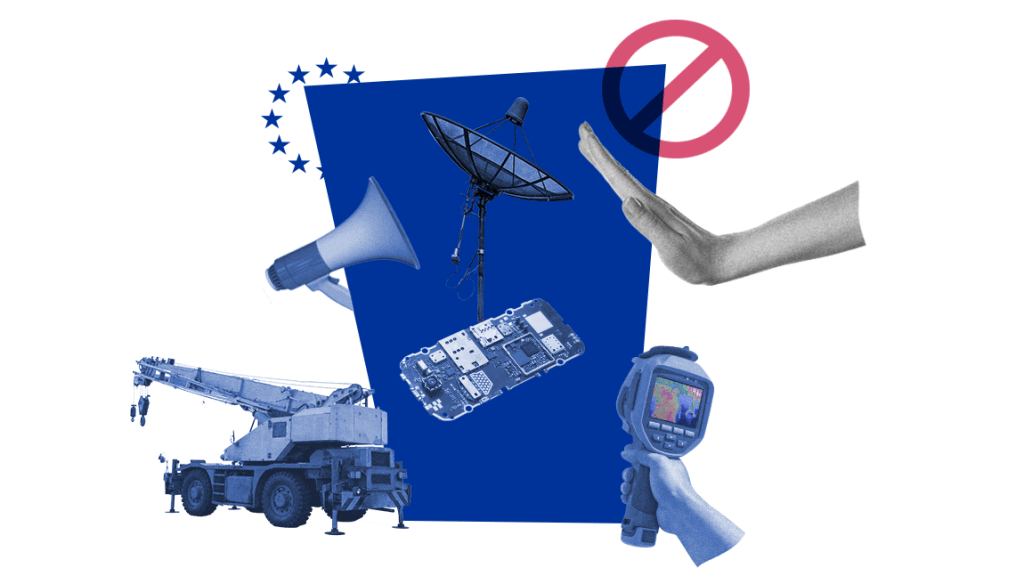
The Council added additional 87 entities to the list of entities directly supporting Russia’s military and industrial complex in its war of aggression against Ukraine. They will be subject to tighter export restrictions concerning dual use goods and technologies.
The list includes four Iranian entities manufacturing unmanned aerial vehicles (drones) and providing them to Russia, other third-country entities involved in the circumvention of trade restrictions, and certain Russian entities involved in the development, production and supply of electronic components for Russia’s military and industrial complex.
Furthermore, this decision expands the list of restricted items that could contribute to the technological enhancement of Russia’s defence and security sector to include: electronic components, semiconductor materials, manufacturing and testing equipment for electronic integrated circuits and printed circuit boards, precursors to energetic materials and precursors to chemical weapons, optical components, navigational instruments, metals used in the defence sector and marine equipment.
Broadcasting
In order to address the Russian Federation’s systematic, international campaign of media manipulation and distortion of facts aimed at enhancing its strategy of destabilisation of its neighbouring countries – the EU and its member states -, the Council extended the suspension of broadcasting licences to five additional media outlets: RT Balkan, Oriental Review, Tsargrad, New Eastern Outlook and Katehon. These outlets are under the permanent direct or indirect control of the leadership of the Russian Federation and have been used by latter for its continuous and concerted propaganda actions targeted at the civil society in the EU and neighbouring countries, gravely distorting and manipulating facts.
10th Russian sanctions package agreed by the EU |
In particular, the propaganda has repeatedly and consistently targeted European political parties, especially during election periods, as well as civil society, asylum seekers, Russian ethnic minorities, gender minorities, and the functioning of democratic institutions in the EU and its member states.
In line with the Charter of Fundamental Rights, these measures will not prevent those media outlets and their staff from carrying out activities in the EU other than broadcasting, e.g. research and interviews.
Roads and ports
The EU extended the prohibition to transport goods into the EU by road to trailers and semi-trailers registered in Russia, including when hauled by trucks registered outside of Russia.
Furthermore, in view of the sharp increase of deceptive practices by vessels transporting crude oil and petroleum products, the Council decided to prohibit access to EU ports and locks to any vessels that engage in ship-to-ship transfers, if the competent authorities have reasonable cause to suspect that the vessel is either in breach of the ban on importing seaborne Russian crude oil and petroleum products into the EU, or is transporting Russian crude oil or petroleum products purchased above the price cap agreed by the Price Cap Coalition.
The same prohibition will apply to vessels when competent authorities have solid reasons to suspect that they illegally interfere, switch off or otherwise disable their navigation system when transporting Russian crude oil and petroleum products in breach of international agreements, rules and standards.
Energy
The temporary derogation granted to Germany and Poland for the supply of crude oil from Russia through the northern section of the Druzhba oil pipeline will end. However, the oil which originates in Kazakhstan or another third country will be able to continue to transit through Russia and imported into the EU via the Druzhba oil pipeline.
Individual listings
In addition to economic sanctions, the Council decided to list a significant amount of additional individuals and entities.
Background
In the European Council conclusions of 23 March 2023, the EU reiterated its resolute condemnation of Russia’s war of aggression against Ukraine, which constitutes a manifest violation of the UN Charter. The EU also reiterated that it remained committed to maintaining and increasing collective pressure on Russia, including through possible further restrictive measures.
The European Council conclusions also underlined the importance and urgency of stepping up efforts to ensure the effective implementation of sanctions at European and national level and its firm commitment to effectively preventing and countering their circumvention in and by third countries.
The EU stands firmly and fully with Ukraine and will continue to provide strong political, economic, military, financial and humanitarian support to Ukraine and its people for as long as it takes.
The relevant legal acts will soon be published in the Official Journal of the EU.
More information: Council of the EU
Publicaciones relacionadas:
 EU renews individual sanctions against Russia
 Russia’s military aggression against Ukraine: EU imposes sanctions against President Putin and Foreign Minister Lavrov and adopts wide ranging individual and economic sanctions
 Russian military control of Ukraine nuclear plants cause for grave concern, nuclear energy agency warns
 President Metsola asks Russia to free protesters: truth is not easily suppressed
 Disinformation: The harder you push, the harder they resist
Leave a Reply