
The III Security Roundtable comprehensively addressed the strategic support to confront organised crime from its different aspects: border security, maritime security, cybersecurity, prison security and the preventive axis in terms of drug consumption and trafficking.
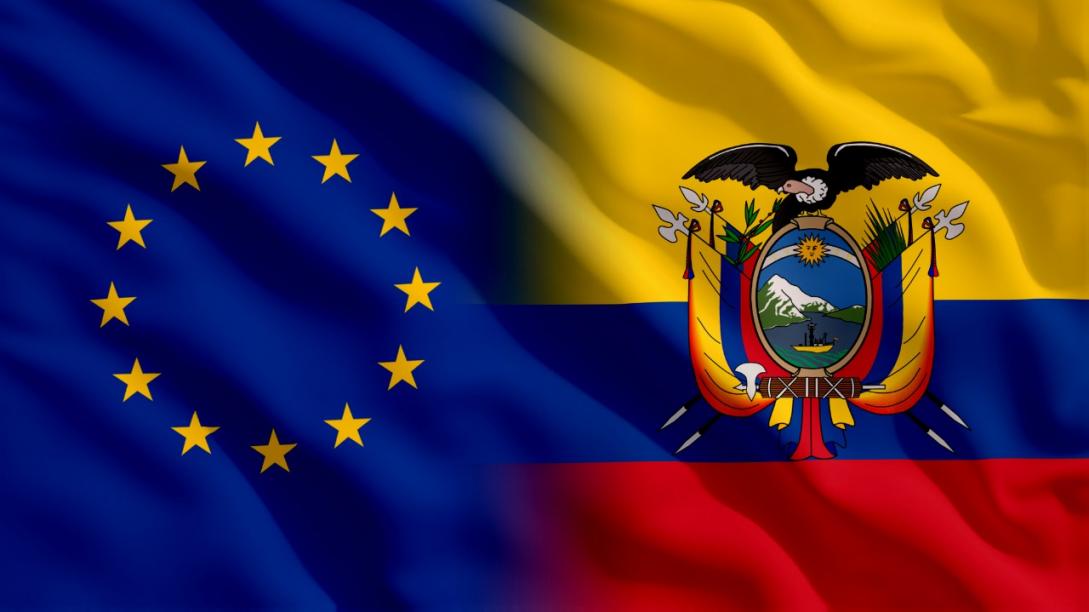
During the III Technical Roundtable on Security Cooperation between Ecuador and the European Union, it was agreed to broaden and deepen their bilateral cooperation in security matters. The event took place on 26 and 27 September.
This technical working space evaluated the current situation of the national and regional programmes financed by the EU in the area of security in which Ecuador participates, such as: EURESP, GIFP, EL PAcCTO, Copolad III, Eurofront, Seacop, Crimario, Cybernet, Cyber4dev, GLACY+, Copernicus, among others.
The III Roundtable was co-chaired by the Undersecretary of Economic Affairs and International Cooperation of the Ministry of Foreign Affairs, Isabel Albornoz, and the Ambassador of the European Union in Ecuador, Charles-Michel Geurts.
Undersecretary Albornoz stressed that the EU is one of Ecuador’s most important partners in security issues and has one of the strongest cooperation structures at regional level. “We greatly appreciate the EU’s response since the beginning of the establishment of this roundtable and its willingness to cooperate with Ecuador. We have to work under the principle of shared responsibility to achieve effective action and confront transnational organised crime. Ecuador has the political will to do so, and this is an aspect that is now becoming a state policy,” Albornoz stressed.
Socialization days for the “Horizon Europe” research and innovation promotion program in Ecuador
|
For his part, Ambassador Geurts underlined that in this III Roundtable the Ecuadorian context has changed compared to the previous year. He indicated that it is much more complex, but that “the European Union is responding. The visit of the Commissioner for Home Affairs, Ylva Johansson, was a strong signal that gave impetus to a new generation of bilateral projects that are currently in the evaluation phase.
He further argued that: “the fight against organised crime based exclusively on the interception of drugs and the arrest and prosecution of the actors in the illicit market shows its limits when it is not part of a comprehensive strategy”. Quoting the recently published blog of Josep Borrell, High Representative for Foreign Affairs and Security Policy / Vice-President of the European Commission, he added that “Their fight is our fight”.
The III Security Roundtable comprehensively addressed strategic support to tackle organised crime from its different aspects: border security, maritime security, cyber security, prison security and the preventive axis on drug use and trafficking.
The counterparts established a list of deliverables that will mark the cooperation between the EU and Ecuador in the next 12 months. The participants also agreed to promote work on prevention and citizen security, to promote the interoperability of intelligence systems and to address new security threats, such as terrorism.
Finally, the counterparts welcomed the efforts of the Ecuadorian Government in the process of negotiating a working agreement with EUROPOL that will allow the sending of a liaison officer to this European agency and the efforts to sign a Memorandum of Understanding with the European Monitoring Centre for Drugs and Drug Addiction.
The technical round table was attended by the authorities of the national security, human rights and foreign ministry institutions, as well as representatives of the EU Delegation in Ecuador, EU-funded programmes and EU member countries: Germany, Austria, Belgium, Spain, France, Hungary, Italy and the Netherlands.
More information: Delegación de la Unión Europea en Ecuador
Publicaciones relacionadas:
 Intensified judicial response to serious cross-border crimes
 Joint Statement on the repudiatory acts of violence in Putumayo and the process of dialogue between the Government and the Central General Staff
 Agreement on naval cooperation reached between European Union and Japan
 Afghanistan: EU’s position and next steps
 The European Commission proposed a pilot project to strengthen the exchange of information between Europol and Colombia
Leave a Reply