
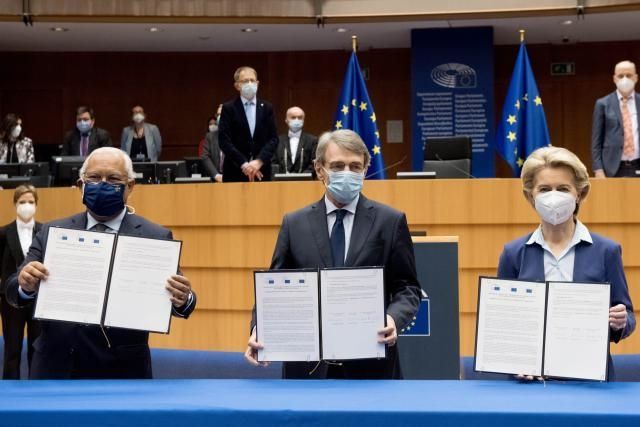
European Parliament President, David Sassoli, Prime Minister of Portugal António Costa, on behalf of the Presidency of the Council, and Commission President Ursula von der Leyen have signed the Joint Declaration on the Conference on the Future of Europe. This paves the way to launching a series of debates and discussions that will enable people from every corner of Europe to share their ideas to help shape Europe’s future.
President Sassoli said:
“Today marks a new start for the European Union and for all European citizens. The Conference on the future of Europe will be a unique opportunity for all European citizens and our civil society to shape Europe’s future, a common project for a functioning European democracy. We call on all of you to come forward to participate with your voice to building what will be tomorrow’s Europe, what will be YOUR Europe.”
Prime Minister Costa said:
“The convening of the Conference on the Future of Europe is a message of confidence and hope for the future that we send Europeans. Confidence that we will overcome the pandemic and the crisis; hope that together we will build a fair, green and digital future Europe.”
President von der Leyen said:
“Today we are inviting all Europeans to speak up. To say what Europe they want to live in, to shape it and join forces to help us build it. Citizens’ expectations are clear: they want to have their say on the future of Europe, on matters which affect their lives. Our promise today is equally clear: we will listen. And then, we will act.”
The Conference sets itself the goal of giving citizens a greater role in shaping EU policies and ambitions, improving the Union’s resilience to crises, be it economic or health-related. It will create a new public forum for an open, inclusive, transparent and structured debate with Europeans around the issues that matter to them and affect their everyday lives.
The Joint Declaration gives a non-exhaustive list of possible themes for the Conference. It mentions health, climate change, social fairness, digital transformation, the EU’s role in the world, and how to strengthen democratic processes governing the EU. These topics concur with overarching EU priorities and the issues raised by citizens in opinion polls. Ultimately, participating citizens will decide what topics the Conference will discuss.
Next steps
The Conference is under the authority of the three institutions leading this endeavour, represented by their Presidents, acting as its Joint Presidency. An Executive Board, equally representing the three institutions will soon be constituted, with national Parliaments having observer status. The Executive Board will oversee the works of the Conference, and prepare the Conference Plenary meetings, including citizens’ input and their follow up.
Background
The Joint Declaration sets out the scope, structure, objectives and principles of the Conference. It sets the scene for citizen-led events, to be co‑organised with civil society and stakeholders at all levels, national and regional Parliaments, the Committee of the Regions, the Economic and Social Committee, social partners and academia. Their participation in the process is essential, to ensure the broadest outreach and engagement.
The Conference will use various fora, including digital, and where possible, also physical formats, respecting COVID rules. An interactive multilingual digital platform will allow citizens and stakeholders to submit ideas online, and help them participate in or organise events.
The platform, and all events organised under the auspices of the Conference, are to be based on principles of inclusiveness, openness and transparency, with respect for privacy and EU data protection rules. European Citizens’ panels organised at European level are to be broadcast, and all online submissions are to be made public.
The Conference is invited to reach conclusions to provide guidance for Europe’s future direction.
More information
Press release – European Commission
Conference on the Future of Europe
Joint Declaration on the Conference on the Future of Europe
Conference on the Future of Europe – revised Council position (3 February 2021)
Commission communication on the Conference of the Future of Europe (22 January 2020)
European Parliament’s position on the Conference on the Future of Europe (15 January 2020)




Leave a Reply