
To mark the 35th anniversary of the emblematic Erasmus+ programme, Vice-President Margaritis Schinas and Commissioner Mariya Gabriel will meet 35 current and former Erasmus+ participants as well as representatives of the founding team of the programme, on Tuesday, 20 September 2022. The event will honour the achievements of the programme, that has involved 13 million people since its creation in 1987.

Each participant will share personal experiences, and discuss achievements and challenges of the EU’s flagship programme for education, training, youth and sport.
There have been substantial changes to the Erasmus+ over the years; it has been continuously modernised, expanded and opened up to countries that were not part of it in its early days. Starting with just 3,000 university students, the programme now offers cooperation and mobility opportunities in school education for pupils and teachers, in vocational education and training, higher education and adult education, as well as projects for apprentices, young people, youth workers, and even (as of 2023) sport coaches. This enlargement in geographic and sectoral scope resulted in 2021, despite the adverse sanitary situation, in over 615.000 realised mobilities. In 2014, the name changed to Erasmus+ to mark the broadening of the programme to all education fields as well as Youth and Sport. Erasmus+ brings opportunities for all ages to discover other countries through a wide choice of participating organisations.
Erasmus+ annual report 2020
|
Challenges have been turned into opportunities, as Erasmus+ was adapted to quickly respond to the COVID-19 pandemic through simplified rules and procedures to better accommodate for mobilities, and with two extraordinary calls for proposals to support digital education readiness and creative skills.
Following the Russian war of aggression on Ukraine, the Erasmus+ programme ensured the greatest possible flexibility in implementing projects with a view to providing support to Ukrainian learners and education staff.
The current 2021-2027 Erasmus+ edition marks the integration of DiscoverEU into the programme. With this change and thanks to the exceptional funding granted in the context of the 2022 European Year of Youth, 70,000 travel tickets are being made available in 2022. DiscoverEU is open to 18 year-olds and gives the opportunity to discover Europe through travelling and learning experiences. The next application round will open on 11 October, and is now open to candidates from the EU and all Erasmus+ programme countries, namely Iceland, Liechtenstein, North Macedonia, Norway, Serbia and Turkey.
Viewers are invited to watch the discussion on 20 September live on the Erasmus+ website and on social media. They will also be able to participate and contribute to the debate online.
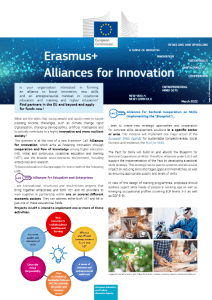
Erasmus+ alliances for innovation
|
Background
Erasmus+ was created in 1987, providing learning mobility opportunities to just 3000 university students. Since then, around 13 million people have taken part in the Erasmus+ programme.
For the period 2021-2027, Erasmus+ has an estimated budget of €26.2 billion, which is nearly doubled compared to the predecessor programme (2014-2020), and furthermore completed by around €2.2 billion from the EU external cooperation instrument.
Erasmus+ mobility and cooperation projects support the green and digital transitions, while helping to foster active citizenship and greater participation in democratic life. Inclusion remains a core priority of the programme to allow more people to learn and participate in transnational projects but also to reach out to increasing numbers of people with fewer opportunities.
More Information: European Commission – Press release
Publicaciones relacionadas:
 New Erasmus+ programme in the European Union
 What’s new in the Erasmus+ programme?
 Erasmus+: A success in 2020 in spite of restrictions
 Erasmus+: 44 European Universities to cooperate across borders and disciplines
 European Union sends largest batch of Pakistani students to European universities on scholarships
Leave a Reply