
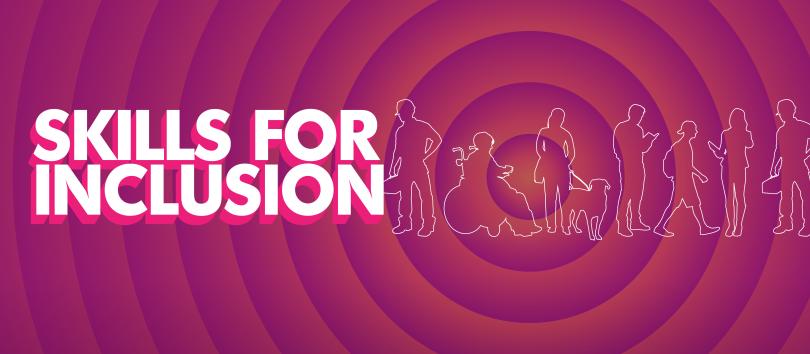
Social inclusion in education and skills development is taking centre stage in 2023, with the European Year of Skills running the agenda for the next months.
A recent survey within the European Union and ten of its neighbouring countries, undertaken by Eurofound and the ETF, reveals not only the number of challenges faced by societies to address social inclusion, especially for women, youth and vulnerable communities, but also the urgency needed to deal with them. The impact of the Covid-19 health pandemic, financial crisis, unemployment, and poor opportunities to education and training are just some of the critical issues with which people are struggling especially in the EU’s neighbouring countries.
‘It’s really shocking and a very serious situation. The levels of pessimism, dismay and financial struggles amongst citizens in both the EU and ten neighbouring countries are very high,’ says Cristina Mereuta, ETF Senior Human Capital Development Expert in Labour Market and Employment.
At the same time the demands of technological change, the greening of economies, globalisation and demographic factors, including migration and displacement due to environmental hazards and conflict, are profoundly influencing labour markets and the workplace and the skills people need to work and live. Education and skills development are critical to ensure individuals have access to, and remain engaged in, our fast-evolving workplaces and society.
The ETF’s Lida Kita, Senior Human Capital Development Expert on Social Inclusion outlines our approach to dealing with these challenges.
‘Through collaborations, knowledge-sharing and innovation, we are working to impact on policy-making and delivery,’ says Kita. ‘Through participation in its various networks with countries in the EU‘s neighbouring regions, we are saying you can change the mantra, and how we treat what are called excluded or marginalised groups,’ she adds.

Commission proposes to strengthen equality bodies to fight discrimination
|
What are we doing to support skills for social inclusion?
At the ETF, we act as a facilitator to promote social inclusion at a system level. Creating more inclusive societies requires policies for education, skills development and employment that are integrated and mutually reinforcing. We address the issue at multiple levels:
- Individual learner – primarily through the Creating New Learning initiative, we support the development of learner-centred curriculum approaches for technical, digital, personal, social and civic competence development; the continuous professional development of teachers on issues such as multiculturalism and special needs; and career guidance provision
- Learning institution – our Network for Excellence of vocational centres encourages the exchange of best practice to enhance visibility, collaboration and support innovative social inclusion practices
- Business and enterprises – as part of the Skills for Enterprises (S4E) initiative, we work to build employee and business adaptability and resilience through relevant training and skills development that respond to market and societal needs, encouraging high-level training provision, and engagement in supportive networks
- Societal and system-level – provision of policy advice on labour market and employment policies and interventions, and expertise support for skills demand analysis and the inclusion of vulnerable individuals and communities, development and implementation of qualifications systems, and support for monitoring and adaptation of policy measures
- State level – by promoting good governance, as featured in our GLAD network, which includes the participation of the public and private sector, social partners, and civil society in decision-making and the strengthening of democratic processes
- International level – by building partnerships, as in our Skills Lab Network, for international cooperation with multiple partners: international organisations, national authorities, research community, digital platforms, social partners, civil society, youth organisations and many others.
Background
Our work is devised and delivered in the context of the EU’s policies, including the European Pillar of Social Rights, and the EU’s external relations priorities in support of the United Nation’s 2030 Sustainable Development Goals, in particular, quality education and decent work and economic growth, for prosperous, innovative and inclusive societies.
As well as strengthening the EU’s role in the world, social inclusion is a priority theme of the Swedish EU Council Presidency from January to June 2023. It aims to continue the implementation of the European Pillar of Social Rights to improve working conditions, including in the digital economy and for people working through platforms, and to tackle gender inequalities in the labour market for a better work-life balance for all.
We support education, skills development and employment in the EU’s neighbouring regions – Western Balkans and Türkiye, Southern and Eastern Mediterranean, Eastern Europe, and Central Asia – within a lifelong learning context reaching out to the most vulnerable in society. The aim is to establish policies and practices that enhance the role of human capital development in sustainability and social inclusion, emphasising its civic, social, and equity dimensions.
In January and February 2023, as the European Year of Skills gets underway, the ETF communication campaign focuses on the importance of education and skills development for social inclusion with highlights, expert discussions and learning points from the EU’s neighbourhood regions shared throughout all our media channels.
Source: Europe Training Foundation



Leave a Reply