
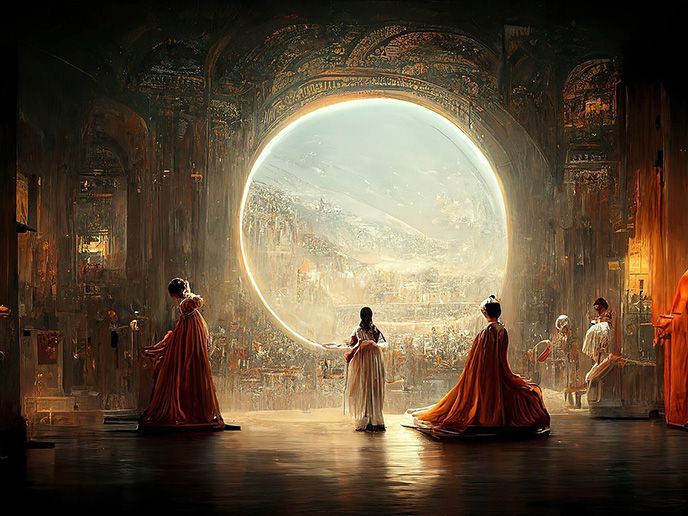
Long before digital editing tools and computer-assisted design programmes, French poet and art critic Charles Baudelaire thought photography was art’s biggest undoing. Fast forward to today, and who would have thought we wouldn’t need a brush to create art anymore. In August, American game designer Jason Allen entered his first art competition under the category Digital Arts / Digitally-Manipulated Photography. No paint, palette, canvas or brush needed, just about 80 hours with a programme that turns lines of text into ultrarealistic graphics. Allen used AI software called Midjourney to create ‘Théâtre D’opéra Spatial’. The piece portrays women in Victorian style clothing with space helmets. The image was printed on canvas before submission. He beat out 10 other entrants with 15 art pieces in the same category to win the 2022 Colorado State Fair Fine Arts Competition. The prize was USD 300.
What does it mean to be an artist, anyway?
“I’m fascinated by this imagery. I love it. And it [sic] think everyone should see it,” Allen told ‘CNN Business’. As a proud winner, he posted the news. It didn’t take long for the Twitterverse to erupt. “This sucks for the exact same reason we don’t let robots participate in the Olympics.” (“This is the literal definition of ‘pressed a few buttons to make a digital art piece’. AI artwork is the ‘banana taped to the wall’ of the digital world now.”)
Let the debate begin
Is AI making art or helping us in making art? Allen welcomes the controversy and criticism. “Rather than hating on the technology or the people behind it, we need to recognize that it’s a powerful tool and use it for good so we can all move forward rather than sulking about it.” Artists are very troubled. “A new AI image generator appears to be capable of making art that looks 100 % human made. As an artist I am extremely concerned … This thing wants our jobs, its [sic] actively anti-artist,” tweeted American concept artist RJ Palmer. “People put bananas on the wall and called it art,” Olga Robak, a spokeswoman for the Colorado Department of Agriculture that oversees the state fair, commented in the ‘Washington Post’. “Even photography was not considered an art form for a long time; people said it was just pushing a button, and now we realize it’s about composition, color, light. Who are we to say that AI is not the same way?” Dagny McKinley, one of the judges, added: “It’s not going to take away from a beautiful painting or a sculpture you can touch. It’s just one more tool we have to advance what we can create.” Allen also shifts the blame from those who use tools such as Midjourney to the AI industry. “It shouldn’t be an indictment of the technology itself. The ethics isn’t in the technology. It’s in the people,” he told ‘The New York Times’. “This isn’t going to stop. Art is dead, dude. It’s over. A.I. won. Humans lost.” So, would you pay for art when you can generate it yourself?
Source: European Commission — CORDIS
Publicaciones relacionadas:
 Digitising the cultural frontline: Hatathon 3.0: NFT Edition launches in Ukraine
 Eurojust helps return to Italy a painting by Artemisia Gentileschi worth more than 2 million euros
 101 Arrested And 19,000 Stolen Artefacts Recovered In International Crackdown On Art Trafficking
 Artistic enigma decoded by cosmic Czech start-up
 Let’s sing! June 21 – European Day of Music
Leave a Reply