
The EU has completed political procedures ratifying the ambitious free trade agreement (FTA) with New Zealand. The decision by the Council of the European Union comes less than a week after the European Parliament gave its consent.
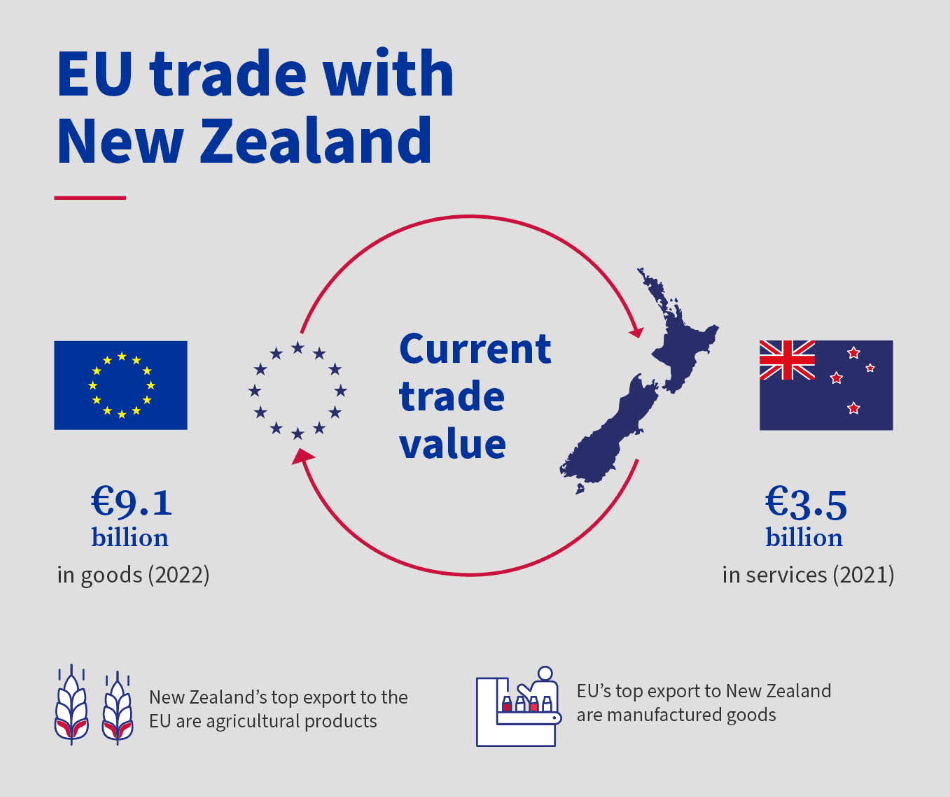
The deal is expected to cut some €140 million a year in duties for EU companies. As a result, bilateral trade is expected to grow by up to 30% within a decade, with EU exports growing by up to €4.5 billion annually. EU investment into New Zealand is expected to grow by up to 80%. This landmark agreement also includes unprecedented sustainability commitments, including respect of the Paris Climate Agreement and core labour rights.
Trade agreements form part of the EU’s open trade – or ‘partnering’ – approach, which is one of the three goals of the European Economic Security Strategy presented in June. This agreement also strengthens the EU’s engagement in the strategically and economically important Indo-Pacific region.
Ursula von der Leyen, President of the European Commission, said: “New Zealand is a key partner for us in the Indo-Pacific region, and this ambitious free trade agreement will bring us even closer together. The deal will bring major opportunities for EU companies, with exports expected to grow by up to €4.5 billion annually. But this is not all: thanks to unprecedented social and climate commitments, our consumers and environment will also reap the benefits. This is how the EU achieves positive results at global level – by working in cooperation with our partners.”
New export opportunities for businesses big and small
The EU-New Zealand FTA will provide new opportunities for businesses by:
- Eliminating all tariffs on EU exports to New Zealand;
- Opening the New Zealand services market in key sectors such as financial services, telecommunications, maritime transport and delivery services;
- Ensuring non-discriminatory treatment to EU investors in New Zealand and vice versa;
- Improving access for EU companies to New Zealand government procurement contracts for goods, services, works and works concessions;
- Facilitating data flows, predictable and transparent rules for digital trade and a secure online environment for consumers;
- Preventing unjustified data localisation requirements and maintaining high standards of personal data protection;
- Helping small businesses export more through a dedicated chapter on small and medium enterprises;
- Significantly reducing compliance requirements and procedures to allow for quicker flow of goods;
- Significant commitments by New Zealand to protect and enforce intellectual property rights, aligned with EU standards.
Agri-food: stimulating exports while shielding EU sensitivities
Upon application of the agreement, EU farmers will immediately have much better opportunities to sell their produce in New Zealand. Tariffs will be eliminated as of day one on key EU exports such as pig meat, wine and sparkling wine, chocolate, sugar confectionary and biscuits.
EU farmers will see benefits beyond the tariff cuts. The FTA will protect the full list of EU wines and spirits (close to 2,000 names) such as Prosecco, Polish Vodka, Rioja, Champagne and Tokaji. In addition, 163 of the most renowned traditional EU products (Geographical Indications), such as Asiago, Feta, Comté or Queso Manchego cheeses, Istarski pršut ham, Lübecker Marzipan, and Elia Kalamatas olives will be protected in New Zealand.
The agreement takes into account the interests of sensitive EU agricultural sectors, including a number of dairy products, beef and sheep meat, ethanol and sweetcorn. For these sectors, there will be no liberalisation of trade. Instead, the agreement will allow zero or lower tariff imports from New Zealand only in limited amounts (through so-called Tariff Rate Quotas).
The most ambitious sustainability commitments of any free trade agreement
The EU-New Zealand FTA is first to integrate the EU’s new approach to trade and sustainable development (TSD) announced in the Communication “The power of trade partnerships: together for green and just economic growth”.
Both sides agreed to ambitious TSD commitments covering a wide range of issues, based on cooperation and stronger enforcement. For the first time ever in an EU free trade agreement, the deal has a dedicated sustainable food systems chapter, a dedicated trade and gender equality article, and a specific provision on trade and fossil fuel subsidies reform. The deal also liberalises environmental goods and services at entry into force.
Next steps
Before the agreement can enter into force, New Zealand will need to complete its ratification procedure. This is expected to happen in the first or second quarter of 2024.
SOURCE: Press Release – European Commission
Publicaciones relacionadas:
 EU-US Critical Minerals Agreement
 Statement by the European Commission following the extraordinary meeting of the EU-UK Joint Committee
 SOTEU 2020: President Von der Leyen sets the course for Europe
 EU-US: A new transatlantic agenda for global change
BREXIT: Relations with the UK: Commission proposes targeted contingency measures to prepare for possible “no-deal” scenario
EU-US: A new transatlantic agenda for global change
BREXIT: Relations with the UK: Commission proposes targeted contingency measures to prepare for possible “no-deal” scenario
Leave a Reply