
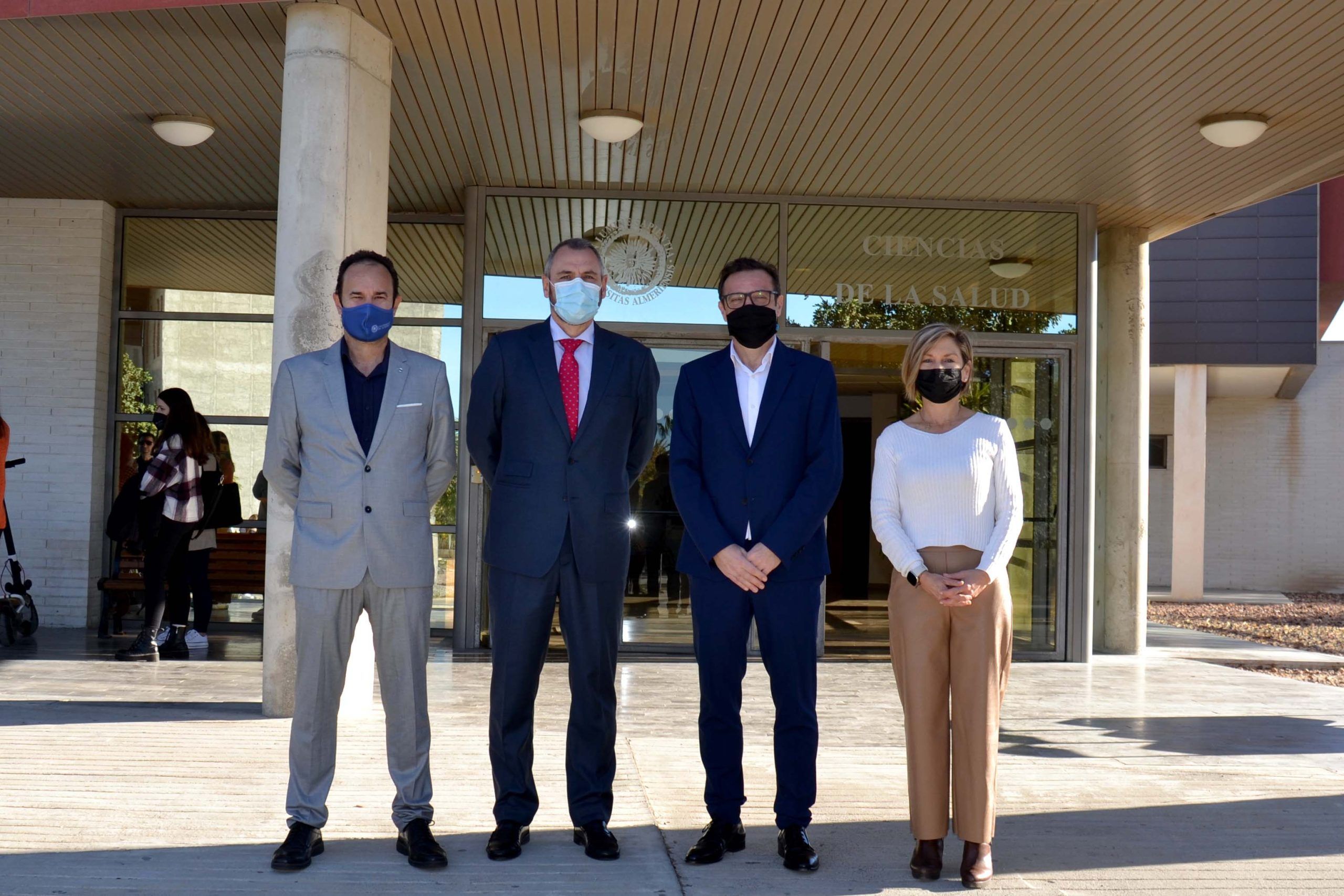
 The Department of Informatics of the University of Almeria has organized this conference, which has counted this Thursday with the participation of Juan Salom Clotet, head of the Cybersecurity Coordination Unit of the Operational Deputy Directorate of the Civil Guard, who explained that 18 percent of the crimes investigated by this security force are cybercrimes.
Last Thursday, February 17, the VIII Conference of Informatics of the University of Almeria was celebrated opening with the ‘Technical Talks’, this edition being dedicated to cybersecurity with the greatest specialists in this field in Spain.
The vice-rector for Digital Transformation, José Antonio Martínez, has been in charge of inaugurating the Conference, which has been held in the Conference Room of the Health Sciences Building, together with the head of the Department of Computer Science, Juan Francisco Sanjuan, and Rosa María Ayala, director of the School of Engineering.
Martínez pointed out that “today we are inaugurating the eighth edition of the Informatics Conference of the University of Almeria, organized by the Department of Informatics, and it is a pleasure for all of us to have them again after this two-year pandemic period. The last edition, the seventh, was held in 2020 just before the pandemic”.
A comeback in style with a highly topical subject. “It is a field that has become very fashionable now, it is pushing very hard because, as I said before, the pandemic has arrived and has come to change our way of working, our way of seeing things, and that has forced us, in many cases, to have to justify and carry out many security actions on IT issues”. In his speech he explained the work that had to be done from the IT services of the UAL in the middle of the pandemic to be able to provide technological support to the University and to continue working in on-line mode, which led to having to increase security measures, since the universities became the focus of cyber-attacks.
For his part, Juan Francisco Sanjuan, director of the Department of Computer Science, indicated that the speakers at this conference “are the top specialists in cybersecurity in Spain” and explained that the conference will continue tomorrow with more talks, and in the coming days. “Next week we start with the Doctoral Conferences, which we have for master’s and doctoral students. We also have many activities until May 15 for pre-university students where there are the Computer Science Olympics, video game contest, the First Lego League, which we have next Saturday, and also the robotics challenge. The truth is that we are happy because last year we could not do any of them and in this case we have taken advantage of this year that we are all vaccinated and we can work normally to do these events”.
The first speaker was Pedro Sánchez, DFIR of Banco Santander, with ‘The attack of the red dragon’. He was followed by Francisco J. Rodríguez, former member of the Spanish National Cybersecurity Institute, trainer of the cyberspace joint command and trainer of state security forces, who gave a talk on ‘Cybersecurity and cyberintelligence’. After him, Yago Jesús Molina, founder of eGarante, gave the talk ‘Threatening GNU/Linux’.
The last speaker of the day was Juan Salom Clotet, head of the Cybersecurity Coordination Unit of the Operational Deputy Directorate of the Civil Guard, with the ‘Response of the Civil Guard against cybercrime’.
“I am going to talk about the response given by the Civil Guard to the problem of Cybercrime, how we are organized and structured to give an adequate response to the citizen”. The colonel explained that it is a rather complex problem. “The transnationality and the low level of complaints from the victims of cyber-attacks make prosecution very difficult. The Guardia Civil receives very few complaints. We do receive minor crimes, i.e. frauds, victims of a small scam when buying online. But major crimes such as Ramsonwaere are rarely reported, partly due to the negative promotional impact for a company of recognizing that it has been the victim of an attack”.
In terms of data, he explained that “already 18 percent of the crimes known to the Guardia Civil are cybercrimes and around 80 percent of them are frauds on the Internet, in Internet commerce”. To combat this problem, the Civil Guard has reinforced the personnel dedicated to the fight against cyberterrorism and has created the ‘Arroba’ teams, but the colonel stresses the importance of culture. “We are working in this field from the Central Department very seriously because we believe that we are going to do much more spreading cybersecurity culture than investigating”. In this sense, the Guardia Civil conducts outreach campaigns through the media or talks in schools or senior centers, since children and the elderly are two groups that are sensitive to this problem.





Leave a Reply