




• Skip to primary navigation
  • Skip to main content
  • Skip to primary sidebar
  • Skip to footer
  • Bluesky
  • Facebook
  • Instagram
  • Twitter
  • YouTube
CDE Almería – Centro de Documentación Europea – Universidad de Almería

CDE Almería - Centro de Documentación Europea - Universidad de Almería

Centro de Documentación Europea de la Universidad de Almería

  • HOME
  • WHAT´S ON
    • EU NEWS
    • Activities
    • EU Calls and Awards
    • Radio Program «Europe with You»
  • DOCUMENTATION
    • EU Media Collection
      • Web Space
      • MEDIATHEQUE REPOSITORY
  • Europe on the net
    • Institutions
    • EU Representation in Spain
    • European information network of Andalusia
  • ABOUT US
    • Presentation
    • Services
    • People
    • Contact
  • Spanish
  • English

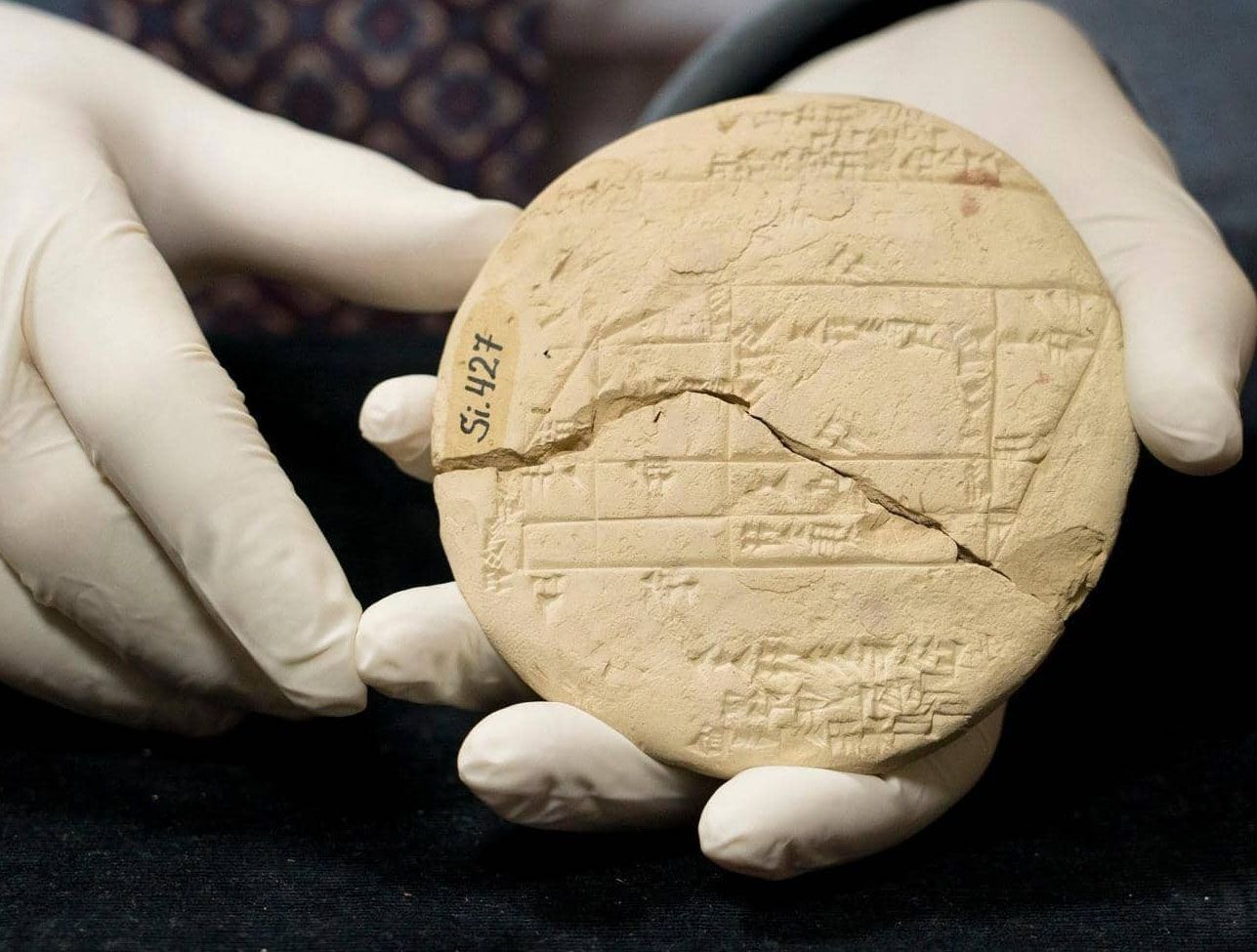
Lying in plain sight, clay tablet revealed as oldest example of complex geometry

Inicio » EU News » Research and Innovation » Lying in plain sight, clay tablet revealed as oldest example of complex geometry

20 de August de 2021

Australian mathematician discovers applied geometry on ancient tablet.

© UNSW Sydney

There it was, nestled snuggly at the Istanbul Archaeological Museum for over 100 years after it was unearthed in the 19th century in the ancient Babylonian city Sippar (present-day Iraq). Who knew what secrets the artefact had kept all these years? According to research published in the journal ‘Foundations of Science’, the clay tablet known as Si.427 contains the earliest example of complex geometry. Dating back 3 700 years, the hand tablet was created by a Babylonian surveyor who wrote on it with a stylus.

Altering the history of mathematics?

Judging by the time period, the Babylonians were using Pythagorean ideas long before the Greek philosopher Pythagoras. Apparently, trigonometry didn’t begin up there in the sky with the Greeks, but with the Babylonians down on the ground. “The discovery and analysis of the tablet have important implications for the history of mathematics,” commented lead researcher Dr Daniel Mansfield from the University of New South Wales in Australia in a news release. “For instance, this is over a thousand years before Pythagoras was born.” The land surveyor applied advanced mathematics to make boundary lines. Specifically, he used a type of trigonometry now known as Pythagorean triples to create accurate right angles. It marks the first time Babylonians used theoretical understanding of geometry to work out practical problems. They were way ahead of their time.

All about a piece of land that’s being sold

“Si.427 dates from the Old Babylonian (OB) period – 1900 to 1600 BCE,” explained Dr Mansfield. “It’s the only known example of a cadastral document from the OB period, which is a plan used by surveyors to define land boundaries. In this case, it tells us legal and geometric details about a field that’s split after some of it was sold off.” “With this new tablet, we can actually see for the first time why they were interested in geometry: to lay down precise land boundaries,” Dr Mansfield added. “This is from a period where land is starting to become private – people started thinking about land in terms of ‘my land and your land’, wanting to establish a proper boundary to have positive neighbourly relationships. And this is what this tablet immediately says. It’s a field being split, and new boundaries are made.” “Much like we would today, you’ve got private individuals trying to figure out where their land boundaries are, and the surveyor comes out but instead of using a piece of GPS equipment, they use Pythagorean triples,” Dr Mansfield told ‘The Guardian’. “Once you understand what Pythagorean triples are, your society has reached a particular level of mathematical sophistication.” “Now that we know what problem the Babylonians were solving, that recolours all the mathematical tablets from this period,” concluded Dr Mansfield. “You see mathematics being developed to address the needs of the time.”

More information

CORDIS

Publicaciones relacionadas:

Why are morning people happier? Up to 78 million batteries will be discarded daily by 2025, researchers warn Seaweed and solar energy join hands at sea Smart tech for more sustainable seas Genetics and their role in small and large birth weight

EU News,  Research and Innovation CORDIS,  geometry,  News

“This is a space for debate. All comments, for or against publication, that are respectful and do not contain expressions that are discriminatory, defamatory or contrary to current legislation will be published”.

Reader Interactions

Leave a Reply Cancel reply

Your email address will not be published. Required fields are marked *

This site uses Akismet to reduce spam. Learn how your comment data is processed.

Primary Sidebar

Footer

  • CDE Almería
  • Biblioteca Nicolás Salmerón – Universidad de Almería
  • Planta: 1ª, Despacho: 1.05.0B.
  • Ctra. Sacramento s/n. Almería (Spain)
  • Teléfono: (+34) 950 015266

HOME
NEWS
DOCUMENTATION
EUROPE ON THE NET
ABOUT US

  • LEGAL NOTICE
  • PRIVACY POLICY
  • COOKIE POLICY
  • ACCESSIBILITY
  • SITEMAP

Copyright © 2026 CDE Almería · Creative Commons LicenseThis work is licensed under a Creative Commons Attribution-NonCommercial 4.0 International License.

<p>El Centro de Documentación Europea de la Universidad de Almería utiliza cookies propias y de terceros para facilitar al usuario la navegación en su página Web y el acceso a los distintos contenidos alojados en la misma. Asimismo, se utilizan cookies analíticas de terceros para medir la interacción de los usuarios con el sitio Web. Pinche el siguiente enlace si desea información sobre el uso de cookies y como deshabilitarlas. </p>

Politica de privacidad

El Centro de Documentación Europea de la Universidad de Almería utiliza cookies propias y de terceros para facilitar al usuario la navegación en su página Web y el acceso a los distintos contenidos alojados en la misma. Asimismo, se utilizan cookies analíticas de terceros para medir la interacción de los usuarios con el sitio Web. Pinche el siguiente enlace si desea información sobre el uso de cookies y como deshabilitarlas. <a href="/politica-de-cookies" rel="noopener" target="_blank">Más información</a>

Cookies estrictamente necesarias

Las cookies estrictamente necesarias tiene que activarse siempre para que podamos guardar tus preferencias de ajustes de cookies.

Básicamente la web no funcionara bien si no las activas.

Estas cookies son:

  • Comprobación de inicio de sesión.
  • Cookies de seguridad.
  • Aceptación/rechazo previo de cookies.
Cookies de terceros

Esta web utiliza Google Analytics, Google Tag Manager y Yandex Metrika para recopilar información anónima tal como el número de visitantes del sitio, o las páginas más populares.

Dejar estas cookies activas nos permite mejorar nuestra web.

Política de cookies

Pinche el siguiente enlace si desea información sobre el uso de cookies y como deshabilitarlas. Más información