• Skip to primary navigation
  • Skip to main content
  • Skip to primary sidebar
  • Skip to footer
  • Bluesky
  • Facebook
  • Instagram
  • Twitter
  • YouTube
CDE Almería – Centro de Documentación Europea – Universidad de Almería

CDE Almería - Centro de Documentación Europea - Universidad de Almería

Centro de Documentación Europea de la Universidad de Almería

  • HOME
  • WHAT´S ON
    • EU NEWS
    • Activities
    • EU Calls and Awards
    • Radio Program «Europe with You»
  • DOCUMENTATION
    • EU Media Collection
      • Web Space
      • MEDIATHEQUE REPOSITORY
  • Europe on the net
    • Institutions
    • EU Representation in Spain
    • European information network of Andalusia
  • ABOUT US
    • Presentation
    • Services
    • People
    • Contact
  • Spanish
  • English

How is plastic recycled?

Inicio » EU News » Environmental Affairs » How is plastic recycled?

2 de June de 2022

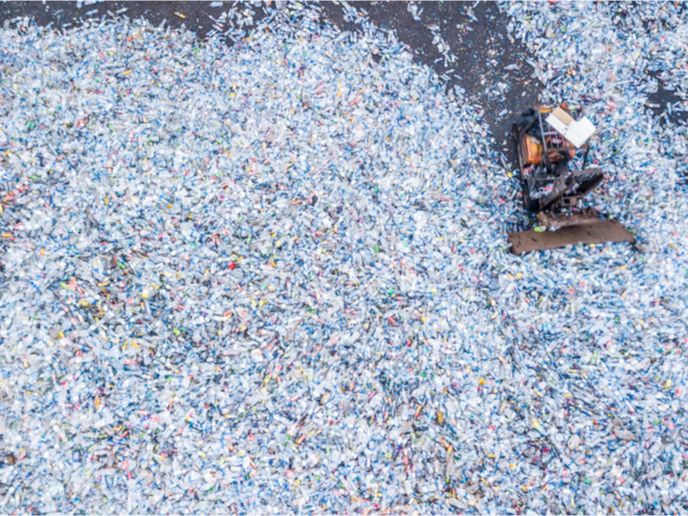
Glass can be melted, paper can be mulched. But what happens to your plastic waste after the recycling bin is collected? Our expert Barbara Morico from NextChem in Italy explains.

How is plastic recycled?

Plastic has long been the bête noire of environmentalists. It is destined, we’re told, to remain in landfill for millennia, or choke the life out of sea creatures. So what exactly happens to the used food containers and fizzy drink bottles that we leave out for collection?
“At the point of collection, there are three different pathways for plastic material – recycling, landfill and incineration,” explains Morico, a senior process engineer at NextChem in Italy. “The reason why not all plastic can be recycled is that the quality of the material decreases after each cycle, gets mixed up with other materials, and after a while cannot be recycled anymore.”
She adds that blended or highly contaminated materials cannot be easily recycled either. These often end up in landfill, or are incinerated.

Waste and recycling: Commission seeks views on revision of the Waste Framework Directive

Different types of plastic are then separated mechanically. The most commonly recycled plastics are polyethylene terephthalate (PET), found in food packaging like drink bottles, high density polyethylene (HDPE) used in items like milk cartons and shampoo bottles, and polypropylene (PP), used to make items like ready-meal trays.
However some plastic materials are harder to recycle than others. Polyester is used to make artificial fibres for clothing, netting and other applications. The base polymer molecule is actually the same as the molecule that makes PET.

Reparar, reutilizar y reciclar

Polyester is a thermoplastic, meaning it can be melted and reformed. “But current mechanical separation techniques however have real difficulties with polyester,” adds Morico. “This is because the material tends to be blended with other materials, and separation is extremely difficult.”
A huge amount of potentially reusable plastic therefore ends up in landfill or is incinerated. Numerous research institutions and companies are working to develop new separation techniques. One potential solution explored by Morico through the EU-funded DEMETO project is chemical separation using microwaves.
More information: Press release – European Commission

Publicaciones relacionadas:

Timmermans “Air pollution is a matter of inequality”. Sustainable supplies of raw materials is crucial for EU industry European Green Deal: Commission proposes to strengthen the protection of the environment through criminal law CO2 the culprit in southern hemisphere temperature drop millions of years ago Leading EU initiatives to preserve the oceans



Environmental Affairs,  EU News Medio Ambiente

“This is a space for debate. All comments, for or against publication, that are respectful and do not contain expressions that are discriminatory, defamatory or contrary to current legislation will be published”.

Reader Interactions

Leave a Reply Cancel reply

Your email address will not be published. Required fields are marked *

This site uses Akismet to reduce spam. Learn how your comment data is processed.

Primary Sidebar

Footer

  • CDE Almería
  • Biblioteca Nicolás Salmerón – Universidad de Almería
  • Planta: 1ª, Despacho: 1.05.0B.
  • Ctra. Sacramento s/n. Almería (Spain)
  • Teléfono: (+34) 950 015266

HOME
NEWS
DOCUMENTATION
EUROPE ON THE NET
ABOUT US

  • LEGAL NOTICE
  • PRIVACY POLICY
  • COOKIE POLICY
  • ACCESSIBILITY
  • SITEMAP

Copyright © 2026 CDE Almería · Creative Commons LicenseThis work is licensed under a Creative Commons Attribution-NonCommercial 4.0 International License.

<p>El Centro de Documentación Europea de la Universidad de Almería utiliza cookies propias y de terceros para facilitar al usuario la navegación en su página Web y el acceso a los distintos contenidos alojados en la misma. Asimismo, se utilizan cookies analíticas de terceros para medir la interacción de los usuarios con el sitio Web. Pinche el siguiente enlace si desea información sobre el uso de cookies y como deshabilitarlas. </p>

Politica de privacidad

El Centro de Documentación Europea de la Universidad de Almería utiliza cookies propias y de terceros para facilitar al usuario la navegación en su página Web y el acceso a los distintos contenidos alojados en la misma. Asimismo, se utilizan cookies analíticas de terceros para medir la interacción de los usuarios con el sitio Web. Pinche el siguiente enlace si desea información sobre el uso de cookies y como deshabilitarlas. <a href="/politica-de-cookies" rel="noopener" target="_blank">Más información</a>

Cookies estrictamente necesarias

Las cookies estrictamente necesarias tiene que activarse siempre para que podamos guardar tus preferencias de ajustes de cookies.

Básicamente la web no funcionara bien si no las activas.

Estas cookies son:

  • Comprobación de inicio de sesión.
  • Cookies de seguridad.
  • Aceptación/rechazo previo de cookies.
Cookies de terceros

Esta web utiliza Google Analytics, Google Tag Manager y Yandex Metrika para recopilar información anónima tal como el número de visitantes del sitio, o las páginas más populares.

Dejar estas cookies activas nos permite mejorar nuestra web.

Política de cookies

Pinche el siguiente enlace si desea información sobre el uso de cookies y como deshabilitarlas. Más información