
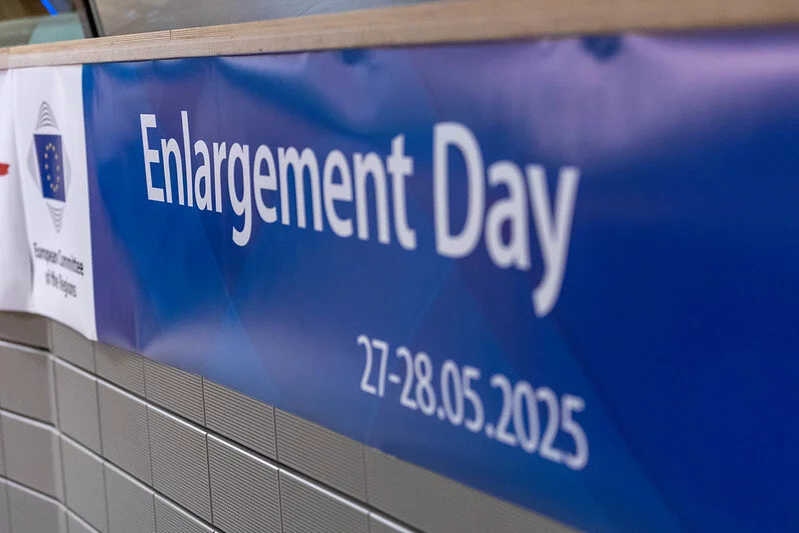
Decentralisation and the transition towards a greener, more sustainable economy were centre-stage at the Enlargement Day conference held by the European Committee of the Regions on 27-28 May – the European Union’s largest event of the year dedicated to EU enlargement from a local and regional perspective.
The two topics – sustainable development and decentralisation – will form part of the backbone of the collaboration over the next five years between the European Committee of the Regions (CoR) and local and regional authorities from candidate and potential candidate countries.
In a video message, Marta Kos, European Commissioner for Enlargement, described the role of the CoR as a “bridge” to the sub-national level in enlargement countries as “incredibly important”. Adam Szłapka, Minister for the European Union for Poland, which currently holds the rotating Presidency of the Council of the European Union, said that local and regional authorities are the level of government “closest to the citizen, and in the end, it is the people that play a decisive role here. The prospect of joining the EU and the pace of reforms depends on them.”
Momentum towards EU enlargement has strengthened over the past year, with Ukraine and Moldova the most recent countries to have started accession talks. The changed dynamic was reflected during the two days of the event by the launch by the CoR of a joint consultative committee with Albania and of working groups with Moldova and Kosovo*.
Decentralisation
The conference came at a moment when there is heightened attention to local governance in the EU’s neighbourhood. In April, the CoR adopted a resolution condemning the arrest and detention of the mayor of Istanbul, Ekrem İmamoğlu, and other local politicians in Türkiye – criticism repeated during the Enlargement Day conference. In addition, the EU’s adoption of major support packages for the Western Balkans and Ukraine – the Growth Plan for the Western Balkans and the Ukraine Facility – has turned extra focus to how economic development plans can better help local communities and how local and regional authorities should be involved.
Participants agreed that effective decentralisation makes governance more efficient, strengthens democracy at the local level, and increases stability. They also stressed that, while each country needs to find its own appropriate balance of powers, the process of decentralisation is improved by consulting sub-national governments in other countries.
Green transition
Environment and climate change – Chapter 27 of the EU acquis, the body of EU laws that candidate countries must adopt – are viewed as being among the most challenging areas for countries seeking to meet EU standards, and also require a particularly high level of involvement on the part of local and regional authorities. At the same time, levels of public resistance can be high.
Participants highlighted five areas of particular importance if the green agenda is to succeed at the regional level: securing funding, training and retaining civil servants, establishing effective cooperation between national and sub-national governments, improving legal frameworks, and convincing the public of the benefits to them in everyday life.
The conference provided a significant example of how municipalities are driving forward the energy transition in Türkiye and in the Balkans, many of whose major cities have historically had very high rates of pollution. More than 230 towns and cities in the Western Balkans and Türkiye are now signatories of the Covenant of Mayors for Climate and Energy, entitling them to EU support in return for committing to reduce emissions by 30% by 2030.
Decentralisation and the EU’s green agenda were similarly central in meetings held on 27 May with seven of the nine working groups and joint consultative committees that the CoR has with enlargement countries. Each meeting considered an energy or environmental challenge particularly important to that country, including energy transition for Moldova, climate adaptation in the case of Albania, and environmental degradation in Kosovo*.
Ukraine faces exceptional challenges, since a significant share of public and social infrastructure has been heavily damaged during Russia’s ongoing invasion. However, the Working Group on Ukraine highlighted that many municipalities are nonetheless succeeding in rolling out sustainable-energy projects, in part in response to the need to restore public services – including hospitals and water systems, as well as energy infrastructure, housing and schools. More than 200 Ukrainian municipalities are signatories of the Covenant of Mayors and continue to pursue its objectives despite the war.
* This designation is without prejudice to positions on status and is in line with UNSC 1244 and the ICJ Opinion on the Kosovo Declaration of Independence.
Quotes:
- Marta Kos, European Commissioner for Enlargement (video message): “Regional and local authorities are essential as EU accession requires an intensive effort by the whole of our societies. Everyone needs to own it. Local and regional authorities implement a large part of the EU legislation. This is also why I always make the point while on visits to our enlargement partners to go beyond the capital cities.”
- Adam Szłapka, Minister for the European Union, Republic of Poland (video message): “Enlargement remains one of the priorities for the Polish Presidency. We see enlargement as a geostrategic investment in peace, security, stability and prosperity. New members have a potential to strengthen the competitiveness and the single market and create opportunities for citizens and businesses. There is a new dynamic in the enlargement process. Local and regional authorities play an important role in this process. They are the closest to the citizen, and in the end, it is the people that play a decisive role here. The prospect of joining the EU and the pace of reforms depends on them.”
- Nikola Dobroslavić (HR/EPP), prefect of the Dubrovnik-Neretva County and chair of the JCC Montenegro: “The Committee of the Regions has for many years been a champion of the EU enlargement, and of local and regional involvement in the process. We have never tired of talking about it, keeping the flame lit even when it was not as high on the political agenda. Enlargement needs to be anchored in a whole-of-society approach. Local and regional authorities implement most of the EU acquis, almost 70%, and local and regional leaders are very well placed to explain and promote the benefits of enlargement. This will help shape a narrative of our common work, which is anchored in facts and figures, as opposed to populist and alarmist rhetoric.”
- Antje Grotheer (DE/PES), president of Bremen City Parliament and chair of the Working Group on Ukraine: “Climate change and environmental aspects are common challenges that every local and regional authority faces, in Ukraine and in the European Union. We can learn and benefit from each other and ensure that Ukraine’s reconstruction takes the green recovery into account. With the European Alliance of Cities and Regions for the Reconstruction of Ukraine, we keep green infrastructure, renewable energy and sustainable urban development high on the agenda.”
More information: European Committee of the Regions
Publicaciones relacionadas:
 2023 Strategic Foresight Report
 EU mobilises emergency equipment to assist Italian authorities
 The EU has presented at the United Nations its first Voluntary Review on the implementation of the 2030 Agenda for Sustainable Development
 Three Spanish cities with European recognition
 April infringement package: main decisions for Spain
Leave a Reply