
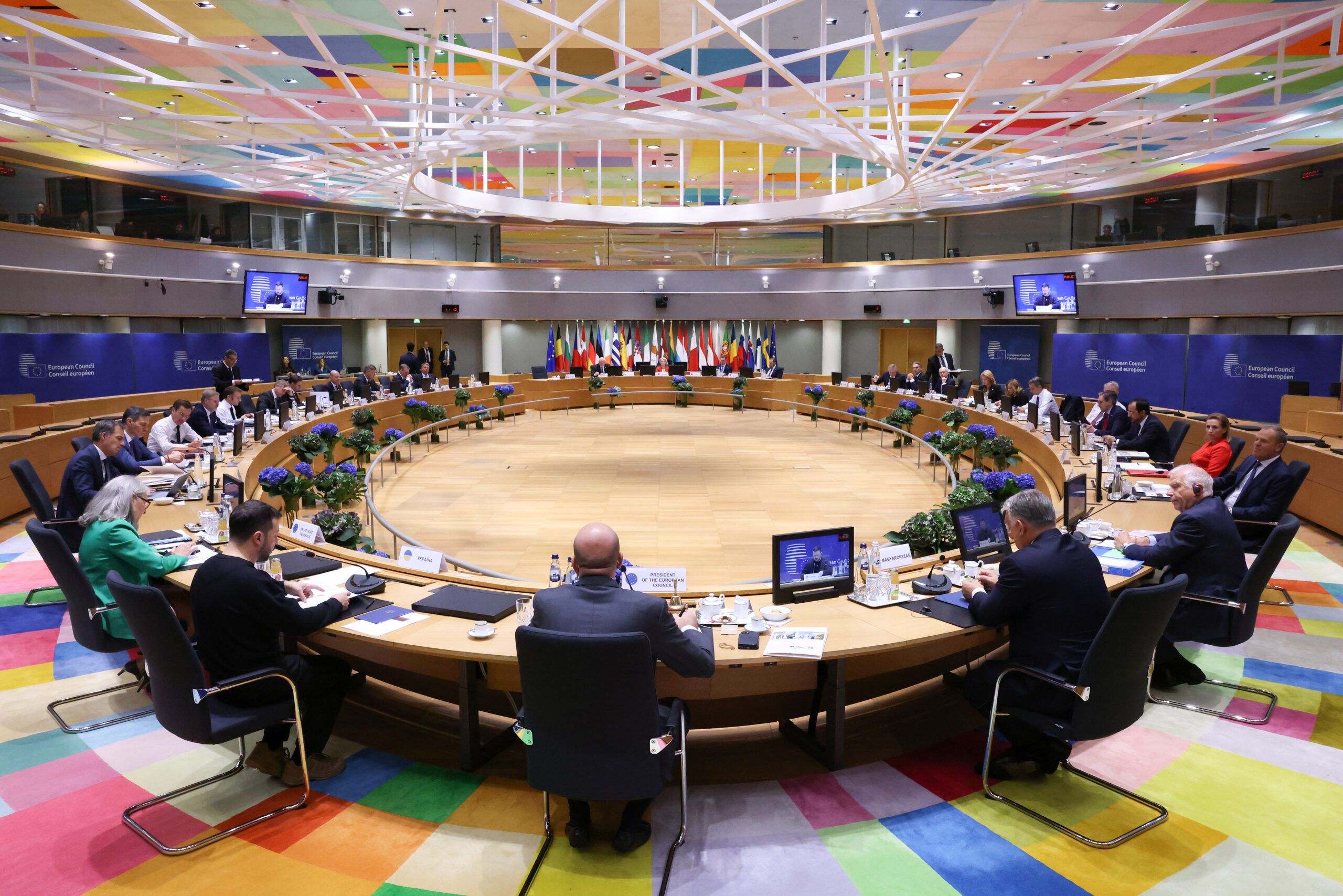
The Foreign Affairs Council – under the chairmanship of the EU High Representative for Foreign Affairs and Security Policy, Kaja Kallas – convened the EU defence ministers in the morning and the EU foreign ministers on 20 May.
Russia’s war against Ukraine and EU support for Ukraine
EU defence ministers discussed EU military support to Ukraine following a video-conference intervention by Ukrainian defence minister Rustem Umerov and in the presence of NATO secretary general Mark Rutte.
They focused on a possible EU contribution to Ukraine’ s security guarantees, in the context of the ongoing work of the coalition of the willing, and on progress made in the implementation of the High Representative’s initiative on “increased military support to Ukraine”, which aims to supply Ukraine with 2 million full sets of large calibre ammunition by 2025.
In the afternoon, the EU foreign ministers were briefly joined by Andrii Sybiha, the Ukrainian foreign minister, who briefed them on ongoing diplomatic activities, including those following the meeting in Turkey.
The Council adopted the 17th package of economic and individual restrictive measures, frustrating Russia’s access to key military technology and limiting the country’s energy revenues – which fuel its war of aggression against Ukraine – by taking firm action against the “clandestine fleet” of oil tankers, their operators and a major Russian oil producer.
The Council was also attended by EU sanctions envoy David O’Sullivan, who briefed on sanctions, and the director of the Intelligence and Situation Centre (INTCEN), Daniel Markić, who reported on the economic impact of EU sanctions on Russia.
Defence preparedness
The Council held a debate on defence preparedness focusing on the implementation of the White Paper on European Defence Preparedness 2030 and the Re-Arming Europe Plan.
Ministers focused on the priority capability areas identified and agreed by the European Council and on how to include them in concrete collaborative projects, including by exploiting the benefits of joint procurement.
The High Representative underlined the need to make progress ahead of the June European Council and NATO Summit.
She also announced that the EU’s Rapid Deployment Capability (of up to 5,000 military personnel) has been put in place, which is an important step in the EU’s ability to act swiftly and decisively whenever a crisis occurs.
Situation in the Middle East, including Syria
The Foreign Affairs Council held an exchange of views on the Middle East, in the context of the intensification of Israeli military operations and the drastic worsening of the humanitarian situation in Gaza.
The High Representative stated that aid must arrive immediately, unimpeded and on a large scale, and that this position had been conveyed both to the Israeli counterpart and to the United Nations and regional leaders.
On Syria, the High Representative announced that EU ministers had agreed to lift all economic sanctions, with the exception of those related to the al-Assad regime and human rights violations. Kallas stressed that this decision is reversible and conditional on progress being made.
The Council also discussed the situation in the ISIS camps and detention centres in north-eastern Syria and the High Representative announced that a financial package worth €18 million would be earmarked to improve conditions in the camps.
Other debates and decisions
The High Representative announced that a contract worth EUR 5.5 million is being prepared with the European Endowment for Democracy to support the work of Radio Free Europe.
The Council agreed on a comprehensive set of EU measures, under three other sanctions regimes, targeting Russia’s hybrid activities, human rights violations in Russia and the use of riot control agents by Russian forces in Ukraine.
The Council adopted conclusions on Yemen, expressing deep concern about the situation in the country and calling for renewed momentum for peace initiatives.
The Council adopted a decision authorising the coordinator of the EPC’s Virtual Manoeuvring Grounds Federation project to invite Switzerland to participate in it.
More information: Foreign Affairs Council
Publicaciones relacionadas:
 EU leaders agreed to start accession talks with Ukraine and Moldova
 FAST-CARE: Council agrees to provide more aid to Ukrainian refugees and to strengthen support in the aftermath of Russian aggression
 Gaza: EU leaders call for humanitarian access
 Russia-Ukraine crisis debated in Parliament
 The decision of Russia’s President is a serious violation of international law
Leave a Reply