
The number of irregular border crossings into the European Union in the first five months of 2024 fell by nearly a quarter (23%) to nearly 80 000, according to preliminary data collected by Frontex.
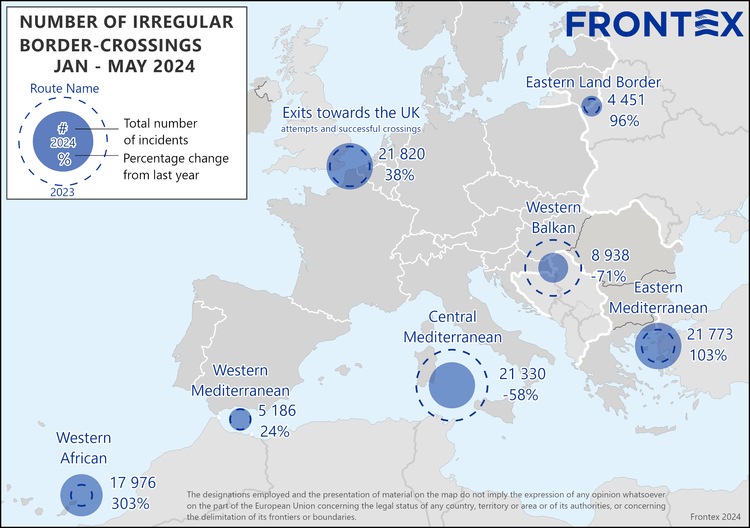
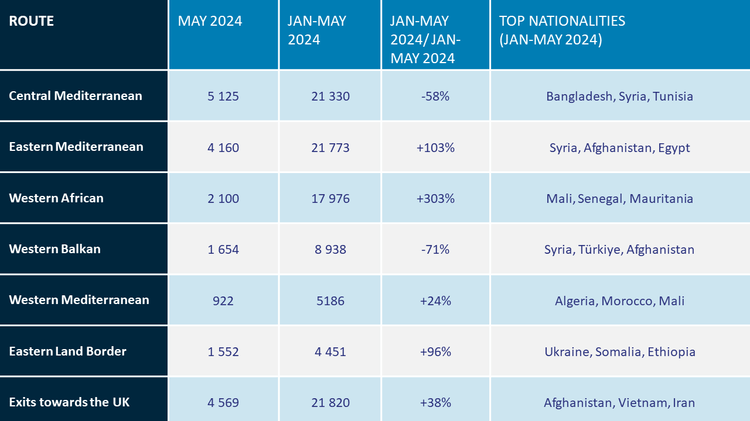
The Western Balkans and Central Mediterranean saw the biggest drops in detections of irregular crossings among the major migratory routes (-71% and -58%, respectively), while the Western African and Eastern Mediterranean routes experienced the highest increases (+303% and +103%, respectively).
Key highlights for the first five months of 2024 include:
- Central Mediterranean saw a 58% drop (y/y) in detections.
- Western Balkans also continued to see significantly lower numbers (-71%), biggest drop among major migratory routes into the EU.
- The Western African route recorded the largest rise.
- Eastern Mediterranean was the most active migratory route, with arrivals doubled.
- Eastern Land Border sees significant rise in detections from a year ago
- Top three nationalities on all routes this year: Syria, Mali, Afghanistan.
The Central Mediterranean route, which saw the largest number of irregular crossings in 2023, continued to show a downward trend from recent months, with a year-on-year drop of 58% to slightly above 21 300 in the first five months of 2024. In the month of May, the number of arrivals stood at nearly 5 100, down nearly 37% from a year ago.
Also in line with the recent downward trend, the number of detections on the Western Balkan route in the January-May period fell 71%) to just over 8 900.
Meanwhile, the Western African route continued to see unprecedented numbers of detections, with number of irregular migrants reaching the Canary Islands in the first five months of the year rising 303% from the same period of last year to nearly 18 000. This was the highest total for this period since Frontex began collecting data in 2011. In May, the number of arrivals stood at 2100.
The most active migratory route in the January-May period was the Eastern Mediterranean, with the number of detections more than doubling to over 21 200 in the first five months of the year.

First evaluation of the Frontex Regulation delivers overall positive assessment despite challenges |
Frontex remains committed to safeguarding the EU’s borders, with 2800 officers and staff engaged in various operations.
Sea crossings remain fraught with peril for the people undertaking irregular migration. Data from the International Organization for Migration (IOM) indicates that 923 individuals have been reported missing in the Mediterranean so far this year. The vast majority of them were navigating the perilous Central Mediterranean route.
In the first five months of 2024, there was also a significant increase in irregular border crossings at the Eastern Land Borders, with numbers nearly doubling to 4 450 compared to the same period last year. This increase, while notable, still represents the least active migratory path into the EU among the major routes. However, recent trends suggest that the Eastern Land route is becoming more active, approaching the figures seen on the Western Mediterranean route. The rise in numbers is largely attributed to heightened activity at the border with Belarus, which has seen an increase in attempted crossings, often facilitated by Belarusian authorities. Additionally, on the Ukrainian border, irregular crossings are primarily carried out by Ukrainian citizens circumventing border checks.
On the Channel route, the number of detections in the first five months of 2024 increased 38% to 21 820.
More information: Frontex
Publicaciones relacionadas:
 Intensified judicial response to serious cross-border crimes
 Afghanistan: EU’s position and next steps
 EU adopts further restrictive measures against human rights violations in Iran
 Standing with Ukraine for as long as it takes
 President Zelenskyy says Russia is a grave threat to the European way of life
Leave a Reply